AQA · GCSE · Biology
Course version: 8461 · Version from Sept 2018
Type 1 diabetes is a disorder in which the pancreas fails to produce…
Full specification wording
Control of blood glucose concentration: Type 1 diabetes is a disorder in which the pancreas fails to produce sufficient insulin.
Insulin is the hormone released by the pancreas when blood glucose rises after a meal.
Checked against the AQA 8461 specification (opens in a new tab) on .
- Point 5 of 13
- 4 key terms
Study notes
From the checked teaching notes for this specification point.
The idea
Insulin is the hormone released by the pancreas when blood glucose rises after a meal. It travels in the blood and causes liver and muscle cells to take up glucose and store it as glycogen, lowering blood glucose. In Type 1 diabetes the pancreatic cells that make insulin are damaged, so too little insulin is secreted. Without enough insulin, glucose stays in the blood instead of entering cells, producing the high blood glucose that characterises the disorder. A useful method is to trace the pathway pancreas → insulin → target cells → glucose uptake, then remove insulin and predict the consequence.
What earns the marks
- Insulin is a hormone produced by the pancreas that lowers blood glucose concentration.
- In Type 1 diabetes the pancreas does not secrete sufficient insulin.
- The cause is a failure of the insulin-producing cells of the pancreas, not a failure of body cells to respond.
- Reduced insulin means less glucose is taken up by liver and muscle cells and less is stored as glycogen.
- As a result blood glucose concentration remains higher than normal after meals.
- Type 1 diabetes is a disorder of insulin production, so it is distinct from Type 2 diabetes.
Common mistakes and how to put them right
Confusing Type 1 with Type 2 by writing that body cells no longer respond to insulin.
Put it right: That describes Type 2, whereas Type 1 is a failure of insulin production.
Stating that insulin is a digestive enzyme or that it is made in the liver.
Put it right: Insulin is a hormone made by the pancreas and acts on target cells.
Exam tips
- Use the phrase insufficient insulin rather than no insulin, matching the specification wording.
- Name both the organ and the hormone in your answer: pancreas and insulin.
- If asked to explain consequences, continue the chain to high blood glucose rather than stopping at the pancreas.
Try the lesson
The start of the Control of blood glucose concentration: Type 1 diabetes is a disorder in which the pancreas fails to produce sufficient insulin. lesson, made from checked teaching notes for this specification point.
Have a go first
In type 1 diabetes, which organ fails to produce sufficient insulin?
Listen
Insulin is the hormone released by the pancreas when blood glucose rises after a meal. It travels in the blood and causes liver and muscle cells to take up glucose and store it as glycogen, lowering blood glucose. In Type 1 diabetes the pancreatic cells that make insulin are damaged, so too little insulin is secreted. Without enough insulin, glucose stays in the blood instead of entering cells, producing the high blood glucose that characterises the disorder. A useful method is to trace the pathway pancreas → insulin → target cells → glucose uptake, then remove insulin and predict the consequence. A strong answer earns marks for these points. Insulin is a hormone produced by the pancreas that lowers blood glucose concentration. In Type 1 diabetes the pancreas does not secrete sufficient insulin. The cause is a failure of the insulin-producing cells of the pancreas, not a failure of body cells to respond. Reduced insulin means less glucose is taken up by liver and muscle cells and less is stored as glycogen. Exam tip: Use the phrase insufficient insulin rather than no insulin, matching the specification wording.
See it
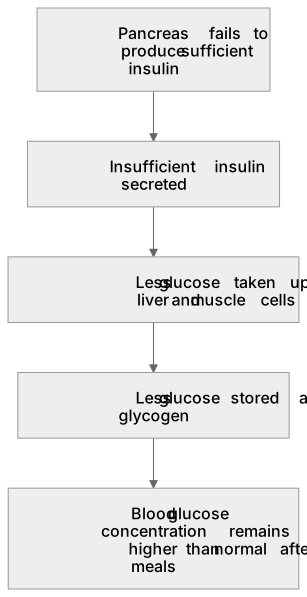
Put it in order
Put these steps in the order they happen.
- 1. Insufficient insulin secreted
- 2. Less glucose taken up by liver and muscle cells
- 3. Pancreas fails to produce sufficient insulin
- 4. Blood glucose concentration remains higher than normal after meals
- 5. Less glucose stored as glycogen
Key words
Say what each word means before you turn the card.
Insulin
Try answering aloud or in your head before turning the card.
Type 1 diabetes
Try answering aloud or in your head before turning the card.
Pancreas
Try answering aloud or in your head before turning the card.
Type 2 diabetes
Try answering aloud or in your head before turning the card.
See every definition
- Insulin
- A hormone produced by the pancreas that lowers blood glucose concentration.
- Type 1 diabetes
- A disorder in which the pancreas fails to produce sufficient insulin.
- Pancreas
- The organ that produces insulin, the hormone that lowers blood glucose concentration.
- Type 2 diabetes
- A condition distinct from Type 1 diabetes, in which body cells no longer respond to insulin.
Label the diagram
Some boxes have lost their names. Pick the right name for each number.
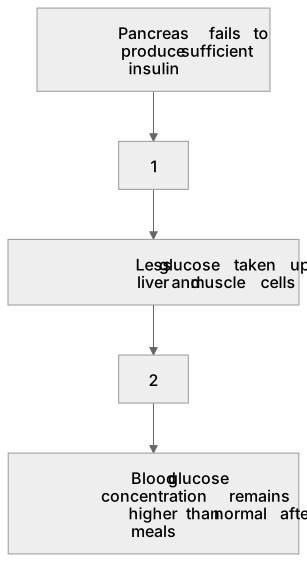
1Box 1
2Box 2
There is more to this lesson
The full lesson goes on to check your understanding and help you earn the marks. Create a free account to carry on, with your progress saved.
A week of Premium from your first lesson · Then the free plan continues · No card, no charge
Test your understanding of Control of blood glucose concentration: Type 1 diabetes is a disorder in which the pancreas fails to produce sufficient insulin.
Active recall beats re-reading. Take an instant quiz now to test what you’ve learned and lock it into long-term memory.
A week of Premium from your first lesson · Then the free plan continues · No card, no charge