AQA · GCSE · Biology
Course version: 8461 · Version from Sept 2018
Body temperature is monitored and controlled by the thermoregulatory…
Full specification wording
Control of body temperature (biology only): Body temperature is monitored and controlled by the thermoregulatory centre in the brain.
The thermoregulatory centre in the brain acts as the body's thermostat.
Checked against the AQA 8461 specification (opens in a new tab) on .
- Point 1 of 7
- 4 key terms
Study notes
From the checked teaching notes for this specification point.
The idea
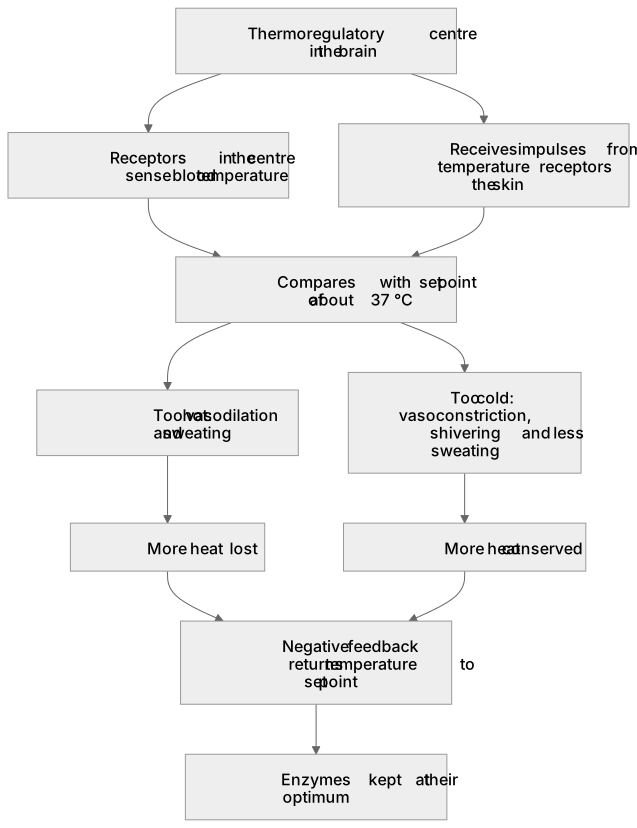
The thermoregulatory centre in the brain acts as the body's thermostat. It receives information about blood temperature from receptors within itself and about skin temperature from receptors in the skin. It compares this information with a set point, around 37 °C, and coordinates responses through the nervous system. When too hot, it triggers vasodilation and sweating; when too cold, vasoconstriction, shivering and less sweating. These responses change heat loss or heat production to bring temperature back to the set point. This is an example of negative feedback, and it keeps enzymes working at their optimum.
What earns the marks
- The thermoregulatory centre is in the brain and monitors body temperature.
- Responses are negative feedback that returns temperature to about 37 °C.
- Stable temperature keeps enzymes at their optimum for metabolism.
Common mistakes and how to put them right
Saying the skin controls temperature.
Put it right: The thermoregulatory centre in the brain coordinates the response.
Thinking sweating cools the body by producing cold.
Put it right: Evaporation of sweat transfers energy away.
Confusing vasodilation with vasoconstriction.
Put it right: Dilation widens vessels to lose heat, constriction narrows them to conserve heat.
Exam tips
- Name the centre and its location in every answer.
- Link each response to more or less heat loss.
- Use the phrase negative feedback when explaining return to normal.
Try the lesson
The start of the Control of body temperature (biology only): Body temperature is monitored and controlled by the thermoregulatory centre in the brain. lesson, made from checked teaching notes for this specification point.
Have a go first
Which part of the body monitors and controls body temperature?
Listen
The thermoregulatory centre in the brain acts as the body's thermostat. It receives information about blood temperature from receptors within itself and about skin temperature from receptors in the skin. It compares this information with a set point, around 37 °C, and coordinates responses through the nervous system. When too hot, it triggers vasodilation and sweating; when too cold, vasoconstriction, shivering and less sweating. These responses change heat loss or heat production to bring temperature back to the set point. This is an example of negative feedback, and it keeps enzymes working at their optimum. A strong answer earns marks for these points. The thermoregulatory centre is in the brain and monitors body temperature. Responses are negative feedback that returns temperature to about 37 °C. Stable temperature keeps enzymes at their optimum for metabolism. A common slip: Saying the skin controls temperature. Instead, the thermoregulatory centre in the brain coordinates the response. Exam tip: Name the centre and its location in every answer.
See it
Key words
Say what each word means before you turn the card.
Negative feedback
Try answering aloud or in your head before turning the card.
Enzyme optimum
Try answering aloud or in your head before turning the card.
Thermoregulatory centre
Try answering aloud or in your head before turning the card.
Vasodilation
Try answering aloud or in your head before turning the card.
See every definition
- Negative feedback
- A process in which responses change heat loss or heat production to bring temperature back to the set point.
- Enzyme optimum
- The temperature at which enzymes work best, kept stable by a stable temperature.
- Thermoregulatory centre
- The body's thermostat in the brain, which monitors body temperature and coordinates responses through the nervous system.
- Vasodilation
- A response triggered when too hot that widens vessels to lose heat.
Label the diagram
Some boxes have lost their names. Pick the right name for each number.
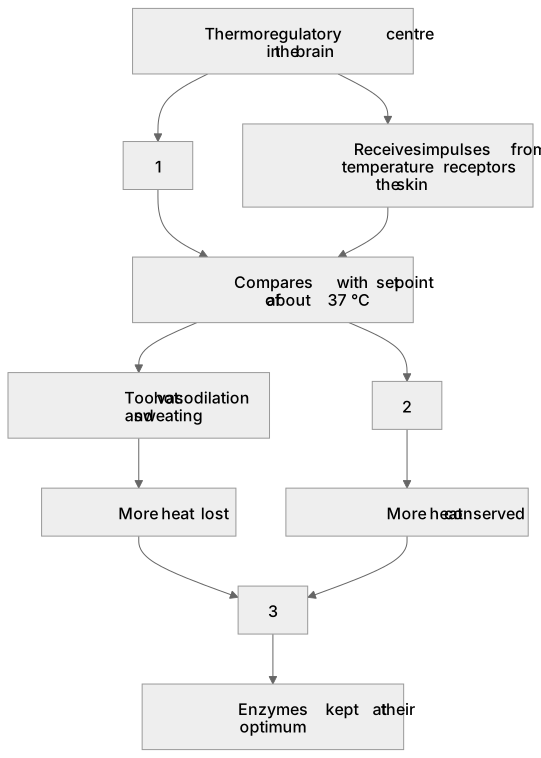
1Box 1
2Box 2
3Box 3
There is more to this lesson
The full lesson goes on to check your understanding and help you earn the marks. Create a free account to carry on, with your progress saved.
A week of Premium from your first lesson · Then the free plan continues · No card, no charge
Test your understanding of Control of body temperature (biology only): Body temperature is monitored and controlled by the thermoregulatory centre in the brain.
Active recall beats re-reading. Take an instant quiz now to test what you’ve learned and lock it into long-term memory.
A week of Premium from your first lesson · Then the free plan continues · No card, no charge