AQA · GCSE · Biology
Course version: 8461 · Version from Sept 2018
A non-communicable disease: In coronary heart disease layers of fatty…
Full specification wording
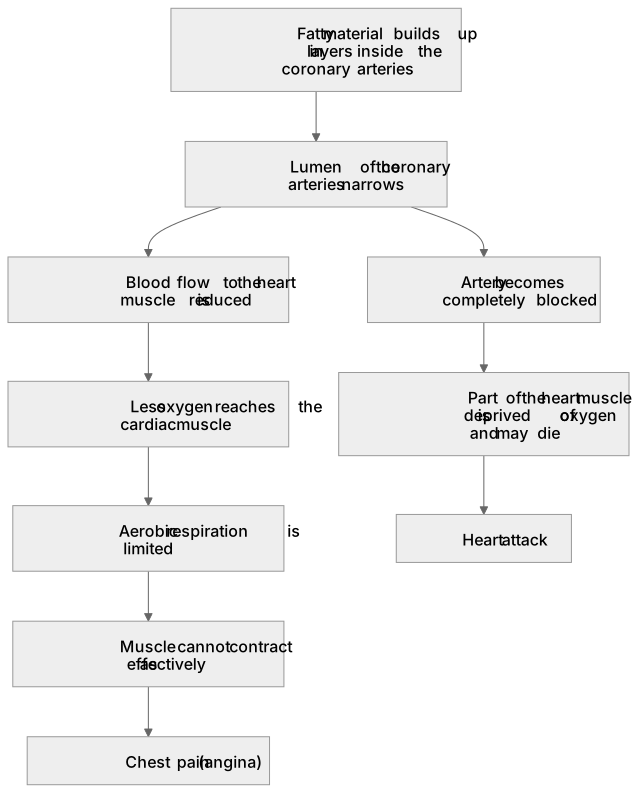
Coronary heart disease: a non-communicable disease: In coronary heart disease layers of fatty material build up inside the coronary arteries, narrowing them.
The coronary arteries supply oxygenated blood to the heart muscle itself.
Checked against the AQA 8461 specification (opens in a new tab) on .
- Point 2 of 10
- 4 key terms
Study notes
From the checked teaching notes for this specification point.
The idea
The coronary arteries supply oxygenated blood to the heart muscle itself. In coronary heart disease, fatty material, mainly cholesterol, builds up in layers inside the walls of these arteries. This deposit narrows the lumen, so blood flow to the heart muscle is reduced. Less oxygen reaches the cardiac muscle, so aerobic respiration is limited and the muscle cannot contract as effectively. This can cause chest pain, called angina, and if an artery becomes completely blocked, part of the heart muscle is deprived of oxygen and may die, causing a heart attack. Risk factors include a diet high in saturated fat, smoking, high blood pressure and lack of exercise. Treatments aim to restore blood flow, for example by using stents or bypass surgery, or to reduce the fatty build-up with statins.
What earns the marks
- Fatty material, mainly cholesterol, builds up in layers inside the coronary arteries.
- The build-up narrows the lumen of the coronary arteries and reduces blood flow to the heart muscle.
- Reduced blood flow lowers oxygen supply to cardiac muscle, limiting aerobic respiration and contraction.
- Consequences include angina and, if an artery is blocked, a heart attack where heart muscle dies.
- Coronary heart disease is non-communicable and is linked to risk factors such as a high saturated fat diet, smoking and high blood pressure.
Common mistakes and how to put them right
Saying fatty material builds up in the heart chambers.
Put it right by stating it builds up inside the coronary arteries.
Confusing narrowing with complete blockage.
Put it right by explaining that narrowing reduces flow, while a blockage can cause a heart attack.
Thinking the coronary arteries carry deoxygenated blood.
Put it right by stating they supply oxygenated blood to the heart muscle.
Exam tips
- Name the coronary arteries and state that they supply the heart muscle with oxygenated blood.
- Link the narrowed lumen to reduced oxygen supply and then to angina or heart attack.
- Use the term lumen when describing the space inside an artery.
Try the lesson
The start of the Coronary heart disease: a non-communicable disease: In coronary heart disease layers of fatty material build up inside the coronary arteries, narrowing them. lesson, made from checked teaching notes for this specification point.
Have a go first
In coronary heart disease, what builds up inside the coronary arteries and narrows them?
Listen
The coronary arteries supply oxygenated blood to the heart muscle itself. In coronary heart disease, fatty material, mainly cholesterol, builds up in layers inside the walls of these arteries. This deposit narrows the lumen, so blood flow to the heart muscle is reduced. Less oxygen reaches the cardiac muscle, so aerobic respiration is limited and the muscle cannot contract as effectively. This can cause chest pain, called angina, and if an artery becomes completely blocked, part of the heart muscle is deprived of oxygen and may die, causing a heart attack. Risk factors include a diet high in saturated fat, smoking, high blood pressure and lack of exercise. Treatments aim to restore blood flow, for example by using stents or bypass surgery, or to reduce the fatty build-up with statins. A strong answer earns marks for these points. Fatty material, mainly cholesterol, builds up in layers inside the coronary arteries. The build-up narrows the lumen of the coronary arteries and reduces blood flow to the heart muscle. Reduced blood flow lowers oxygen supply to cardiac muscle, limiting aerobic respiration and contraction. Consequences include angina and, if an artery is blocked, a heart attack where heart muscle dies. A common slip: Saying fatty material builds up in the heart chambers. Instead, stating it builds up inside the coronary arteries. Exam tip: Name the coronary arteries and state that they supply the heart muscle with oxygenated blood.
See it
Key words
Say what each word means before you turn the card.
Coronary circulation
Try answering aloud or in your head before turning the card.
Fatty deposits and cholesterol
Try answering aloud or in your head before turning the card.
Oxygen supply and aerobic respiration
Try answering aloud or in your head before turning the card.
Non-communicable disease risk factors
Try answering aloud or in your head before turning the card.
See every definition
- Coronary circulation
- The coronary arteries supply oxygenated blood to the heart muscle itself.
- Fatty deposits and cholesterol
- Fatty material, mainly cholesterol, builds up in layers inside the walls of the coronary arteries, narrowing them.
- Oxygen supply and aerobic respiration
- Less oxygen reaches the cardiac muscle, so aerobic respiration is limited and the muscle cannot contract as effectively.
- Non-communicable disease risk factors
- Coronary heart disease is non-communicable and is linked to risk factors such as a high saturated fat diet, smoking and high blood pressure.
Label the diagram
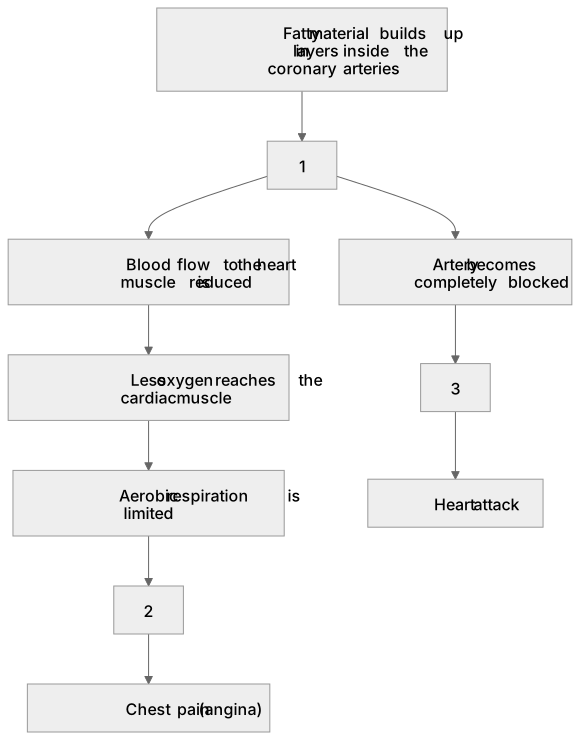
Some boxes have lost their names. Pick the right name for each number.
1Box 1
2Box 2
3Box 3
There is more to this lesson
The full lesson goes on to check your understanding and help you earn the marks. Create a free account to carry on, with your progress saved.
A week of Premium from your first lesson · Then the free plan continues · No card, no charge
Test your understanding of Coronary heart disease: a non-communicable disease: In coronary heart disease layers of fatty material build up inside the coronary arteries, narrowing them.
Active recall beats re-reading. Take an instant quiz now to test what you’ve learned and lock it into long-term memory.
A week of Premium from your first lesson · Then the free plan continues · No card, no charge