AQA · GCSE · Biology
Course version: 8461 · Version from Sept 2018
AT skills covered by this practical activity: AT 1, 3, 4 and 5.
Full specification wording
Decomposition (biology only): AT skills covered by this practical activity: AT 1, 3, 4 and 5.
This practical develops four Apparatus and Techniques (AT) skills.
Checked against the AQA 8461 specification (opens in a new tab) on .
- Point 7 of 7
Study notes
From the checked teaching notes for this specification point.
The idea
This practical develops four Apparatus and Techniques (AT) skills. AT 1 involves using appropriate apparatus to make and record measurements accurately, such as using a water bath for temperature and a pH meter or indicator. AT 3 covers using apparatus and techniques for the observation and measurement of biological material, like observing the decay of milk. AT 4 requires the safe and ethical use of living organisms to measure physiological functions, which here involves the bacteria naturally present in milk causing decay. AT 5 involves measuring rates of reaction by a variety of methods, specifically using a colour change of an indicator (like Cresol red or phenolphthalein) to measure the rate of decay as pH drops.
What earns the marks
- AT 1: Use appropriate apparatus to make and record a range of measurements accurately, including temperature using a water bath and thermometer, and volume using syringes.
- AT 3: Use appropriate apparatus and techniques for the observation and measurement of biological material, such as monitoring the decay process in milk.
- AT 4: Demonstrate safe and ethical use of living organisms to measure physiological functions, specifically the bacteria in milk that respire and produce lactic acid.
- AT 5: Measure rates of reaction by a variety of methods, such as timing the colour change of an indicator to calculate the rate of decay.
Common mistakes and how to put them right
Confusing AT skills with Working Scientifically (WS) skills.
Put it right by remembering AT skills refer to specific practical apparatus and techniques, not general data analysis.
Forgetting that bacteria are living organisms in this practical (AT 4).
Put it right by recognising that the decay is a biological process carried out by microorganisms.
Misidentifying the method of measuring the rate (AT 5).
Put it right by stating that the rate is measured by timing how long it takes for the indicator to change colour due to pH change.
Exam tips
- When asked about the method, explicitly mention the apparatus used (AT 1), such as using a thermostatically controlled water bath to maintain a constant temperature.
- Be prepared to explain how the colour change of the indicator (AT 5) relates to the biological process of bacteria producing acidic products during decay.
Try the lesson
The start of the Decomposition (biology only): AT skills covered by this practical activity: AT 1, 3, 4 and 5. lesson, made from checked teaching notes for this specification point.
Have a go first
How can the rate of decay be measured in a practical investigation using milk?
Listen
This practical develops four Apparatus and Techniques (AT) skills. AT 1 involves using appropriate apparatus to make and record measurements accurately, such as using a water bath for temperature and a pH meter or indicator. AT 3 covers using apparatus and techniques for the observation and measurement of biological material, like observing the decay of milk. AT 4 requires the safe and ethical use of living organisms to measure physiological functions, which here involves the bacteria naturally present in milk causing decay. AT 5 involves measuring rates of reaction by a variety of methods, specifically using a colour change of an indicator (like Cresol red or phenolphthalein) to measure the rate of decay as pH drops. A strong answer earns marks for these points. AT 1: Use appropriate apparatus to make and record a range of measurements accurately, including temperature using a water bath and thermometer, and volume using syringes. AT 3: Use appropriate apparatus and techniques for the observation and measurement of biological material, such as monitoring the decay process in milk. AT 4: Demonstrate safe and ethical use of living organisms to measure physiological functions, specifically the bacteria in milk that respire and produce lactic acid. AT 5: Measure rates of reaction by a variety of methods, such as timing the colour change of an indicator to calculate the rate of decay. A common slip: Confusing AT skills with Working Scientifically (WS) skills. Instead, remembering AT skills refer to specific practical apparatus and techniques, not general data analysis. Exam tip: When asked about the method, explicitly mention the apparatus used (AT 1), such as using a thermostatically controlled water bath to maintain a constant temperature.
See it
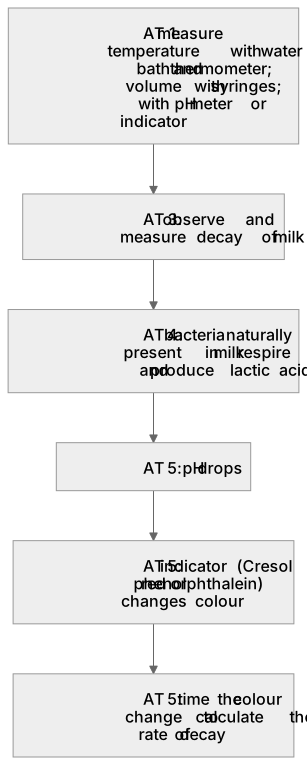
Put it in order
Put these steps in the order they happen.
- 1. AT 4: bacteria naturally present in milk respire and produce lactic acid
- 2. AT 3: observe and measure decay of milk
- 3. AT 1: measure temperature with water bath and thermometer; volume with syringes; pH with pH meter or indicator
- 4. AT 5: time the colour change to calculate the rate of decay
- 5. AT 5: indicator (Cresol red or phenolphthalein) changes colour
- 6. AT 5: pH drops
Label the diagram
Some boxes have lost their names. Pick the right name for each number.
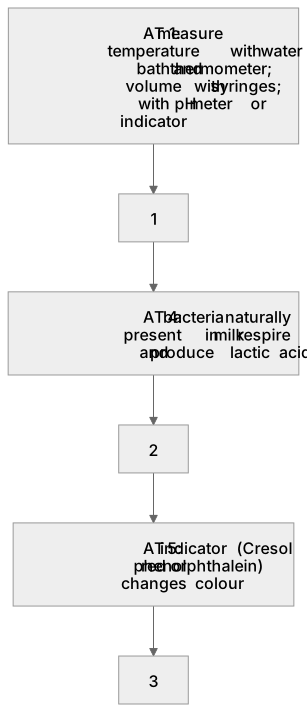
1Box 1
2Box 2
3Box 3
There is more to this lesson
The full lesson goes on to check your understanding and help you earn the marks. Create a free account to carry on, with your progress saved.
A week of Premium from your first lesson · Then the free plan continues · No card, no charge
Test your understanding of Decomposition (biology only): AT skills covered by this practical activity: AT 1, 3, 4 and 5.
Active recall beats re-reading. Take an instant quiz now to test what you’ve learned and lock it into long-term memory.
A week of Premium from your first lesson · Then the free plan continues · No card, no charge