AQA · GCSE · Biology
Course version: 8461 · Version from Sept 2018
Students should be able to explain how temperature, water and availability…
Full specification wording
Decomposition (biology only): Students should be able to explain how temperature, water and availability of oxygen affect the rate of decay of biological material.
Decay is the breakdown of biological material by microorganisms such as bacteria and fungi.
Checked against the AQA 8461 specification (opens in a new tab) on .
- Point 1 of 7
- 4 key terms
Study notes
From the checked teaching notes for this specification point.
The idea
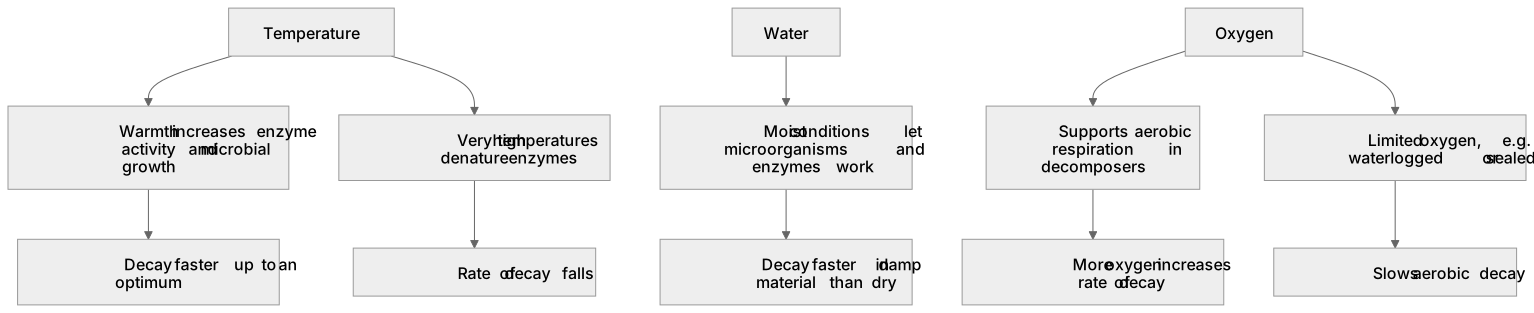
Decay is the breakdown of biological material by microorganisms such as bacteria and fungi. Their enzymes digest the material, and the rate depends on conditions. Warmth increases enzyme activity and microbial growth, so decay is faster up to an optimum; very high temperatures denature enzymes and slow or stop decay. Moisture is needed because microorganisms and their enzymes work in solution, so damp conditions speed up decay while dry conditions slow it. Oxygen is needed for aerobic respiration by decomposers, so plenty of oxygen increases the rate; waterlogged or sealed conditions limit oxygen and slow aerobic decay. These principles explain why food is refrigerated, dried, salted or vacuum-packed to preserve it.
What earns the marks
- Warm temperatures increase enzyme activity and microbial growth, so decay is faster up to an optimum temperature.
- Very high temperatures denature the enzymes of decomposers, so the rate of decay falls.
- Moist conditions allow microorganisms and their enzymes to work, so decay is faster in damp material than in dry material.
- Availability of oxygen supports aerobic respiration in decomposers, so more oxygen increases the rate of decay.
- Limited oxygen, for example in waterlogged or sealed conditions, slows aerobic decay and can favour anaerobic decomposers.
Common mistakes and how to put them right
Saying higher temperature always increases decay.
Put it right: Decay increases up to an optimum, then enzymes denature and the rate falls.
Thinking water is a reactant that is used up.
Put it right: Water provides the moist conditions needed for microbial enzymes to work.
Ignoring oxygen and assuming decay is the same in all conditions.
Put it right: Oxygen availability strongly affects the rate of aerobic decomposition.
Exam tips
- Use the word 'optimum' when describing temperature and explain what happens above it.
- Link each factor to the microorganisms: enzymes, respiration or growth, rather than treating decay as a simple chemical reaction.
- When explaining food preservation, name the factor that is controlled and state how it slows decay.
Try the lesson
The start of the Decomposition (biology only): Students should be able to explain how temperature, water and availability of oxygen affect the rate of decay of biological material. lesson, made from checked teaching notes for this specification point.
Have a go first
Which condition would slow down the decay of biological material?
Listen
Decay is the breakdown of biological material by microorganisms such as bacteria and fungi. Their enzymes digest the material, and the rate depends on conditions. Warmth increases enzyme activity and microbial growth, so decay is faster up to an optimum; very high temperatures denature enzymes and slow or stop decay. Moisture is needed because microorganisms and their enzymes work in solution, so damp conditions speed up decay while dry conditions slow it. Oxygen is needed for aerobic respiration by decomposers, so plenty of oxygen increases the rate; waterlogged or sealed conditions limit oxygen and slow aerobic decay. These principles explain why food is refrigerated, dried, salted or vacuum-packed to preserve it. A strong answer earns marks for these points. Warm temperatures increase enzyme activity and microbial growth, so decay is faster up to an optimum temperature. Very high temperatures denature the enzymes of decomposers, so the rate of decay falls. Moist conditions allow microorganisms and their enzymes to work, so decay is faster in damp material than in dry material. Availability of oxygen supports aerobic respiration in decomposers, so more oxygen increases the rate of decay. A common slip: Saying higher temperature always increases decay. Instead, decay increases up to an optimum, then enzymes denature and the rate falls. Exam tip: Use the word 'optimum' when describing temperature and explain what happens above it.
See it
Key words
Say what each word means before you turn the card.
Decomposition and decay
Try answering aloud or in your head before turning the card.
Enzyme activity and temperature
Try answering aloud or in your head before turning the card.
Aerobic respiration and oxygen
Try answering aloud or in your head before turning the card.
Food preservation
Try answering aloud or in your head before turning the card.
See every definition
- Decomposition and decay
- The breakdown of biological material by microorganisms such as bacteria and fungi, whose enzymes digest the material.
- Enzyme activity and temperature
- Warmth increases enzyme activity and microbial growth so decay is faster up to an optimum, but very high temperatures denature enzymes and slow or stop decay.
- Aerobic respiration and oxygen
- Oxygen is needed for aerobic respiration by decomposers, so plenty of oxygen increases the rate of decay, while waterlogged or sealed conditions limit oxygen and slow aerobic decay.
- Food preservation
- Refrigerating, drying, salting or vacuum-packing food to preserve it, explained by controlling the factors that affect decay.
Label the diagram
Some boxes have lost their names. Pick the right name for each number.
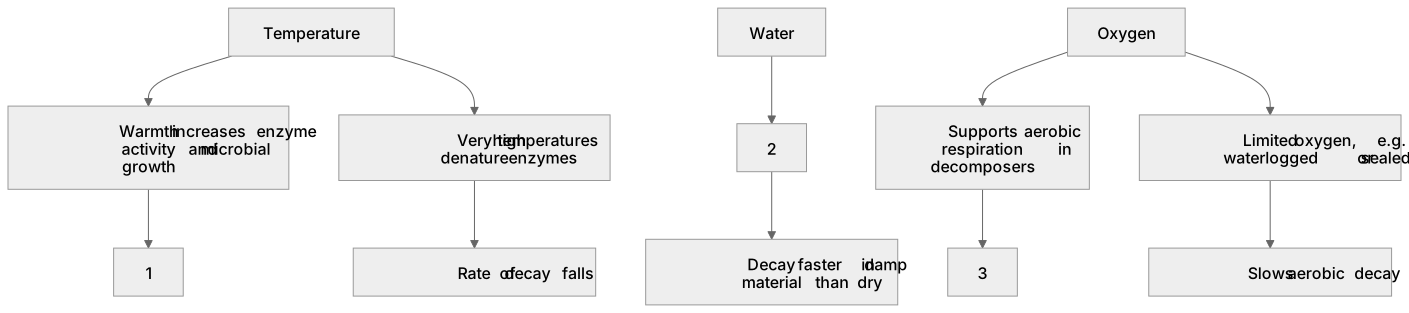
1Box 1
2Box 2
3Box 3
There is more to this lesson
The full lesson goes on to check your understanding and help you earn the marks. Create a free account to carry on, with your progress saved.
A week of Premium from your first lesson · Then the free plan continues · No card, no charge
Test your understanding of Decomposition (biology only): Students should be able to explain how temperature, water and availability of oxygen affect the rate of decay of biological material.
Active recall beats re-reading. Take an instant quiz now to test what you’ve learned and lock it into long-term memory.
A week of Premium from your first lesson · Then the free plan continues · No card, no charge