AQA · GCSE · Biology
Course version: 8461 · Version from Sept 2018
(HT only) Identification can be made by: • reference to a gardening manual…
Full specification wording
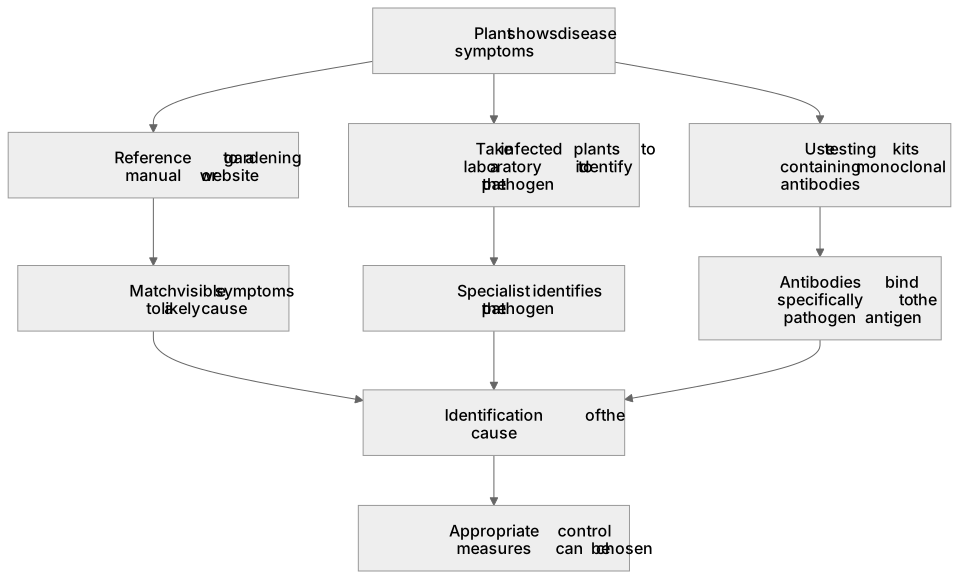
Detection and identification of plant diseases: (HT only) Identification can be made by: • reference to a gardening manual or website • taking infected plants to a laboratory to identify the pathogen • using testing kits that contain monoclonal antibodies.
Once a plant shows disease symptoms, a grower must work out the cause before choosing a treatment.
Checked against the AQA 8461 specification (opens in a new tab) on .
- Point 2 of 6
- 2 key terms
Study notes
From the checked teaching notes for this specification point.
The idea
Once a plant shows disease symptoms, a grower must work out the cause before choosing a treatment. A gardener can compare the visible signs, such as leaf spots or distorted growth, with photographs and descriptions in a gardening manual or a reliable website; this is quick and free but depends on correct matching. If the cause is unclear, a sample of the infected plant can be sent or taken to a laboratory, where specialists culture or examine the pathogen and identify it accurately. Testing kits containing monoclonal antibodies are also used: the antibodies bind only to a specific pathogen antigen, giving a rapid result, often on a dipstick. Each method trades speed, cost and accuracy, so the choice depends on the situation.
What earns the marks
- Reference sources such as a gardening manual or website allow a grower to match visible symptoms to a likely cause without specialist equipment.
- Laboratory identification involves sending or taking infected plant material so that a specialist can identify the pathogen directly.
- Testing kits use monoclonal antibodies that bind specifically to antigens of the target pathogen, giving a rapid and specific result.
- Monoclonal antibodies are produced from a single clone of cells, so they are identical and bind to one specific antigen.
- The three methods differ in speed, cost and reliability, so the most suitable method depends on the context.
- Identification is needed before appropriate control measures can be chosen, because different pathogens need different treatments.
Common mistakes and how to put them right
Thinking any antibody will detect any pathogen.
Put it right: Monoclonal antibodies are specific, so a kit detects only the pathogen whose antigen matches the antibody.
Assuming laboratory testing is always the first step.
Put it right: A manual or website is often used first because it is quick and cheap, with laboratory testing reserved for uncertain cases.
Confusing identification with treatment.
Put it right: Identification establishes the cause, and treatment is a separate later decision.
Exam tips
- Link each method to a practical advantage or limitation, such as speed, cost or accuracy, rather than listing methods alone.
- When describing test kits, name monoclonal antibodies and explain specific binding to pathogen antigens.
- Apply the methods to a scenario, for example advising a gardener who finds spotted leaves on a tomato plant.
Try the lesson
The start of the Detection and identification of plant diseases: (HT only) Identification can be made by: • reference to a gardening manual or website • taking infected plants to a laboratory to identify the pathogen • using testing kits that contain monoclonal antibodies. lesson, made from checked teaching notes for this specification point.
Have a go first
Which of the following is a recognised method for identifying the specific pathogen causing a plant disease?
Listen
Once a plant shows disease symptoms, a grower must work out the cause before choosing a treatment. A gardener can compare the visible signs, such as leaf spots or distorted growth, with photographs and descriptions in a gardening manual or a reliable website; this is quick and free but depends on correct matching. If the cause is unclear, a sample of the infected plant can be sent or taken to a laboratory, where specialists culture or examine the pathogen and identify it accurately. Testing kits containing monoclonal antibodies are also used: the antibodies bind only to a specific pathogen antigen, giving a rapid result, often on a dipstick. Each method trades speed, cost and accuracy, so the choice depends on the situation. A strong answer earns marks for these points. Reference sources such as a gardening manual or website allow a grower to match visible symptoms to a likely cause without specialist equipment. Laboratory identification involves sending or taking infected plant material so that a specialist can identify the pathogen directly. Testing kits use monoclonal antibodies that bind specifically to antigens of the target pathogen, giving a rapid and specific result. Monoclonal antibodies are produced from a single clone of cells, so they are identical and bind to one specific antigen. A common slip: Thinking any antibody will detect any pathogen. Instead, monoclonal antibodies are specific, so a kit detects only the pathogen whose antigen matches the antibody. Exam tip: Link each method to a practical advantage or limitation, such as speed, cost or accuracy, rather than listing methods alone.
See it
Key words
Say what each word means before you turn the card.
Detection and identification of plant disease
Try answering aloud or in your head before turning the card.
Monoclonal antibodies and specificity
Try answering aloud or in your head before turning the card.
See every definition
- Detection and identification of plant disease
- Working out the cause of a plant's disease once it shows symptoms, before choosing a treatment.
- Monoclonal antibodies and specificity
- Antibodies produced from a single clone of cells, so they are identical and bind to one specific antigen.
Label the diagram
Some boxes have lost their names. Pick the right name for each number.
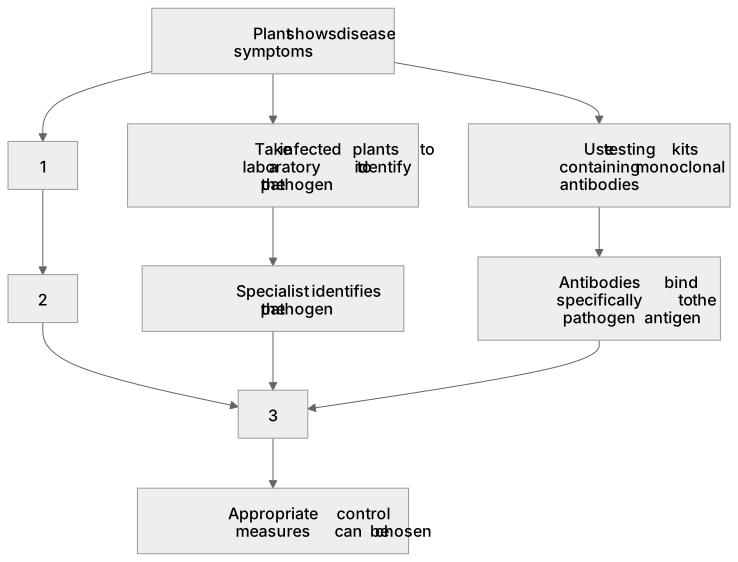
1Box 1
2Box 2
3Box 3
There is more to this lesson
The full lesson goes on to check your understanding and help you earn the marks. Create a free account to carry on, with your progress saved.
A week of Premium from your first lesson · Then the free plan continues · No card, no charge
Test your understanding of Detection and identification of plant diseases: (HT only) Identification can be made by: • reference to a gardening manual or website • taking infected plants to a laboratory to identify the pathogen • using testing kits that contain monoclonal antibodies.
Active recall beats re-reading. Take an instant quiz now to test what you’ve learned and lock it into long-term memory.
A week of Premium from your first lesson · Then the free plan continues · No card, no charge