AQA · GCSE · Biology
Course version: 8461 · Version from Sept 2018
Plants can be damaged by a range of ion deficiency conditions: • stunted…
Full specification wording
Detection and identification of plant diseases: Plants can be damaged by a range of ion deficiency conditions: • stunted growth caused by nitrate deficiency • chlorosis caused by magnesium deficiency.
Not all plant problems are caused by pathogens; a lack of essential mineral ions also damages plants.
Checked against the AQA 8461 specification (opens in a new tab) on .
- Point 5 of 6
- 4 key terms
Study notes
From the checked teaching notes for this specification point.
The idea
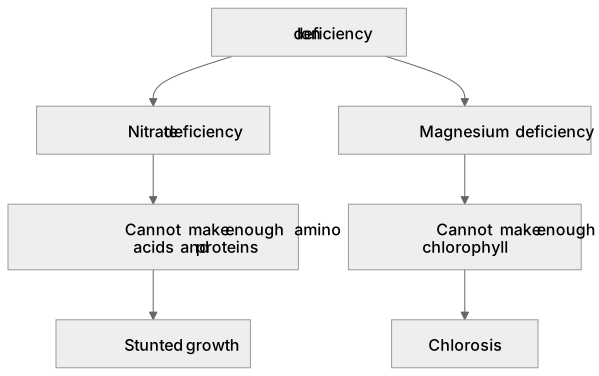
Not all plant problems are caused by pathogens; a lack of essential mineral ions also damages plants. Nitrate ions are needed to make amino acids and proteins, so a plant short of nitrate cannot build enough protein for new cells and shows stunted growth, with older leaves often affected first. Magnesium ions are needed to make chlorophyll, the green pigment that absorbs light for photosynthesis. A plant short of magnesium cannot make enough chlorophyll, so its leaves become pale or yellow, a condition called chlorosis. The two deficiencies produce different symptoms because the ions have different roles. Recognising these symptoms helps a grower distinguish mineral deficiency from disease and choose the right treatment, such as adding fertiliser.
What earns the marks
- Nitrate deficiency causes stunted growth because nitrate is needed to make amino acids and proteins for growth.
- Magnesium deficiency causes chlorosis because magnesium is needed to make chlorophyll.
- Chlorosis is the yellowing or paling of leaves due to reduced chlorophyll.
- Stunted growth means the plant is smaller or grows less than expected for its age and conditions.
- Mineral ion deficiency is a nutritional problem, not an infection by a pathogen.
- The symptoms differ because nitrate is used for proteins while magnesium is used for chlorophyll, so each deficiency has a distinct effect.
Common mistakes and how to put them right
Mixing up the two deficiencies.
Put it right: Nitrate deficiency causes stunted growth, while magnesium deficiency causes chlorosis.
Thinking chlorosis is caused by lack of nitrate.
Put it right: Chlorosis is linked to magnesium deficiency and reduced chlorophyll.
Assuming all yellowing leaves mean disease.
Put it right: Yellowing can be a mineral deficiency, so other symptoms and context must be considered.
Exam tips
- Link each ion to its role in the plant before stating the symptom, so the answer explains why the symptom occurs.
- Use the exact terms stunted growth and chlorosis when they apply.
- If a question gives a fertiliser or soil test result, use it to decide which ion is deficient.
Try the lesson
The start of the Detection and identification of plant diseases: Plants can be damaged by a range of ion deficiency conditions: • stunted growth caused by nitrate deficiency • chlorosis caused by magnesium deficiency. lesson, made from checked teaching notes for this specification point.
Have a go first
A farmer notices that his crop plants are growing much more slowly than expected and are smaller than normal. Which ion deficiency causes stunted growth in plants?
Listen
Not all plant problems are caused by pathogens; a lack of essential mineral ions also damages plants. Nitrate ions are needed to make amino acids and proteins, so a plant short of nitrate cannot build enough protein for new cells and shows stunted growth, with older leaves often affected first. Magnesium ions are needed to make chlorophyll, the green pigment that absorbs light for photosynthesis. A plant short of magnesium cannot make enough chlorophyll, so its leaves become pale or yellow, a condition called chlorosis. The two deficiencies produce different symptoms because the ions have different roles. Recognising these symptoms helps a grower distinguish mineral deficiency from disease and choose the right treatment, such as adding fertiliser. A strong answer earns marks for these points. Nitrate deficiency causes stunted growth because nitrate is needed to make amino acids and proteins for growth. Magnesium deficiency causes chlorosis because magnesium is needed to make chlorophyll. Chlorosis is the yellowing or paling of leaves due to reduced chlorophyll. Stunted growth means the plant is smaller or grows less than expected for its age and conditions. A common slip: Mixing up the two deficiencies. Instead, nitrate deficiency causes stunted growth, while magnesium deficiency causes chlorosis. Exam tip: Link each ion to its role in the plant before stating the symptom, so the answer explains why the symptom occurs.
See it
Key words
Say what each word means before you turn the card.
Nitrate deficiency
Try answering aloud or in your head before turning the card.
Magnesium deficiency
Try answering aloud or in your head before turning the card.
Chlorosis
Try answering aloud or in your head before turning the card.
Stunted growth
Try answering aloud or in your head before turning the card.
See every definition
- Nitrate deficiency
- A shortage of nitrate ions, which are needed to make amino acids and proteins, so the plant cannot build enough protein for new cells and shows stunted growth.
- Magnesium deficiency
- A shortage of magnesium ions, which are needed to make chlorophyll, so the plant cannot make enough chlorophyll and its leaves become pale or yellow.
- Chlorosis
- The yellowing or paling of leaves due to reduced chlorophyll, caused by magnesium deficiency.
- Stunted growth
- When a plant is smaller or grows less than expected for its age and conditions, caused by nitrate deficiency.
Label the diagram
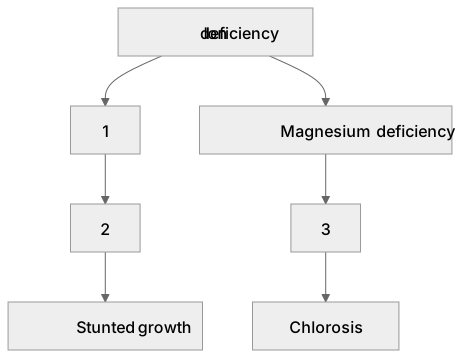
Some boxes have lost their names. Pick the right name for each number.
1Box 1
2Box 2
3Box 3
There is more to this lesson
The full lesson goes on to check your understanding and help you earn the marks. Create a free account to carry on, with your progress saved.
A week of Premium from your first lesson · Then the free plan continues · No card, no charge
Test your understanding of Detection and identification of plant diseases: Plants can be damaged by a range of ion deficiency conditions: • stunted growth caused by nitrate deficiency • chlorosis caused by magnesium deficiency.
Active recall beats re-reading. Take an instant quiz now to test what you’ve learned and lock it into long-term memory.
A week of Premium from your first lesson · Then the free plan continues · No card, no charge