AQA · GCSE · Biology
Course version: 8461 · Version from Sept 2018
In multicellular organisms, surfaces and organ systems are specialised for…
Full specification wording
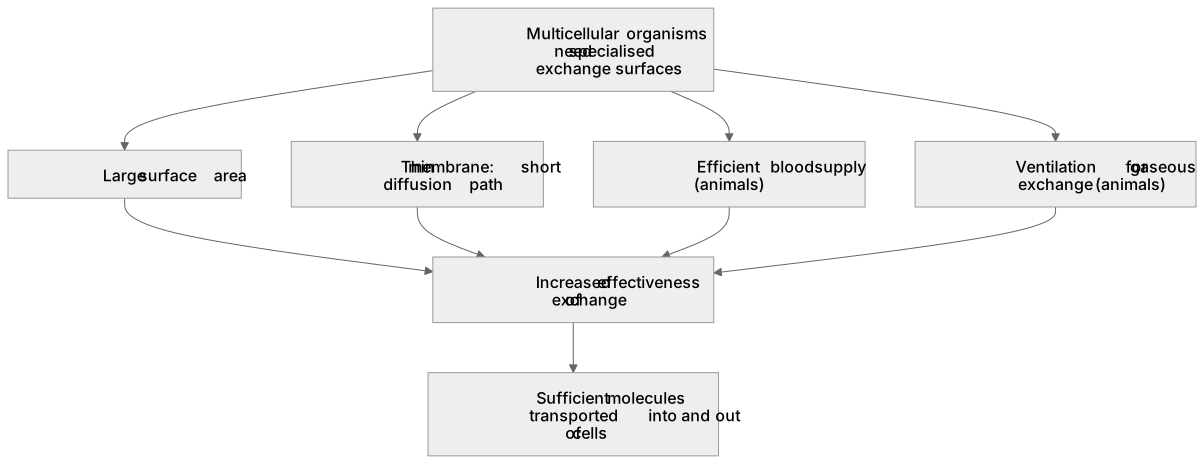
Diffusion: In multicellular organisms, surfaces and organ systems are specialised for exchanging materials. This is to allow sufficient molecules to be transported into and out of cells for the organism’s needs. The effectiveness of an exchange surface is increased by: • having a large surface area • a membrane that is thin, to provide a short diffusion path • (in animals) having an efficient blood supply • (in animals, for gaseous exchange) being ventilated.
Multicellular organisms need exchange surfaces because many cells are deep inside the body, far from the outside environment.
Checked against the AQA 8461 specification (opens in a new tab) on .
- Point 11 of 11
- 4 key terms
Study notes
From the checked teaching notes for this specification point.
The idea
Multicellular organisms need exchange surfaces because many cells are deep inside the body, far from the outside environment. Specialised surfaces and organ systems allow enough molecules to move into and out of cells to meet the organism's needs. Four features increase effectiveness. A large surface area provides more space for molecules to cross. A thin membrane gives a short diffusion path, so diffusion is faster. In animals, an efficient blood supply maintains a steep concentration gradient by carrying absorbed molecules away and bringing others to the surface. Ventilation for gaseous exchange replaces air, keeping oxygen high and carbon dioxide low at the exchange surface. Examples include the alveoli in lungs and villi in the small intestine.
What earns the marks
- Multicellular organisms need specialised exchange surfaces because diffusion over large distances is too slow to supply all cells.
- A large surface area increases the number of molecules that can cross at the same time, increasing the rate of exchange.
- A thin membrane provides a short diffusion path, so molecules diffuse across more quickly.
- In animals, an efficient blood supply maintains a steep concentration gradient by transporting substances to and from the exchange surface.
- Ventilation for gaseous exchange maintains concentration gradients by replacing air, keeping oxygen concentration high and carbon dioxide concentration low.
Common mistakes and how to put them right
Thinking a large organism can rely on its outer surface for exchange.
Put it right by explaining that a small surface-area-to-volume ratio makes simple diffusion too slow, so specialised surfaces are needed.
Confusing surface area with volume.
Put it right by stating that exchange depends on a large surface area, not a large volume.
Believing a thin membrane makes diffusion happen without a concentration gradient.
Put it right by explaining that a thin membrane shortens the diffusion path, but a concentration gradient is still required.
Exam tips
- Name a specific exchange surface, such as alveoli or villi, and link each feature to faster diffusion.
- Use the phrase concentration gradient when explaining the roles of blood supply and ventilation.
- For calculation questions, show the surface area and volume values clearly and compare the ratio to explain exchange efficiency.
Try the lesson
The start of the Diffusion: In multicellular organisms, surfaces and organ systems are specialised for exchanging materials. This is to allow sufficient molecules to be transported into and out of cells for the organism’s needs. The effectiveness of an exchange surface is increased by: • having a large surface area • a membrane that is thin, to provide a short diffusion path • (in animals) having an efficient blood supply • (in animals, for gaseous exchange) being ventilated. lesson, made from checked teaching notes for this specification point.
Have a go first
The lining of the small intestine has many tiny folds that give it a large surface area. How does a large surface area help the small intestine to absorb digested food?
Listen
Multicellular organisms need exchange surfaces because many cells are deep inside the body, far from the outside environment. Specialised surfaces and organ systems allow enough molecules to move into and out of cells to meet the organism's needs. Four features increase effectiveness. A large surface area provides more space for molecules to cross. A thin membrane gives a short diffusion path, so diffusion is faster. In animals, an efficient blood supply maintains a steep concentration gradient by carrying absorbed molecules away and bringing others to the surface. Ventilation for gaseous exchange replaces air, keeping oxygen high and carbon dioxide low at the exchange surface. Examples include the alveoli in lungs and villi in the small intestine. A strong answer earns marks for these points. Multicellular organisms need specialised exchange surfaces because diffusion over large distances is too slow to supply all cells. A large surface area increases the number of molecules that can cross at the same time, increasing the rate of exchange. A thin membrane provides a short diffusion path, so molecules diffuse across more quickly. In animals, an efficient blood supply maintains a steep concentration gradient by transporting substances to and from the exchange surface. A common slip: Thinking a large organism can rely on its outer surface for exchange. Instead, explaining that a small surface-area-to-volume ratio makes simple diffusion too slow, so specialised surfaces are needed. Exam tip: Name a specific exchange surface, such as alveoli or villi, and link each feature to faster diffusion.
See it
Key words
Say what each word means before you turn the card.
Surface area to volume ratio
Try answering aloud or in your head before turning the card.
Diffusion and concentration gradients
Try answering aloud or in your head before turning the card.
Specialisation of cells and organs
Try answering aloud or in your head before turning the card.
Transport and gas exchange in animals
Try answering aloud or in your head before turning the card.
See every definition
- Surface area to volume ratio
- A small surface-area-to-volume ratio makes simple diffusion too slow, so specialised surfaces are needed.
- Diffusion and concentration gradients
- A thin membrane shortens the diffusion path, but a concentration gradient is still required.
- Specialisation of cells and organs
- Surfaces and organ systems are specialised for exchanging materials to allow sufficient molecules to be transported into and out of cells.
- Transport and gas exchange in animals
- An efficient blood supply maintains a steep concentration gradient, and ventilation replaces air, keeping oxygen high and carbon dioxide low.
Label the diagram
Some boxes have lost their names. Pick the right name for each number.
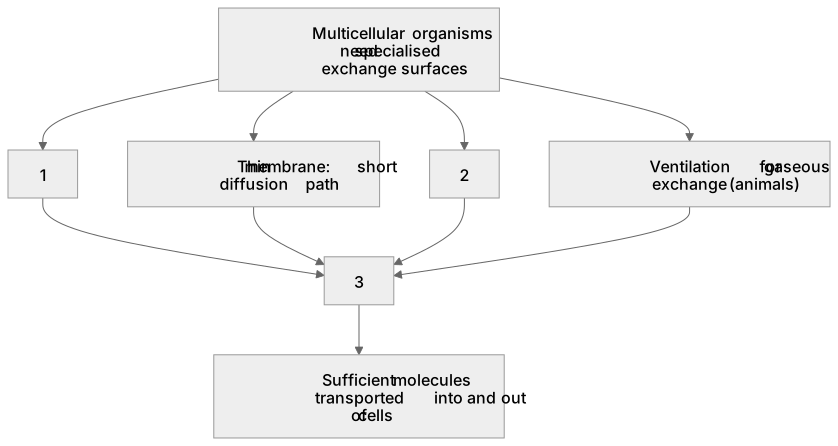
1Box 1
2Box 2
3Box 3
There is more to this lesson
The full lesson goes on to check your understanding and help you earn the marks. Create a free account to carry on, with your progress saved.
A week of Premium from your first lesson · Then the free plan continues · No card, no charge
Test your understanding of Diffusion: In multicellular organisms, surfaces and organ systems are specialised for exchanging materials. This is to allow sufficient molecules to be transported into and out of cells for the organism’s needs. The effectiveness of an exchange surface is increased by: • having a large surface area • a membrane that is thin, to provide a short diffusion path • (in animals) having an efficient blood supply • (in animals, for gaseous exchange) being ventilated.
Active recall beats re-reading. Take an instant quiz now to test what you’ve learned and lock it into long-term memory.
A week of Premium from your first lesson · Then the free plan continues · No card, no charge