AQA · GCSE · Biology
Course version: 8461 · Version from Sept 2018
Students should be able to calculate and compare surface area to volume…
Full specification wording
Diffusion: Students should be able to calculate and compare surface area to volume ratios.
Surface area to volume ratio (SA:V) compares the total external surface area of an object with its volume.
Checked against the AQA 8461 specification (opens in a new tab) on .
- Point 8 of 11
Study notes
From the checked teaching notes for this specification point.
The idea
Surface area to volume ratio (SA:V) compares the total external surface area of an object with its volume. For a cube of side length L, surface area = 6 × L² and volume = L³, so SA:V = 6 ÷ L. As an organism or structure gets larger, volume increases faster than surface area, so the ratio falls. For example, a cube of side 1 cm has SA:V = 6 ÷ 1 = 6, while a cube of side 3 cm has SA:V = 6 ÷ 3 = 2. To calculate, work out surface area and volume using the correct formulae, then divide surface area by volume and cancel units. To compare, calculate the ratio for each object and state which is larger, linking this to how quickly substances can diffuse into or out of the object.
What earns the marks
- Calculate surface area correctly using the appropriate formula for the shape, such as 6 × L² for a cube.
- Calculate volume correctly using the appropriate formula, such as L³ for a cube.
- Divide surface area by volume to obtain the ratio, cancelling units correctly.
- Compare two or more ratios and state which object has the larger or smaller surface area to volume ratio.
- Relate a larger surface area to volume ratio to more effective diffusion over the available surface.
Common mistakes and how to put them right
Dividing volume by surface area instead of surface area by volume.
Put it right by writing the ratio as surface area first, then volume.
Forgetting to square or cube the side length.
Put it right by checking each formula before substituting numbers.
Assuming the larger object always has the larger ratio.
Put it right by calculating both ratios, since larger objects usually have a smaller ratio.
Exam tips
- Write the formula, substitute values, then give the final ratio with units cancelled.
- Show each step of working so method marks can be awarded even if the final value is wrong.
- When comparing, quote both calculated ratios and then make the comparative statement explicit.
Try the lesson
The start of the Diffusion: Students should be able to calculate and compare surface area to volume ratios. lesson, made from checked teaching notes for this specification point.
Have a go first
A cube-shaped organism has sides of 3 cm. A second cube-shaped organism has sides of 6 cm. Which statement correctly compares their surface area to volume ratios?
Listen
Surface area to volume ratio (SA:V) compares the total external surface area of an object with its volume. For a cube of side length L, surface area = 6 × L² and volume = L³, so SA:V = 6 ÷ L. As an organism or structure gets larger, volume increases faster than surface area, so the ratio falls. For example, a cube of side 1 cm has SA:V = 6 ÷ 1 = 6, while a cube of side 3 cm has SA:V = 6 ÷ 3 = 2. To calculate, work out surface area and volume using the correct formulae, then divide surface area by volume and cancel units. To compare, calculate the ratio for each object and state which is larger, linking this to how quickly substances can diffuse into or out of the object. A strong answer earns marks for these points. Calculate surface area correctly using the appropriate formula for the shape, such as 6 × L² for a cube. Calculate volume correctly using the appropriate formula, such as L³ for a cube. Divide surface area by volume to obtain the ratio, cancelling units correctly. Compare two or more ratios and state which object has the larger or smaller surface area to volume ratio. A common slip: Dividing volume by surface area instead of surface area by volume. Instead, writing the ratio as surface area first, then volume. Exam tip: Write the formula, substitute values, then give the final ratio with units cancelled.
See it
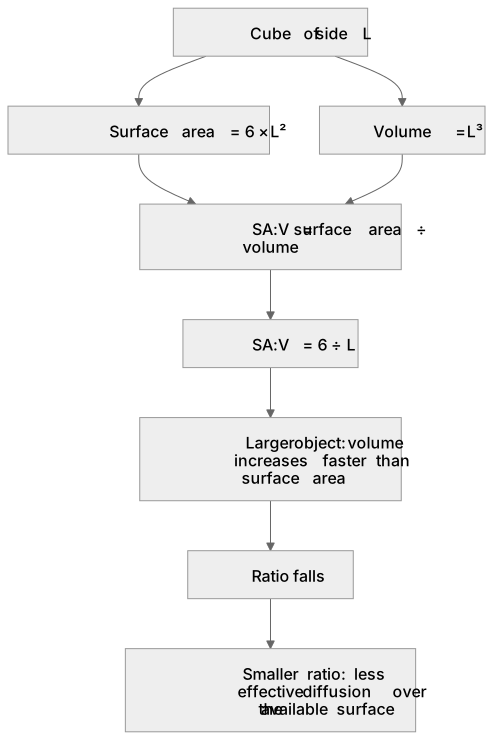
Label the diagram
Some boxes have lost their names. Pick the right name for each number.
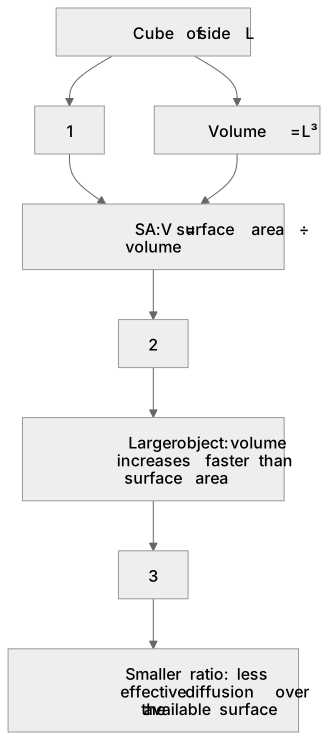
1Box 1
2Box 2
3Box 3
There is more to this lesson
The full lesson goes on to check your understanding and help you earn the marks. Create a free account to carry on, with your progress saved.
A week of Premium from your first lesson · Then the free plan continues · No card, no charge
Test your understanding of Diffusion: Students should be able to calculate and compare surface area to volume ratios.
Active recall beats re-reading. Take an instant quiz now to test what you’ve learned and lock it into long-term memory.
A week of Premium from your first lesson · Then the free plan continues · No card, no charge