AQA · GCSE · Biology
Course version: 8461 · Version from Sept 2018
Students should be able to explain how different factors affect the rate…
Full specification wording
Diffusion: Students should be able to explain how different factors affect the rate of diffusion.
Diffusion is the net movement of particles from a region of higher concentration to a region of lower concentration, down a concentration gradient, as a result of random motion.
Checked against the AQA 8461 specification (opens in a new tab) on .
- Point 4 of 11
Study notes
From the checked teaching notes for this specification point.
The idea
Diffusion is the net movement of particles from a region of higher concentration to a region of lower concentration, down a concentration gradient, as a result of random motion. To explain how factors affect its rate, link each factor to particle behaviour or to the geometry of the exchange surface. A steeper concentration gradient, a higher temperature, or a larger surface area of membrane each increases the rate. For example, oxygen diffuses from alveolar air into blood because alveolar air has a higher oxygen concentration than deoxygenated blood; breathing keeps this gradient steep. Explaining means giving a causal mechanism, not merely naming the factor, and applying it to a named context such as a root hair cell or a villus.
What earns the marks
- State that diffusion is the net movement of particles down a concentration gradient, from higher to lower concentration, caused by random particle motion.
- Explain that a steeper concentration gradient increases the rate because more particles move in one direction than the other, giving a greater net movement per unit time.
- Explain that a higher temperature increases the rate because particles have more kinetic energy and move faster, so collisions and net movement are more frequent.
- Explain that a larger surface area of membrane increases the rate because more particles can cross the membrane at the same time.
- Apply the factors to a named biological context, such as oxygen uptake across alveoli or absorption of mineral ions by root hair cells.
- Use the relationship rate proportional to surface area multiplied by concentration difference divided by distance, treating it as a qualitative guide rather than a calculation requirement.
Common mistakes and how to put them right
Saying particles 'want' to move or move 'to be equal', which is teleological.
Put it right by stating that random motion produces net movement down a concentration gradient.
Confusing diffusion with active transport.
Put it right by noting that diffusion is passive and requires no energy from respiration.
Claiming that a higher temperature slows diffusion because particles 'stick together'.
Put it right by explaining that increased kinetic energy speeds up particle movement and raises the rate.
Exam tips
- Name the factor, state whether the rate increases or decreases, then give the particle-level reason in one linked sentence.
- When a question supplies data, quote a relevant value or trend from the table or graph before explaining it.
- Use a named example such as gas exchange in alveoli to show application rather than describing diffusion in the abstract.
Try the lesson
The start of the Diffusion: Students should be able to explain how different factors affect the rate of diffusion. lesson, made from checked teaching notes for this specification point.
Have a go first
A student places a drop of purple dye into a beaker of still water at 20 °C. The dye spreads slowly through the water. Which change would make the dye spread through the water faster?
Listen
Diffusion is the net movement of particles from a region of higher concentration to a region of lower concentration, down a concentration gradient, as a result of random motion. To explain how factors affect its rate, link each factor to particle behaviour or to the geometry of the exchange surface. A steeper concentration gradient, a higher temperature, or a larger surface area of membrane each increases the rate. For example, oxygen diffuses from alveolar air into blood because alveolar air has a higher oxygen concentration than deoxygenated blood; breathing keeps this gradient steep. Explaining means giving a causal mechanism, not merely naming the factor, and applying it to a named context such as a root hair cell or a villus. A strong answer earns marks for these points. State that diffusion is the net movement of particles down a concentration gradient, from higher to lower concentration, caused by random particle motion. Explain that a steeper concentration gradient increases the rate because more particles move in one direction than the other, giving a greater net movement per unit time. Explain that a higher temperature increases the rate because particles have more kinetic energy and move faster, so collisions and net movement are more frequent. Explain that a larger surface area of membrane increases the rate because more particles can cross the membrane at the same time. A common slip: Saying particles 'want' to move or move 'to be equal', which is teleological. Instead, stating that random motion produces net movement down a concentration gradient. Exam tip: Name the factor, state whether the rate increases or decreases, then give the particle-level reason in one linked sentence.
See it
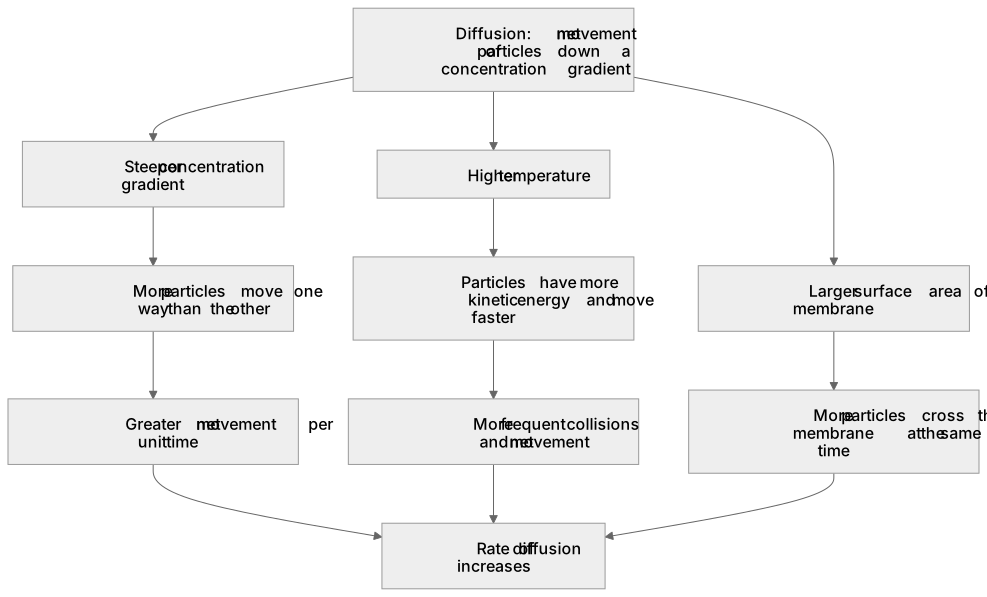
Label the diagram
Some boxes have lost their names. Pick the right name for each number.
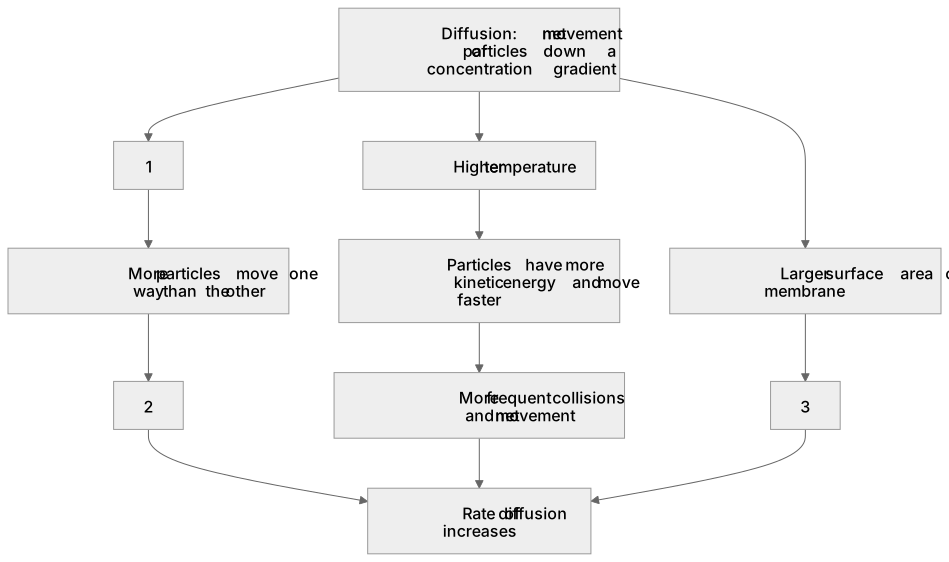
1Box 1
2Box 2
3Box 3
There is more to this lesson
The full lesson goes on to check your understanding and help you earn the marks. Create a free account to carry on, with your progress saved.
A week of Premium from your first lesson · Then the free plan continues · No card, no charge
Test your understanding of Diffusion: Students should be able to explain how different factors affect the rate of diffusion.
Active recall beats re-reading. Take an instant quiz now to test what you’ve learned and lock it into long-term memory.
A week of Premium from your first lesson · Then the free plan continues · No card, no charge