AQA · GCSE · Biology
Course version: 8461 · Version from Sept 2018
(HT only) In the complementary strands a C is always linked to a G on the…
Full specification wording
DNA structure (biology only): (HT only) In the complementary strands a C is always linked to a G on the opposite strand and a T to an A.
DNA is a double-stranded molecule held together by hydrogen bonds between bases on opposite strands.
Checked against the AQA 8461 specification (opens in a new tab) on .
- Point 9 of 19
- 4 key terms
Study notes
From the checked teaching notes for this specification point.
The idea
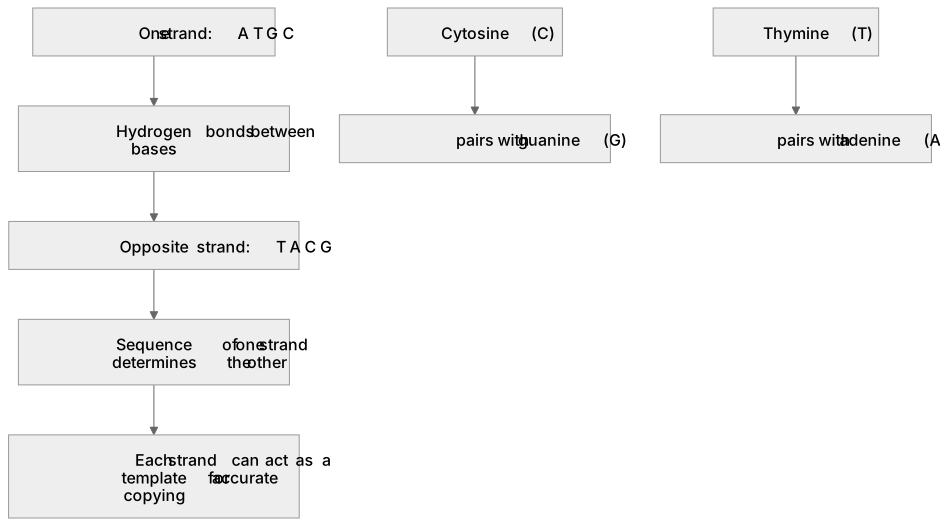
DNA is a double-stranded molecule held together by hydrogen bonds between bases on opposite strands. The strands are complementary, meaning the base on one strand determines the base on the other. Cytosine (C) always pairs with guanine (G), and thymine (T) always pairs with adenine (A). This is called complementary base pairing. Because of this rule, if you know the sequence of one strand, you can work out the sequence of the other.
For example: If one strand reads A T G C, the opposite strand reads T A C G. The pairing also explains Chargaff's observation that the amount of A equals the amount of T, and the amount of C equals the amount of G in double-stranded DNA.
What earns the marks
- DNA consists of two complementary strands held together by hydrogen bonds between bases.
- Cytosine pairs with guanine, and thymine pairs with adenine, on opposite strands.
- The base sequence of one strand determines the base sequence of the complementary strand.
- Complementary base pairing means the proportion of adenine equals the proportion of thymine, and cytosine equals guanine, in double-stranded DNA.
- Base pairing allows accurate copying of DNA because each strand can act as a template.
Common mistakes and how to put them right
Pairing C with T or A with G.
Put it right by stating that C pairs with G and T pairs with A.
Writing the complementary sequence in the same direction without reversing it.
Put it right by writing the partner bases opposite their partners.
Forgetting that the pairs are held by hydrogen bonds, not covalent bonds.
Put it right by naming hydrogen bonds between the bases.
Exam tips
- When asked for a complementary sequence, write each base directly opposite its partner to avoid errors.
- Use the full names and letters together, for example cytosine (C), to show precise knowledge.
- Check that every C has a G and every T has an A before finishing your answer.
Try the lesson
The start of the DNA structure (biology only): (HT only) In the complementary strands a C is always linked to a G on the opposite strand and a T to an A. lesson, made from checked teaching notes for this specification point.
Have a go first
A short section of one DNA strand has the base sequence A T G C A. Which base sequence is found on the opposite strand?
Listen
DNA is a double-stranded molecule held together by hydrogen bonds between bases on opposite strands. The strands are complementary, meaning the base on one strand determines the base on the other. Cytosine (C) always pairs with guanine (G), and thymine (T) always pairs with adenine (A). This is called complementary base pairing. Because of this rule, if you know the sequence of one strand, you can work out the sequence of the other. For example, if one strand reads A T G C, the opposite strand reads T A C G. The pairing also explains Chargaff's observation that the amount of A equals the amount of T, and the amount of C equals the amount of G in double-stranded DNA. A strong answer earns marks for these points. DNA consists of two complementary strands held together by hydrogen bonds between bases. Cytosine pairs with guanine, and thymine pairs with adenine, on opposite strands. The base sequence of one strand determines the base sequence of the complementary strand. Complementary base pairing means the proportion of adenine equals the proportion of thymine, and cytosine equals guanine, in double-stranded DNA. A common slip: Pairing C with T or A with G. Instead, stating that C pairs with G and T pairs with A. Exam tip: When asked for a complementary sequence, write each base directly opposite its partner to avoid errors.
See it
Key words
Say what each word means before you turn the card.
Complementary base pairing
Try answering aloud or in your head before turning the card.
Double-stranded structure of DNA
Try answering aloud or in your head before turning the card.
Hydrogen bonding between bases
Try answering aloud or in your head before turning the card.
Template function of DNA strands
Try answering aloud or in your head before turning the card.
See every definition
- Complementary base pairing
- In the complementary strands a C is always linked to a G on the opposite strand and a T to an A.
- Double-stranded structure of DNA
- DNA consists of two complementary strands held together by hydrogen bonds between bases.
- Hydrogen bonding between bases
- The two complementary strands are held together by hydrogen bonds between bases on opposite strands.
- Template function of DNA strands
- Base pairing allows accurate copying of DNA because each strand can act as a template.
Label the diagram
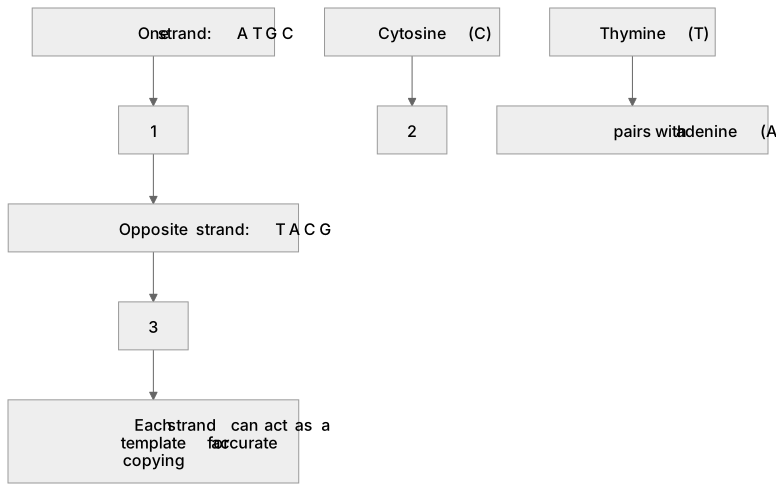
Some boxes have lost their names. Pick the right name for each number.
1Box 1
2Box 2
3Box 3
There is more to this lesson
The full lesson goes on to check your understanding and help you earn the marks. Create a free account to carry on, with your progress saved.
A week of Premium from your first lesson · Then the free plan continues · No card, no charge
Test your understanding of DNA structure (biology only): (HT only) In the complementary strands a C is always linked to a G on the opposite strand and a T to an A.
Active recall beats re-reading. Take an instant quiz now to test what you’ve learned and lock it into long-term memory.
A week of Premium from your first lesson · Then the free plan continues · No card, no charge