AQA · GCSE · Biology
Course version: 8461 · Version from Sept 2018
The order of bases controls the order in which amino acids are assembled…
Full specification wording
DNA structure (biology only): The order of bases controls the order in which amino acids are assembled to produce a particular protein.
The linear sequence of bases in a gene determines the linear sequence of amino acids in a polypeptide.
Checked against the AQA 8461 specification (opens in a new tab) on .
- Point 5 of 19
- 3 key terms
Study notes
From the checked teaching notes for this specification point.
The idea
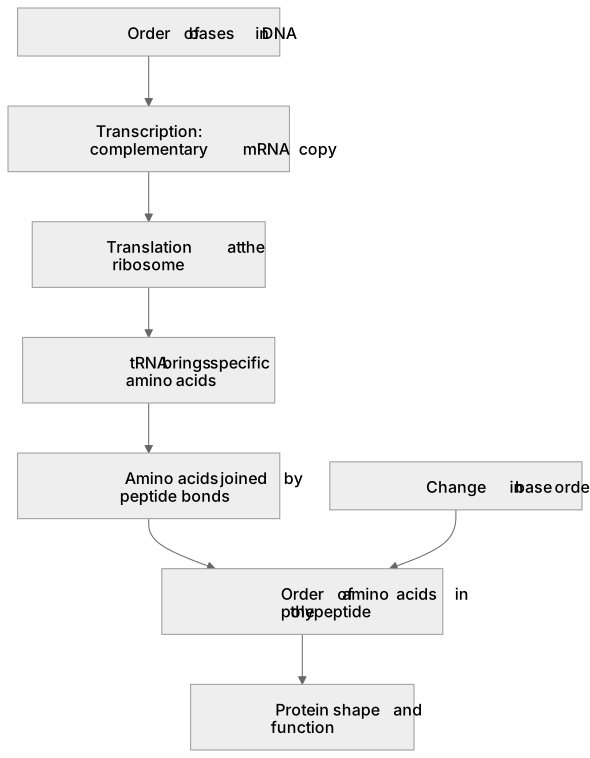
The linear sequence of bases in a gene determines the linear sequence of amino acids in a polypeptide. During transcription, the DNA base sequence is copied into a complementary mRNA molecule. During translation, the ribosome reads the mRNA codons in order, and transfer RNA molecules bring specific amino acids that are joined by peptide bonds. For example, if the DNA triplet sequence is ATG TTA CGT, the mRNA codons are UAC AAU GCA, and the amino acids are assembled in that exact order. Changing the order of bases changes the order of amino acids, which can alter the protein's shape and function. This explains how genes control cell activity and why mutations can have harmful, neutral or beneficial effects.
What earns the marks
- The order of bases in a gene determines the order of amino acids in the polypeptide.
- Transcription produces a complementary mRNA copy of the DNA base sequence.
- Translation at the ribosome reads mRNA codons in sequence and joins amino acids with peptide bonds.
- Transfer RNA molecules bring specific amino acids corresponding to each codon.
- A change in base order can change the amino acid sequence, altering protein structure and function.
Common mistakes and how to put them right
Thinking that the order of bases directly builds the protein without mRNA.
Put it right: mRNA carries the complementary code from DNA to the ribosome.
Confusing transcription and translation.
Put it right: Transcription makes mRNA from DNA, while translation makes a polypeptide from mRNA.
Assuming any base change always changes the protein.
Put it right: Some changes may not alter the amino acid sequence because the code is degenerate, or may not affect protein function.
Exam tips
- When explaining protein synthesis, always link the DNA base sequence to the mRNA codon sequence and then to the amino acid sequence.
- Use the terms transcription and translation accurately and in the correct order.
- If asked about a mutation, state whether the amino acid sequence changes and then explain the possible effect on protein shape and function.
Try the lesson
The start of the DNA structure (biology only): The order of bases controls the order in which amino acids are assembled to produce a particular protein. lesson, made from checked teaching notes for this specification point.
Have a go first
What does the order of bases in a gene control?
Listen
The linear sequence of bases in a gene determines the linear sequence of amino acids in a polypeptide. During transcription, the DNA base sequence is copied into a complementary mRNA molecule. During translation, the ribosome reads the mRNA codons in order, and transfer RNA molecules bring specific amino acids that are joined by peptide bonds. For example, if the DNA triplet sequence is ATG TTA CGT, the mRNA codons are UAC AAU GCA, and the amino acids are assembled in that exact order. Changing the order of bases changes the order of amino acids, which can alter the protein's shape and function. This explains how genes control cell activity and why mutations can have harmful, neutral or beneficial effects. A strong answer earns marks for these points. The order of bases in a gene determines the order of amino acids in the polypeptide. Transcription produces a complementary mRNA copy of the DNA base sequence. Translation at the ribosome reads mRNA codons in sequence and joins amino acids with peptide bonds. Transfer RNA molecules bring specific amino acids corresponding to each codon. Exam tip: When explaining protein synthesis, always link the DNA base sequence to the mRNA codon sequence and then to the amino acid sequence.
See it
Key words
Say what each word means before you turn the card.
transcription
Try answering aloud or in your head before turning the card.
translation
Try answering aloud or in your head before turning the card.
mRNA
Try answering aloud or in your head before turning the card.
See every definition
- transcription
- During transcription, the DNA base sequence is copied into a complementary mRNA molecule.
- translation
- During translation, the ribosome reads the mRNA codons in order and amino acids are joined by peptide bonds.
- mRNA
- A complementary mRNA copy of the DNA base sequence is produced during transcription and carries the code to the ribosome.
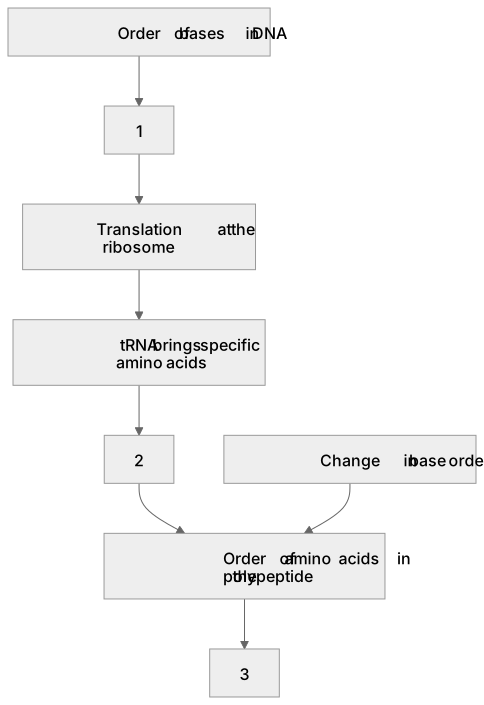
Label the diagram
Some boxes have lost their names. Pick the right name for each number.
1Box 1
2Box 2
3Box 3
There is more to this lesson
The full lesson goes on to check your understanding and help you earn the marks. Create a free account to carry on, with your progress saved.
A week of Premium from your first lesson · Then the free plan continues · No card, no charge
Test your understanding of DNA structure (biology only): The order of bases controls the order in which amino acids are assembled to produce a particular protein.
Active recall beats re-reading. Take an instant quiz now to test what you’ve learned and lock it into long-term memory.
A week of Premium from your first lesson · Then the free plan continues · No card, no charge