AQA · GCSE · Biology
Course version: 8461 · Version from Sept 2018
Students should be able to demonstrate an understanding of the scale and…
Full specification wording
Eukaryotes and prokaryotes: Students should be able to demonstrate an understanding of the scale and size of cells and be able to make order of magnitude calculations, including the use of standard form.
Cells vary enormously in size, so biologists compare them using orders of magnitude and standard form.
Checked against the AQA 8461 specification (opens in a new tab) on .
- Point 6 of 6
- 4 key terms
Study notes
From the checked teaching notes for this specification point.
The idea
Cells vary enormously in size, so biologists compare them using orders of magnitude and standard form. An order of magnitude is a factor of ten: a cell 100 µm across is two orders of magnitude wider than one 1 µm across. Standard form writes a number as A × 10ⁿ, where A is at least 1 and less than 10. For example, 0.005 m becomes 5 × 10⁻³ m. To compare sizes, convert both measurements to the same unit, write them in standard form, then compare the powers of ten. A typical animal cell is about 10–30 µm, a bacterium about 1–5 µm and a virus far smaller. Practise converting between metres, millimetres, micrometres and nanometres before comparing.
What earns the marks
- Convert measurements to the same unit before comparing cell sizes.
- Write numbers in standard form as A × 10ⁿ with A between 1 and 10.
- An order of magnitude is a tenfold difference, so compare powers of ten.
- Use the correct unit conversions, for example 1 mm = 1000 µm and 1 µm = 1000 nm.
- State the comparison as a whole-number or simple ratio of orders of magnitude.
- Check that the final answer has the correct unit and a sensible size for a cell.
Common mistakes and how to put them right
Comparing numbers in different units without converting.
Put it right by converting both to the same unit first.
Writing standard form with A outside the range 1 to 10, such as 25 × 10³.
Put it right: Correct this to 2.5 × 10⁴.
Treating a tenfold difference as one order of magnitude but a hundredfold difference as one order too.
Put it right by counting each factor of ten as one order.
Exam tips
- Underline the two sizes and their units before starting any comparison.
- Show each conversion step so the examiner can follow your reasoning.
- Give the final comparison as a number of orders of magnitude, for example about two orders of magnitude larger.
Try the lesson
The start of the Eukaryotes and prokaryotes: Students should be able to demonstrate an understanding of the scale and size of cells and be able to make order of magnitude calculations, including the use of standard form. lesson, made from checked teaching notes for this specification point.
Have a go first
A cell is 0.02 mm wide. Which value gives the width of this cell in standard form in metres?
Listen
Cells vary enormously in size, so biologists compare them using orders of magnitude and standard form. An order of magnitude is a factor of ten: a cell 100 µm across is two orders of magnitude wider than one 1 µm across. Standard form writes a number as A × 10ⁿ, where A is at least 1 and less than 10. For example, 0.005 m becomes 5 × 10⁻³ m. To compare sizes, convert both measurements to the same unit, write them in standard form, then compare the powers of ten. A typical animal cell is about 10–30 µm, a bacterium about 1–5 µm and a virus far smaller. Practise converting between metres, millimetres, micrometres and nanometres before comparing. A strong answer earns marks for these points. Convert measurements to the same unit before comparing cell sizes. Write numbers in standard form as A × 10ⁿ with A between 1 and 10. An order of magnitude is a tenfold difference, so compare powers of ten. Use the correct unit conversions, for example 1 mm = 1000 µm and 1 µm = 1000 nm. A common slip: Comparing numbers in different units without converting. Instead, converting both to the same unit first. Exam tip: Underline the two sizes and their units before starting any comparison.
See it
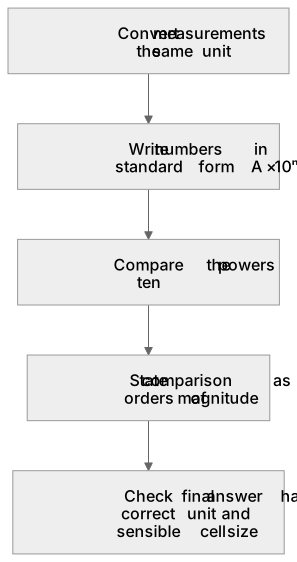
Put it in order
Put these steps in the order they happen.
- 1. Write numbers in standard form A × 10ⁿ
- 2. Compare the powers of ten
- 3. Convert measurements to the same unit
- 4. Check final answer has correct unit and sensible cell size
- 5. State comparison as orders of magnitude
Key words
Say what each word means before you turn the card.
Order of magnitude
Try answering aloud or in your head before turning the card.
Standard form
Try answering aloud or in your head before turning the card.
Unit conversion
Try answering aloud or in your head before turning the card.
Scale and size of cells
Try answering aloud or in your head before turning the card.
See every definition
- Order of magnitude
- A factor of ten, so a cell 100 µm across is two orders of magnitude wider than one 1 µm across.
- Standard form
- A way of writing a number as A × 10ⁿ, where A is at least 1 and less than 10.
- Unit conversion
- Changing a measurement between units such as metres, millimetres, micrometres and nanometres, for example 1 mm = 1000 µm and 1 µm = 1000 nm.
- Scale and size of cells
- Cells vary enormously in size, so biologists compare them using orders of magnitude and standard form.
Label the diagram
Some boxes have lost their names. Pick the right name for each number.
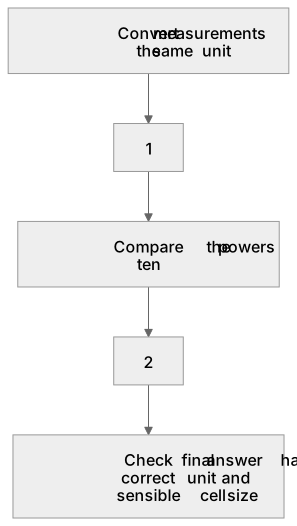
1Box 1
2Box 2
There is more to this lesson
The full lesson goes on to check your understanding and help you earn the marks. Create a free account to carry on, with your progress saved.
A week of Premium from your first lesson · Then the free plan continues · No card, no charge
Test your understanding of Eukaryotes and prokaryotes: Students should be able to demonstrate an understanding of the scale and size of cells and be able to make order of magnitude calculations, including the use of standard form.
Active recall beats re-reading. Take an instant quiz now to test what you’ve learned and lock it into long-term memory.
A week of Premium from your first lesson · Then the free plan continues · No card, no charge