AQA · GCSE · Biology
Course version: 8461 · Version from Sept 2018
Students should be able to describe the evidence for evolution including…
Full specification wording
Evidence for evolution: Students should be able to describe the evidence for evolution including fossils and antibiotic resistance in bacteria.
Evolution is supported by multiple independent lines of evidence.
Checked against the AQA 8461 specification (opens in a new tab) on .
- Point 1 of 4
Study notes
From the checked teaching notes for this specification point.
The idea
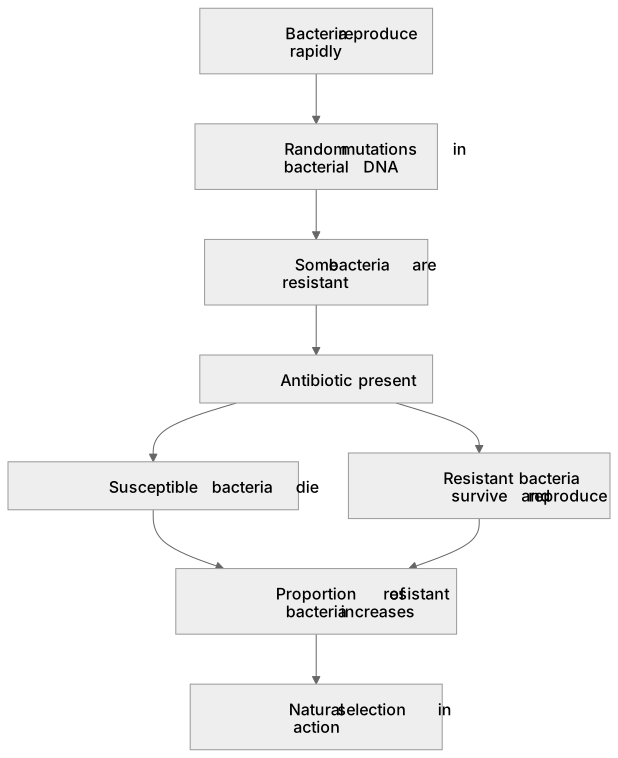
Evolution is supported by multiple independent lines of evidence. Fossils show organisms from the past, often unlike living species, and their positions in rock layers reveal change over time. Antibiotic resistance in bacteria provides observable evidence: when bacteria reproduce rapidly, random mutations can make some individuals resistant. In the presence of an antibiotic, susceptible bacteria die while resistant bacteria survive and reproduce, so the proportion of resistant bacteria increases. This is natural selection in action.
What earns the marks
- Fossils are preserved remains or traces of organisms from the past, often found in sedimentary rock, and can show structures not seen in living species.
- The fossil record shows that organisms have changed over time, with simpler forms generally found in older rocks and more complex or different forms in newer rocks.
- Antibiotic resistance arises from random mutations in bacterial DNA that give some bacteria an advantage when an antibiotic is present.
- When an antibiotic is used, susceptible bacteria are killed while resistant bacteria survive and reproduce, increasing the proportion of resistant bacteria in the population.
Common mistakes and how to put them right
Thinking that bacteria deliberately become resistant in response to an antibiotic.
Put it right: That random mutation occurs first and the antibiotic then selects resistant bacteria.
Believing that individual bacteria change during their lifetime.
Put it right: That the population changes because resistant individuals survive and reproduce.
Assuming fossils only show complete bodies.
Put it right: That fossils include bones, shells, impressions and traces, and often only parts are preserved.
Exam tips
- Use the word ‘selection’ when explaining antibiotic resistance: state that the antibiotic selects resistant bacteria rather than causing resistance.
- When describing fossils, refer to changes over time and give a clear example, such as a fossil showing a feature absent in living relatives.
- Link each piece of evidence back to evolution explicitly, for example by stating that the evidence shows populations changing over many generations.
Try the lesson
The start of the Evidence for evolution: Students should be able to describe the evidence for evolution including fossils and antibiotic resistance in bacteria. lesson, made from checked teaching notes for this specification point.
Have a go first
Which type of evidence comes from the preserved remains of organisms that lived many thousands of years ago?
Listen
Evolution is supported by multiple independent lines of evidence. Fossils show organisms from the past, often unlike living species, and their positions in rock layers reveal change over time. Antibiotic resistance in bacteria provides observable evidence: when bacteria reproduce rapidly, random mutations can make some individuals resistant. In the presence of an antibiotic, susceptible bacteria die while resistant bacteria survive and reproduce, so the proportion of resistant bacteria increases. This is natural selection in action. A strong answer earns marks for these points. Fossils are preserved remains or traces of organisms from the past, often found in sedimentary rock, and can show structures not seen in living species. The fossil record shows that organisms have changed over time, with simpler forms generally found in older rocks and more complex or different forms in newer rocks. Antibiotic resistance arises from random mutations in bacterial DNA that give some bacteria an advantage when an antibiotic is present. When an antibiotic is used, susceptible bacteria are killed while resistant bacteria survive and reproduce, increasing the proportion of resistant bacteria in the population. A common slip: Thinking that bacteria deliberately become resistant in response to an antibiotic. Instead, that random mutation occurs first and the antibiotic then selects resistant bacteria. Exam tip: Use the word ‘selection’ when explaining antibiotic resistance: state that the antibiotic selects resistant bacteria rather than causing resistance.
See it
Label the diagram
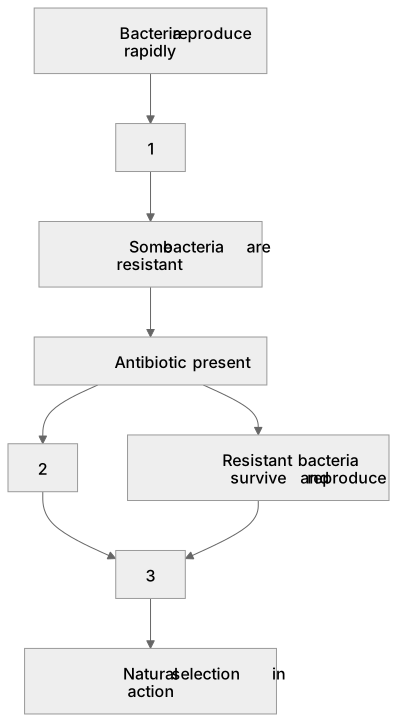
Some boxes have lost their names. Pick the right name for each number.
1Box 1
2Box 2
3Box 3
There is more to this lesson
The full lesson goes on to check your understanding and help you earn the marks. Create a free account to carry on, with your progress saved.
A week of Premium from your first lesson · Then the free plan continues · No card, no charge
Test your understanding of Evidence for evolution: Students should be able to describe the evidence for evolution including fossils and antibiotic resistance in bacteria.
Active recall beats re-reading. Take an instant quiz now to test what you’ve learned and lock it into long-term memory.
A week of Premium from your first lesson · Then the free plan continues · No card, no charge