AQA · GCSE · Biology
Course version: 8461 · Version from Sept 2018
If two populations of one species become so different in phenotype that…
Full specification wording
Evolution: If two populations of one species become so different in phenotype that they can no longer interbreed to produce fertile offspring they have formed two new species.
A species is often defined by the ability to interbreed and produce fertile offspring.
Checked against the AQA 8461 specification (opens in a new tab) on .
- Point 4 of 4
Study notes
From the checked teaching notes for this specification point.
The idea
A species is often defined by the ability to interbreed and produce fertile offspring. If two populations of one species become separated, for example by a river or mountain range, each experiences different selection pressures. Over many generations their phenotypes and alleles diverge. Eventually they become so different that they can no longer interbreed to produce fertile offspring, so they have formed two new species. A useful method is to compare populations: if mating produces no offspring, or infertile offspring such as a mule, they are separate species. Speciation therefore requires isolation, variation, selection and enough time.
What earns the marks
- States that a species can interbreed to produce fertile offspring.
- Explains that two populations become different in phenotype because of different selection pressures or isolation.
- States that when they can no longer interbreed to produce fertile offspring they have formed two new species.
- Recognises that speciation requires many generations and usually some form of separation.
- Uses an example such as a mule being infertile to show that two populations are separate species.
Common mistakes and how to put them right
Thinking any two animals that look different are separate species.
Put it right by using the fertile offspring criterion.
Believing speciation happens in one generation.
Put it right by explaining it requires many generations of divergence.
Confusing infertile offspring with no offspring.
Put it right by stating that infertile offspring do not count as successful interbreeding.
Exam tips
- Define species using the fertile offspring criterion before applying it.
- Mention isolation or separation as the starting point for speciation.
- Use the phrase can no longer interbreed to produce fertile offspring in your answer.
Try the lesson
The start of the Evolution: If two populations of one species become so different in phenotype that they can no longer interbreed to produce fertile offspring they have formed two new species. lesson, made from checked teaching notes for this specification point.
Have a go first
Two populations of a rodent species become isolated from each other. Over many generations, their phenotypes become so different that they can no longer interbreed to produce fertile offspring. What is the biological result of this change?
Listen
A species is often defined by the ability to interbreed and produce fertile offspring. If two populations of one species become separated, for example by a river or mountain range, each experiences different selection pressures. Over many generations their phenotypes and alleles diverge. Eventually they become so different that they can no longer interbreed to produce fertile offspring, so they have formed two new species. A useful method is to compare populations: if mating produces no offspring, or infertile offspring such as a mule, they are separate species. Speciation therefore requires isolation, variation, selection and enough time. A strong answer earns marks for these points. States that a species can interbreed to produce fertile offspring. Explains that two populations become different in phenotype because of different selection pressures or isolation. States that when they can no longer interbreed to produce fertile offspring they have formed two new species. Recognises that speciation requires many generations and usually some form of separation. A common slip: Thinking any two animals that look different are separate species. Instead, using the fertile offspring criterion. Exam tip: Define species using the fertile offspring criterion before applying it.
See it
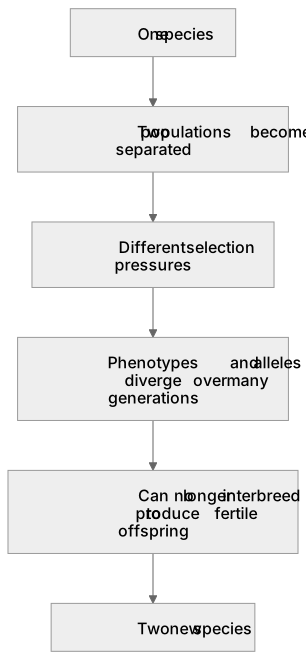
Put it in order
Put these steps in the order they happen.
- 1. Different selection pressures
- 2. Two populations become separated
- 3. One species
- 4. Two new species
- 5. Can no longer interbreed to produce fertile offspring
- 6. Phenotypes and alleles diverge over many generations
Label the diagram
Some boxes have lost their names. Pick the right name for each number.
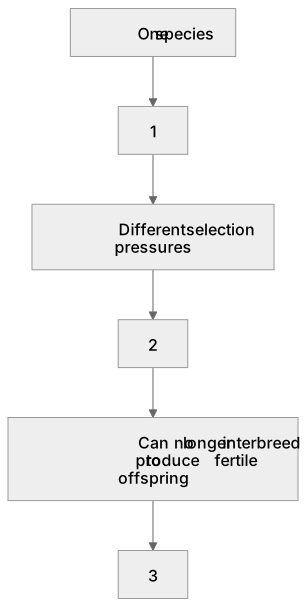
1Box 1
2Box 2
3Box 3
There is more to this lesson
The full lesson goes on to check your understanding and help you earn the marks. Create a free account to carry on, with your progress saved.
A week of Premium from your first lesson · Then the free plan continues · No card, no charge
Test your understanding of Evolution: If two populations of one species become so different in phenotype that they can no longer interbreed to produce fertile offspring they have formed two new species.
Active recall beats re-reading. Take an instant quiz now to test what you’ve learned and lock it into long-term memory.
A week of Premium from your first lesson · Then the free plan continues · No card, no charge