AQA · GCSE · Biology
Course version: 8461 · Version from Sept 2018
New pests and pathogens that affect farming.
Full specification wording
Factors affecting food security: New pests and pathogens that affect farming.
Food security means having reliable access to enough safe, nutritious food.
Checked against the AQA 8461 specification (opens in a new tab) on .
- Point 5 of 9
- 3 key terms
Study notes
From the checked teaching notes for this specification point.
The idea
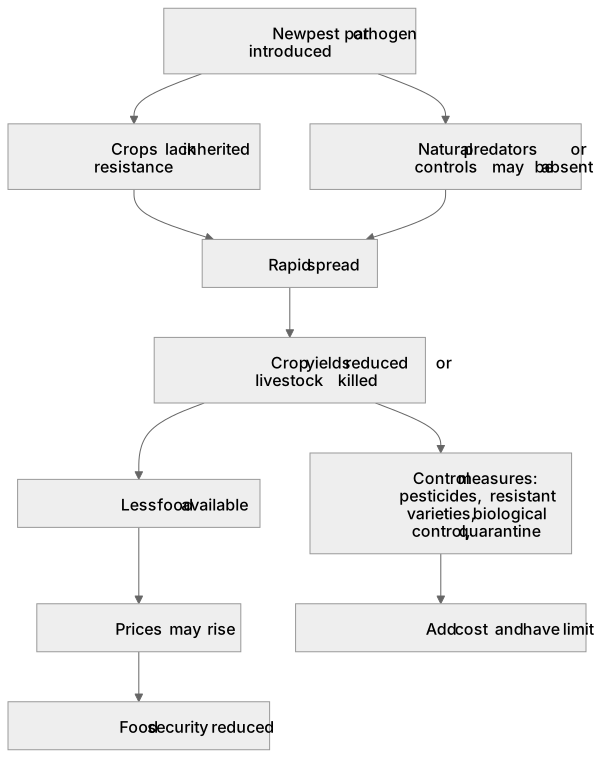
Food security means having reliable access to enough safe, nutritious food. A new pest or pathogen can reduce crop yields or livestock numbers, so less food reaches consumers and prices may rise. Pests include organisms such as locusts, which consume leaves and grains; pathogens include fungi, bacteria and viruses causing diseases like potato blight. When newly introduced, local crops may lack inherited resistance, and natural predators may be absent, allowing rapid spread. Farmers may respond with pesticides, resistant varieties, biological control or quarantine, but these cost money and have limits. This factor links directly to food security because it lowers the amount of food produced and makes it less affordable.
What earns the marks
- State that a pest is an organism that damages crops or livestock, while a pathogen is a microorganism that causes disease.
- Explain that new pests or pathogens can reduce crop yields or kill livestock, lowering the total food available.
- Describe how a newly introduced pest or pathogen may spread quickly because crops lack resistance and natural predators or controls may be absent.
- Give a named example, such as locusts eating cereal crops or potato blight reducing potato yields.
- Explain that control measures such as pesticides, resistant crop varieties, biological control or quarantine can reduce the impact but add cost and may not be fully effective.
- Link the reduced food supply to food security by stating that less food is available or that prices rise, making food harder to obtain.
Common mistakes and how to put them right
Confusing pests with pathogens.
Put it right by defining each term separately.
Assuming all pests and pathogens can be easily controlled with pesticides.
Put it right by mentioning a range of control methods and their limitations.
Writing only that pests eat crops without linking this to food security.
Put it right by adding a sentence that connects reduced yield to less reliable food access.
Exam tips
- Use the phrase food security in your answer and explain what it means in context, rather than leaving it as an unconnected term.
- Include one named pest or pathogen and state the specific crop or livestock it affects, so your example is precise.
- When describing control methods, add a limitation such as cost, resistance or harm to non-target species to show deeper understanding.
Try the lesson
The start of the Factors affecting food security: New pests and pathogens that affect farming. lesson, made from checked teaching notes for this specification point.
Have a go first
A new insect pest arrives in a country and attacks the wheat crop. What is the most likely effect on the amount of wheat that can be harvested?
Listen
Food security means having reliable access to enough safe, nutritious food. A new pest or pathogen can reduce crop yields or livestock numbers, so less food reaches consumers and prices may rise. Pests include organisms such as locusts, which consume leaves and grains; pathogens include fungi, bacteria and viruses causing diseases like potato blight. When newly introduced, local crops may lack inherited resistance, and natural predators may be absent, allowing rapid spread. Farmers may respond with pesticides, resistant varieties, biological control or quarantine, but these cost money and have limits. This factor links directly to food security because it lowers the amount of food produced and makes it less affordable. A strong answer earns marks for these points. State that a pest is an organism that damages crops or livestock, while a pathogen is a microorganism that causes disease. Explain that new pests or pathogens can reduce crop yields or kill livestock, lowering the total food available. Describe how a newly introduced pest or pathogen may spread quickly because crops lack resistance and natural predators or controls may be absent. Give a named example, such as locusts eating cereal crops or potato blight reducing potato yields. A common slip: Confusing pests with pathogens: a pest is an organism that damages crops or livestock, whereas a pathogen is a disease-causing microorganism. Instead, defining each term separately. Exam tip: Use the phrase food security in your answer and explain what it means in context, rather than leaving it as an unconnected term.
See it
Key words
Say what each word means before you turn the card.
Pest
Try answering aloud or in your head before turning the card.
Pathogen
Try answering aloud or in your head before turning the card.
Food security
Try answering aloud or in your head before turning the card.
See every definition
- Pest
- An organism that damages crops or livestock, such as locusts, which consume leaves and grains.
- Pathogen
- A microorganism that causes disease, including fungi, bacteria and viruses causing diseases like potato blight.
- Food security
- Having reliable access to enough safe, nutritious food, which is lowered when less food is produced and food becomes less affordable.
Label the diagram
Some boxes have lost their names. Pick the right name for each number.
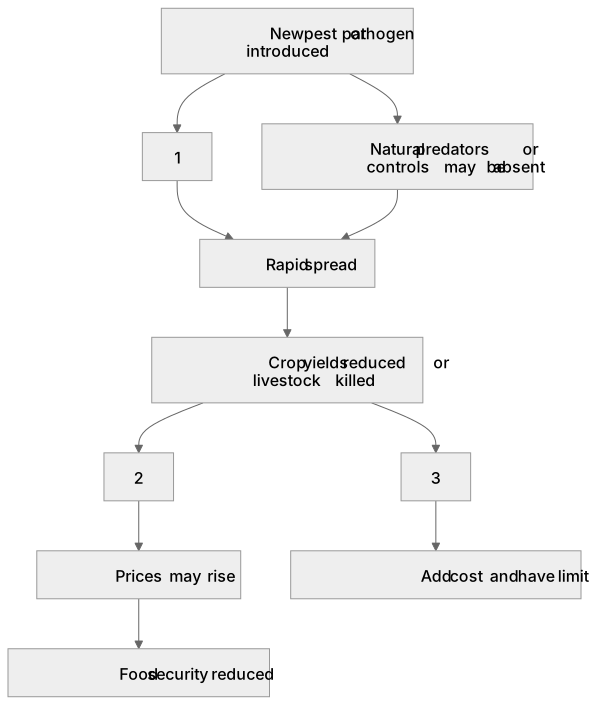
1Box 1
2Box 2
3Box 3
There is more to this lesson
The full lesson goes on to check your understanding and help you earn the marks. Create a free account to carry on, with your progress saved.
A week of Premium from your first lesson · Then the free plan continues · No card, no charge
Test your understanding of Factors affecting food security: New pests and pathogens that affect farming.
Active recall beats re-reading. Take an instant quiz now to test what you’ve learned and lock it into long-term memory.
A week of Premium from your first lesson · Then the free plan continues · No card, no charge