AQA · GCSE · Biology
Course version: 8461 · Version from Sept 2018
The increasing birth rate has threatened food security in some countries.
Full specification wording
Factors affecting food security: The increasing birth rate has threatened food security in some countries.
A rising birth rate increases the number of people who need food.
Checked against the AQA 8461 specification (opens in a new tab) on .
- Point 3 of 9
- 3 key terms
Study notes
From the checked teaching notes for this specification point.
The idea
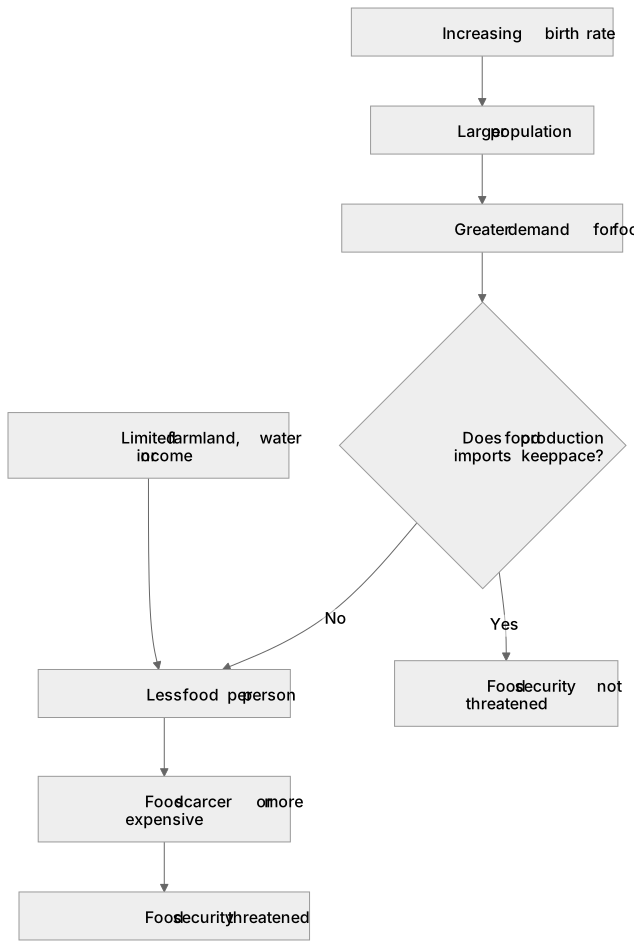
A rising birth rate increases the number of people who need food. If food production or imports do not rise at the same pace, the amount available per person falls and food security is threatened. The pressure is greatest where farmland is limited, harvests are unreliable or incomes are low. A named example could be a country where rapid population growth outstrips local crop production, so more food must be imported or some people go hungry.
What earns the marks
- An increasing birth rate raises the population size.
- A larger population needs more food in total.
- If food production or imports do not increase at the same rate, food per person falls.
- Food may become scarcer or more expensive, threatening food security.
- The effect is greater where farmland, water or income is limited.
Common mistakes and how to put them right
Saying a higher birth rate directly reduces crop growth.
Put it right: It increases demand for food, which threatens security if supply cannot keep up.
Ignoring supply; correction: food security depends on both the number of people and the amount of food available.
Exam tips
- Use the chain: more births, larger population, greater demand, pressure on food supply.
- Include the condition that food supply must fail to keep pace for security to be threatened.
- Refer to a specific context such as limited farmland or low income to show application.
Try the lesson
The start of the Factors affecting food security: The increasing birth rate has threatened food security in some countries. lesson, made from checked teaching notes for this specification point.
Have a go first
Which of the following best explains how an increasing birth rate can threaten food security in a country?
Listen
A rising birth rate increases the number of people who need food. If food production or imports do not rise at the same pace, the amount available per person falls and food security is threatened. The pressure is greatest where farmland is limited, harvests are unreliable or incomes are low. A named example could be a country where rapid population growth outstrips local crop production, so more food must be imported or some people go hungry. A strong answer earns marks for these points. An increasing birth rate raises the population size. A larger population needs more food in total. If food production or imports do not increase at the same rate, food per person falls. Food may become scarcer or more expensive, threatening food security. A common slip: Saying a higher birth rate directly reduces crop growth. Instead, it increases demand for food, which threatens security if supply cannot keep up. Exam tip: Use the chain: more births, larger population, greater demand, pressure on food supply.
See it
Key words
Say what each word means before you turn the card.
Demand for food
Try answering aloud or in your head before turning the card.
Food supply
Try answering aloud or in your head before turning the card.
Population growth
Try answering aloud or in your head before turning the card.
See every definition
- Demand for food
- The need for food in total, which rises as an increasing birth rate raises the population size.
- Food supply
- Food production or imports, which must increase at the same rate as the population for food per person not to fall.
- Population growth
- An increasing birth rate raising the population size, so that a larger population needs more food in total.
Label the diagram
Some boxes have lost their names. Pick the right name for each number.
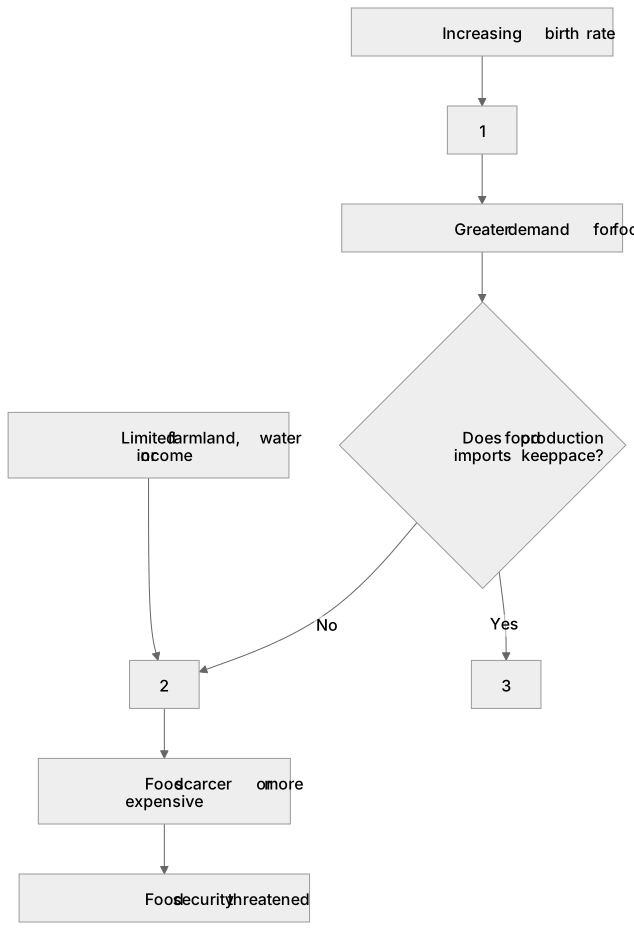
1Box 1
2Box 2
3Box 3
There is more to this lesson
The full lesson goes on to check your understanding and help you earn the marks. Create a free account to carry on, with your progress saved.
A week of Premium from your first lesson · Then the free plan continues · No card, no charge
Test your understanding of Factors affecting food security: The increasing birth rate has threatened food security in some countries.
Active recall beats re-reading. Take an instant quiz now to test what you’ve learned and lock it into long-term memory.
A week of Premium from your first lesson · Then the free plan continues · No card, no charge