AQA · GCSE · Biology
Course version: 8461 · Version from Sept 2018
Plant crops have been genetically engineered to be resistant to diseases…
Full specification wording
Genetic engineering: Plant crops have been genetically engineered to be resistant to diseases or to produce bigger better fruits.
Genetic engineering has been applied to crop plants to give useful agricultural characteristics.
Checked against the AQA 8461 specification (opens in a new tab) on .
- Point 2 of 13
- 4 key terms
Study notes
From the checked teaching notes for this specification point.
The idea
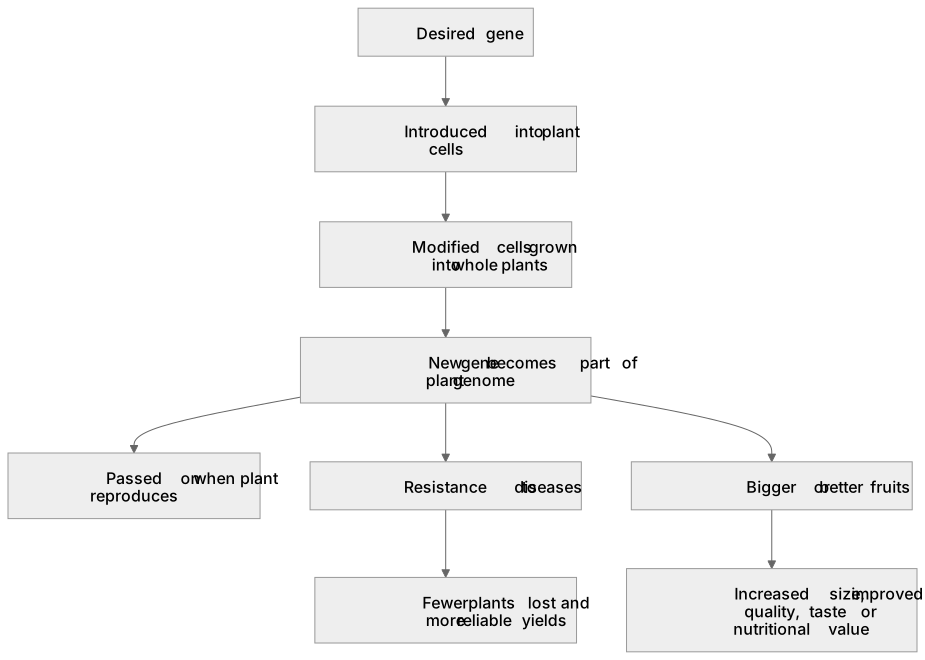
Genetic engineering has been applied to crop plants to give useful agricultural characteristics. One aim is resistance to diseases caused by fungi, bacteria or viruses, so fewer plants are lost and yields are more reliable. Another aim is to produce bigger or better fruits, for example by altering genes that control fruit size, ripening or nutritional content. The desired gene is introduced into plant cells, often using a vector such as a plasmid or a virus, and the modified cells are grown into whole plants. Because the new gene is in the plant's genome, it is passed on when the plant reproduces. Farmers may then grow these crops, although their use raises benefits and risks that are considered separately.
What earns the marks
- Crop plants can be genetically engineered to resist diseases.
- Disease resistance may reduce crop losses and improve yield.
- Crop plants can be genetically engineered to produce bigger or better fruits.
- Bigger or better fruits may mean increased size, improved quality, taste or nutritional value.
- The desired gene is inserted into plant cells and the modified cells are grown into plants.
- The introduced gene becomes part of the plant genome and can be inherited.
Common mistakes and how to put them right
Thinking genetic engineering only changes fruit size.
Put it right: Also considering disease resistance and other quality traits.
Assuming all genetically engineered crops are automatically safe or unsafe.
Put it right by treating benefits and risks as points to evaluate rather than certainties.
Confusing disease resistance with pest resistance.
Put it right by specifying the disease organism, such as a fungus or virus, that the plant resists.
Exam tips
- Name a specific crop example, such as disease-resistant maize or improved fruit, to make your answer concrete.
- Distinguish clearly between resistance to disease and improved fruit characteristics.
- When asked to evaluate, give both an advantage and a concern rather than only one side.
Try the lesson
The start of the Genetic engineering: Plant crops have been genetically engineered to be resistant to diseases or to produce bigger better fruits. lesson, made from checked teaching notes for this specification point.
Have a go first
Which characteristic have plant crops been genetically engineered to have?
Listen
Genetic engineering has been applied to crop plants to give useful agricultural characteristics. One aim is resistance to diseases caused by fungi, bacteria or viruses, so fewer plants are lost and yields are more reliable. Another aim is to produce bigger or better fruits, for example by altering genes that control fruit size, ripening or nutritional content. The desired gene is introduced into plant cells, often using a vector such as a plasmid or a virus, and the modified cells are grown into whole plants. Because the new gene is in the plant's genome, it is passed on when the plant reproduces. Farmers may then grow these crops, although their use raises benefits and risks that are considered separately. A strong answer earns marks for these points. Crop plants can be genetically engineered to resist diseases. Disease resistance may reduce crop losses and improve yield. Crop plants can be genetically engineered to produce bigger or better fruits. Bigger or better fruits may mean increased size, improved quality, taste or nutritional value. A common slip: Thinking genetic engineering only changes fruit size. Instead, also considering disease resistance and other quality traits. Exam tip: Name a specific crop example, such as disease-resistant maize or improved fruit, to make your answer concrete.
See it
Key words
Say what each word means before you turn the card.
Disease resistance
Try answering aloud or in your head before turning the card.
Fruit quality
Try answering aloud or in your head before turning the card.
Gene insertion
Try answering aloud or in your head before turning the card.
Inheritance of the introduced gene
Try answering aloud or in your head before turning the card.
See every definition
- Disease resistance
- Crop plants can be genetically engineered to resist diseases, which may reduce crop losses and improve yield.
- Fruit quality
- Crop plants can be genetically engineered to produce bigger or better fruits, which may mean increased size, improved quality, taste or nutritional value.
- Gene insertion
- The desired gene is inserted into plant cells and the modified cells are grown into plants.
- Inheritance of the introduced gene
- The introduced gene becomes part of the plant genome and can be inherited.
Label the diagram
Some boxes have lost their names. Pick the right name for each number.
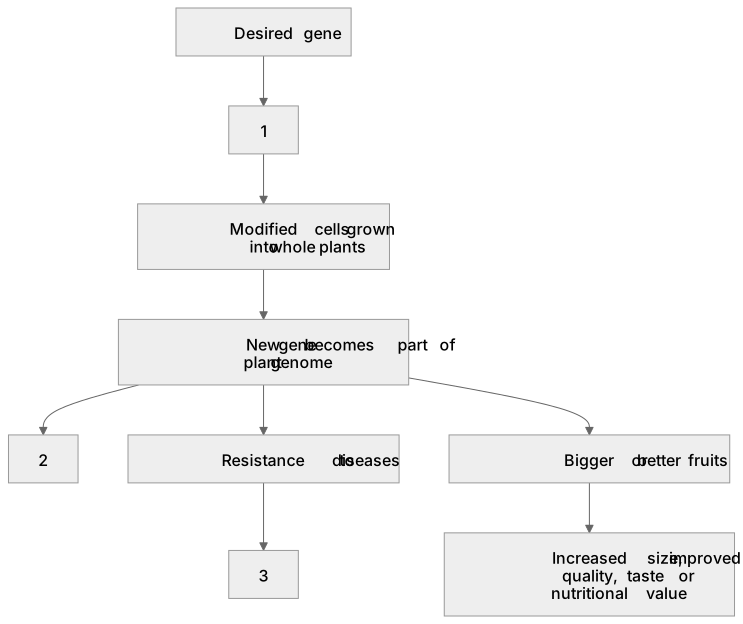
1Box 1
2Box 2
3Box 3
There is more to this lesson
The full lesson goes on to check your understanding and help you earn the marks. Create a free account to carry on, with your progress saved.
A week of Premium from your first lesson · Then the free plan continues · No card, no charge
Test your understanding of Genetic engineering: Plant crops have been genetically engineered to be resistant to diseases or to produce bigger better fruits.
Active recall beats re-reading. Take an instant quiz now to test what you’ve learned and lock it into long-term memory.
A week of Premium from your first lesson · Then the free plan continues · No card, no charge