AQA · GCSE · Biology
Course version: 8461 · Version from Sept 2018
(HT only) Students should be able to construct a genetic cross by Punnett…
Full specification wording
Genetic inheritance: (HT only) Students should be able to construct a genetic cross by Punnett square diagram and use it to make predictions using the theory of probability.
A Punnett square is a grid that shows every possible combination of alleles from two parents.
Checked against the AQA 8461 specification (opens in a new tab) on .
- Point 11 of 11
- 2 key terms
Study notes
From the checked teaching notes for this specification point.
The idea
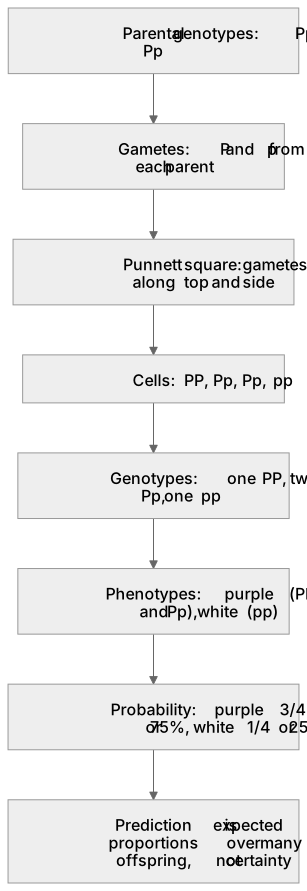
A Punnett square is a grid that shows every possible combination of alleles from two parents. Write the gametes of one parent across the top and the other down the side, then fill each cell by combining the row and column alleles. For example, a cross between two heterozygous purple-flowered plants (Pp × Pp) gives cells PP, Pp, Pp and pp. The theory of probability then predicts the chance of each outcome: one cell in four is PP, so the probability of a purple-flowered offspring is 3/4 or 75%, and of a white-flowered offspring is 1/4 or 25%. Probabilities describe chance, not certainty, so predictions are about expected proportions in large numbers of offspring.
What earns the marks
- Identify the parental genotypes and the alleles carried by each gamete before drawing the grid.
- Draw a correctly sized Punnett square with one parent's gametes along the top and the other parent's gametes down the side.
- Combine the alleles in each cell, writing the dominant allele first by convention, for example Pp rather than pP.
- State the phenotype associated with each genotype, distinguishing homozygous dominant, heterozygous and homozygous recessive.
- Express the predicted outcome as a probability, fraction, decimal or percentage, for example 1/4, 0.25 or 25%.
- Explain that the prediction is a statistical expectation for many offspring, not a guarantee for a single offspring.
Common mistakes and how to put them right
Writing gametes as pairs of alleles instead of single alleles.
Put it right by remembering that gametes carry one allele of each gene.
Filling the grid by copying parental genotypes rather than combining one allele from each parent.
Put it right by taking one allele from the row and one from the column for every cell.
Treating a 3:1 predicted ratio as certain for four offspring.
Put it right by explaining that probability predicts expected proportions over many offspring, not the exact result of a small family.
Exam tips
- Draw the Punnett square clearly with a ruler and label the parental gametes so the examiner can follow your reasoning.
- Always finish by linking the genotype ratio to a phenotype ratio and then to a probability, because the prediction is the point of the cross.
- Use the wording of the question to decide whether the answer should be a ratio, a fraction or a percentage, and give the probability in the requested form.
Try the lesson
The start of the Genetic inheritance: (HT only) Students should be able to construct a genetic cross by Punnett square diagram and use it to make predictions using the theory of probability. lesson, made from checked teaching notes for this specification point.
Have a go first
Two heterozygous purple-flowered pea plants (Pp) are crossed. Using a Punnett square, what is the probability that an offspring will have white flowers?
Listen
A Punnett square is a grid that shows every possible combination of alleles from two parents. Write the gametes of one parent across the top and the other down the side, then fill each cell by combining the row and column alleles. For example, a cross between two heterozygous purple-flowered plants (Pp × Pp) gives cells PP, Pp, Pp and pp. The theory of probability then predicts the chance of each outcome: one cell in four is PP, so the probability of a purple-flowered offspring is 3/4 or 75%, and of a white-flowered offspring is 1/4 or 25%. Probabilities describe chance, not certainty, so predictions are about expected proportions in large numbers of offspring. A strong answer earns marks for these points. Identify the parental genotypes and the alleles carried by each gamete before drawing the grid. Draw a correctly sized Punnett square with one parent's gametes along the top and the other parent's gametes down the side. Combine the alleles in each cell, writing the dominant allele first by convention, for example Pp rather than pP. State the phenotype associated with each genotype, distinguishing homozygous dominant, heterozygous and homozygous recessive. A common slip: Writing gametes as pairs of alleles instead of single alleles. Instead, remembering that gametes carry one allele of each gene. Exam tip: Draw the Punnett square clearly with a ruler and label the parental gametes so the examiner can follow your reasoning.
See it
Put it in order
Put these steps in the order they happen.
- 1. Genotypes: one PP, two Pp, one pp
- 2. Prediction is expected proportions over many offspring, not certainty
- 3. Phenotypes: purple (PP and Pp), white (pp)
- 4. Parental genotypes: Pp × Pp
- 5. Gametes: P and p from each parent
- 6. Probability: purple 3/4 or 75%, white 1/4 or 25%
- 7. Punnett square: gametes along top and side
- 8. Cells: PP, Pp, Pp, pp
Key words
Say what each word means before you turn the card.
Punnett square
Try answering aloud or in your head before turning the card.
Probability
Try answering aloud or in your head before turning the card.
See every definition
- Punnett square
- A grid that shows every possible combination of alleles from two parents, with one parent's gametes across the top and the other's down the side.
- Probability
- The theory that predicts the chance of each outcome, describing chance rather than certainty, so predictions are about expected proportions in large numbers of offspring.
Label the diagram
Some boxes have lost their names. Pick the right name for each number.
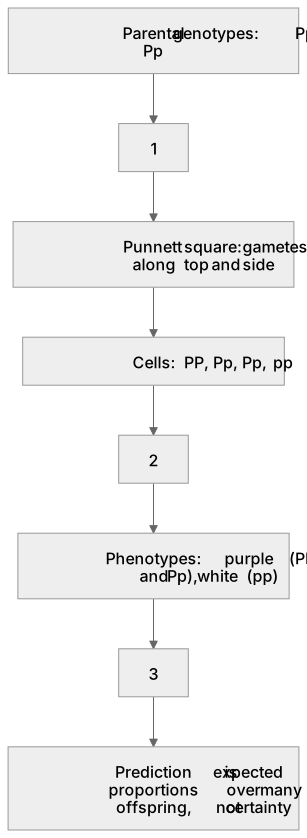
1Box 1
2Box 2
3Box 3
There is more to this lesson
The full lesson goes on to check your understanding and help you earn the marks. Create a free account to carry on, with your progress saved.
A week of Premium from your first lesson · Then the free plan continues · No card, no charge
Test your understanding of Genetic inheritance: (HT only) Students should be able to construct a genetic cross by Punnett square diagram and use it to make predictions using the theory of probability.
Active recall beats re-reading. Take an instant quiz now to test what you’ve learned and lock it into long-term memory.
A week of Premium from your first lesson · Then the free plan continues · No card, no charge