AQA · GCSE · Biology
Course version: 8461 · Version from Sept 2018
Students should be able to understand the concept of probability in…
Full specification wording
Genetic inheritance: Students should be able to understand the concept of probability in predicting the results of a single gene cross, but recall that most phenotype features are the result of multiple genes rather than single gene inheritance.
This statement asks you to use probability to predict the outcomes of a single-gene cross while remembering that most phenotypic features are polygenic.
Checked against the AQA 8461 specification (opens in a new tab) on .
- Point 8 of 11
- 4 key terms
Study notes
From the checked teaching notes for this specification point.
The idea
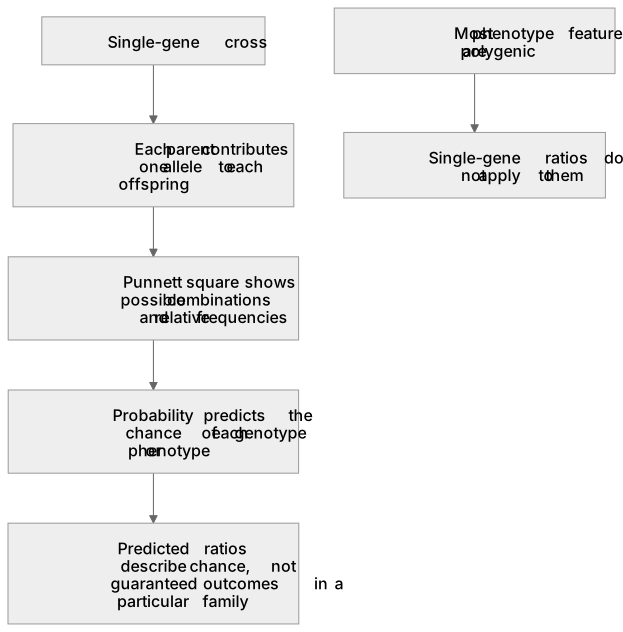
This statement asks you to use probability to predict the outcomes of a single-gene cross while remembering that most phenotypic features are polygenic. In a monohybrid cross, each offspring inherits one allele from each parent, and the Punnett square shows the possible combinations. Probability describes the chance of each outcome, not a guarantee for a particular family. For example, a cross between two heterozygous parents, Aa × Aa, gives a 1 in 4 chance of aa offspring, or 25%, but a family of four children need not contain exactly one aa child. You must also recall that most characteristics, such as height, involve many genes, so simple single-gene ratios do not predict them. Use probability language carefully and distinguish predicted ratios from actual family results.
What earns the marks
- Probability predicts the chance of each genotype or phenotype from a single-gene cross.
- A monohybrid cross involves one gene with two alleles.
- Each parent contributes one allele to each offspring.
- A Punnett square can show the possible combinations and their relative frequencies.
- Predicted ratios describe chance, not guaranteed outcomes in a particular family.
- Most phenotype features are polygenic, so single-gene ratios do not apply to them.
Common mistakes and how to put them right
Treating a 3:1 predicted ratio as a guarantee for every family of four.
Put it right by explaining that probability describes chance, not certainty.
Applying single-gene ratios to polygenic features such as height.
Put it right by recalling that most phenotype features involve multiple genes.
Confusing genotype ratio with phenotype ratio.
Put it right by identifying which genotypes produce each phenotype before stating the ratio.
Exam tips
- Write the parental genotypes clearly before working out the cross.
- Use probability words such as chance, likely or expected rather than will definitely.
- When a question mentions a polygenic feature, state that many genes are involved and simple ratios do not predict it.
Try the lesson
The start of the Genetic inheritance: Students should be able to understand the concept of probability in predicting the results of a single gene cross, but recall that most phenotype features are the result of multiple genes rather than single gene inheritance. lesson, made from checked teaching notes for this specification point.
Have a go first
In a single gene cross, what does a probability of 1/4 for a particular phenotype mean?
Listen
This statement asks you to use probability to predict the outcomes of a single-gene cross while remembering that most phenotypic features are polygenic. In a monohybrid cross, each offspring inherits one allele from each parent, and the Punnett square shows the possible combinations. Probability describes the chance of each outcome, not a guarantee for a particular family. For example, a cross between two heterozygous parents, Aa × Aa, gives a 1 in 4 chance of aa offspring, or 25%, but a family of four children need not contain exactly one aa child. You must also recall that most characteristics, such as height, involve many genes, so simple single-gene ratios do not predict them. Use probability language carefully and distinguish predicted ratios from actual family results. A strong answer earns marks for these points. Probability predicts the chance of each genotype or phenotype from a single-gene cross. A monohybrid cross involves one gene with two alleles. Each parent contributes one allele to each offspring. A Punnett square can show the possible combinations and their relative frequencies. A common slip: Treating a 3:1 predicted ratio as a guarantee for every family of four. Instead, explaining that probability describes chance, not certainty. Exam tip: Write the parental genotypes clearly before working out the cross.
See it
Key words
Say what each word means before you turn the card.
Probability
Try answering aloud or in your head before turning the card.
Monohybrid cross
Try answering aloud or in your head before turning the card.
Polygenic inheritance
Try answering aloud or in your head before turning the card.
Predicted versus actual outcomes
Try answering aloud or in your head before turning the card.
See every definition
- Probability
- Describes the chance of each genotype or phenotype outcome from a single-gene cross, not a guarantee for a particular family.
- Monohybrid cross
- A cross involving one gene with two alleles, in which each parent contributes one allele to each offspring.
- Polygenic inheritance
- Most phenotype features are the result of multiple genes rather than single gene inheritance, so simple single-gene ratios do not predict them.
- Predicted versus actual outcomes
- Predicted ratios describe chance, not guaranteed outcomes in a particular family, so predicted ratios may not match actual family results.
Label the diagram
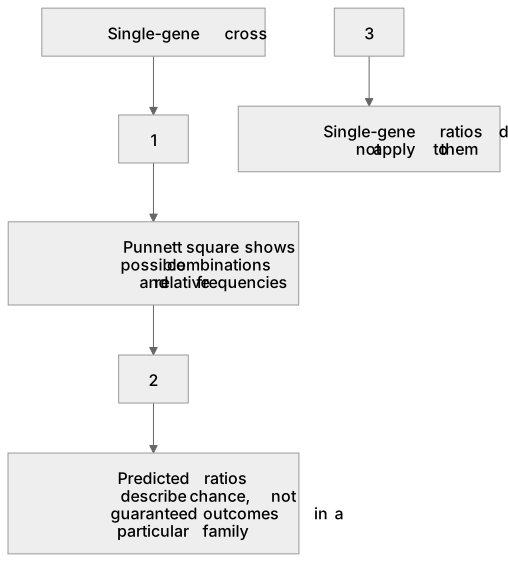
Some boxes have lost their names. Pick the right name for each number.
1Box 1
2Box 2
3Box 3
There is more to this lesson
The full lesson goes on to check your understanding and help you earn the marks. Create a free account to carry on, with your progress saved.
A week of Premium from your first lesson · Then the free plan continues · No card, no charge
Test your understanding of Genetic inheritance: Students should be able to understand the concept of probability in predicting the results of a single gene cross, but recall that most phenotype features are the result of multiple genes rather than single gene inheritance.
Active recall beats re-reading. Take an instant quiz now to test what you’ve learned and lock it into long-term memory.
A week of Premium from your first lesson · Then the free plan continues · No card, no charge