AQA · GCSE · Biology
Course version: 8461 · Version from Sept 2018
Students should be able to describe some of the biological consequences of…
Full specification wording
Global warming: Students should be able to describe some of the biological consequences of global warming.
Global warming is the rise in average global temperature caused by increasing greenhouse gases such as carbon dioxide and methane.
Checked against the AQA 8461 specification (opens in a new tab) on .
- Point 1 of 2
- 4 key terms
Study notes
From the checked teaching notes for this specification point.
The idea
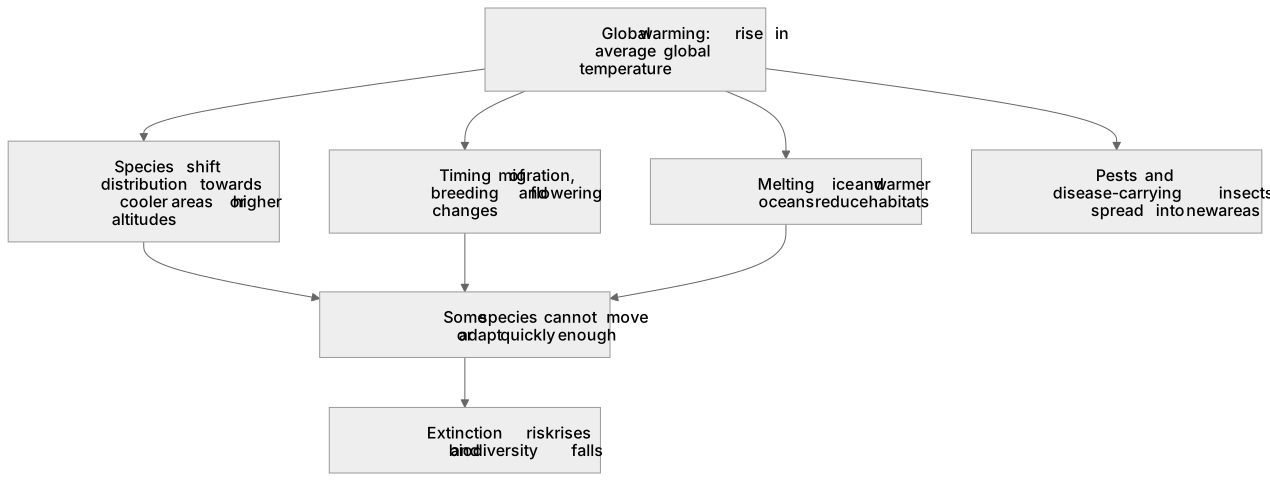
Global warming is the rise in average global temperature caused by increasing greenhouse gases such as carbon dioxide and methane. Its biological consequences include changes to the distribution of species as they move towards cooler areas, loss of habitat for species that cannot move, and changes in the timing of life cycles such as migration, breeding and flowering. Warmer oceans and melting ice reduce habitats for polar species, while some pests and disease-carrying insects may spread into new areas. Biodiversity can fall if species cannot adapt or relocate quickly enough. These effects are described and explained using named examples.
What earns the marks
- Global warming is a rise in average global temperature caused by increasing greenhouse gases.
- Species may shift their distribution towards cooler areas or higher altitudes.
- Some species cannot move or adapt quickly enough and may become extinct, reducing biodiversity.
- Changes in temperature can alter the timing of migration, breeding and flowering.
- Melting ice and warmer oceans reduce habitats for species such as polar bears and corals.
- Pests and disease-carrying insects may spread into new areas as conditions change.
Common mistakes and how to put them right
Confusing global warming with the ozone hole.
Put it right: Global warming is caused by greenhouse gases trapping heat, while ozone depletion is a separate issue.
Saying all species will simply move and survive.
Put it right: Some cannot move or adapt quickly enough and may become extinct.
Describing only temperature rise without a biological consequence.
Put it right: Link the temperature change to effects on species, habitats or life cycles.
Exam tips
- Name a specific species or habitat when describing a consequence to make the answer precise.
- Use words such as distribution, migration and biodiversity to show biological understanding.
- If asked to describe, give several distinct consequences rather than repeating one idea.
Try the lesson
The start of the Global warming: Students should be able to describe some of the biological consequences of global warming. lesson, made from checked teaching notes for this specification point.
Have a go first
Which of the following is a biological consequence of global warming?
Listen
Global warming is the rise in average global temperature caused by increasing greenhouse gases such as carbon dioxide and methane. Its biological consequences include changes to the distribution of species as they move towards cooler areas, loss of habitat for species that cannot move, and changes in the timing of life cycles such as migration, breeding and flowering. Warmer oceans and melting ice reduce habitats for polar species, while some pests and disease-carrying insects may spread into new areas. Biodiversity can fall if species cannot adapt or relocate quickly enough. These effects are described and explained using named examples. A strong answer earns marks for these points. Global warming is a rise in average global temperature caused by increasing greenhouse gases. Species may shift their distribution towards cooler areas or higher altitudes. Some species cannot move or adapt quickly enough and may become extinct, reducing biodiversity. Changes in temperature can alter the timing of migration, breeding and flowering. A common slip: Confusing global warming with the ozone hole. Instead, global warming is caused by greenhouse gases trapping heat, while ozone depletion is a separate issue. Exam tip: Name a specific species or habitat when describing a consequence to make the answer precise.
See it
Key words
Say what each word means before you turn the card.
Species distribution
Try answering aloud or in your head before turning the card.
Biodiversity loss
Try answering aloud or in your head before turning the card.
Adaptation and extinction
Try answering aloud or in your head before turning the card.
Global warming
Try answering aloud or in your head before turning the card.
See every definition
- Species distribution
- Species may shift their distribution towards cooler areas or higher altitudes.
- Biodiversity loss
- Biodiversity can fall if species cannot adapt or relocate quickly enough, and some may become extinct.
- Adaptation and extinction
- Some species cannot move or adapt quickly enough and may become extinct, reducing biodiversity.
- Global warming
- A rise in average global temperature caused by increasing greenhouse gases.
Label the diagram
Some boxes have lost their names. Pick the right name for each number.
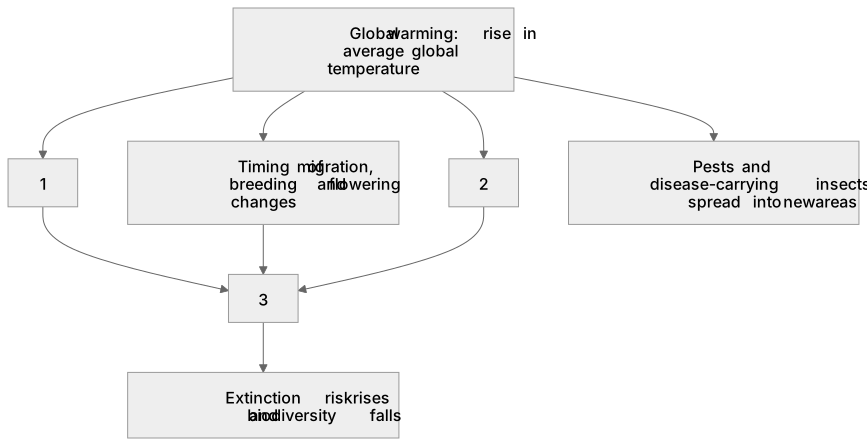
1Box 1
2Box 2
3Box 3
There is more to this lesson
The full lesson goes on to check your understanding and help you earn the marks. Create a free account to carry on, with your progress saved.
A week of Premium from your first lesson · Then the free plan continues · No card, no charge
Test your understanding of Global warming: Students should be able to describe some of the biological consequences of global warming.
Active recall beats re-reading. Take an instant quiz now to test what you’ve learned and lock it into long-term memory.
A week of Premium from your first lesson · Then the free plan continues · No card, no charge