AQA · GCSE · Biology
Course version: 8461 · Version from Sept 2018
All control systems include: • cells called receptors, which detect…
Full specification wording
Homeostasis: All control systems include: • cells called receptors, which detect stimuli (changes in the environment) • coordination centres (such as the brain, spinal cord and pancreas) that receive and process information from receptors • effectors, muscles or glands, which bring about responses which restore optimum levels.
Homeostasis keeps internal conditions within narrow limits despite external change.
Checked against the AQA 8461 specification (opens in a new tab) on .
- Point 5 of 5
- 4 key terms
Study notes
From the checked teaching notes for this specification point.
The idea
Homeostasis keeps internal conditions within narrow limits despite external change. Every control system has three linked parts. Receptors are cells that detect stimuli, which are changes in the environment; examples include temperature receptors in skin and chemoreceptors in the pancreas detecting blood glucose. Coordination centres receive and process information from receptors; the brain, spinal cord and pancreas are named examples. Effectors are muscles or glands that bring about responses restoring optimum levels. Muscles contract; glands secrete substances such as hormones. For instance, a rise in blood glucose is detected by pancreatic receptors, processed by the pancreas, and effectors respond: insulin-secreting cells release insulin, and liver and muscle cells store glucose, lowering it. Negative feedback reverses the change, so optimum levels are restored.
What earns the marks
- Receptors are cells that detect stimuli, which are changes in the environment.
- Coordination centres receive information from receptors and process it; named examples are the brain, spinal cord and pancreas.
- Effectors are muscles or glands; muscles contract and glands secrete substances such as hormones.
- Responses brought about by effectors restore optimum levels, typically by negative feedback.
- A complete account links a named stimulus, receptor, coordination centre, effector and response in one example.
Common mistakes and how to put them right
Saying receptors detect 'the stimulus' without defining a stimulus as a change in the environment.
Put it right by stating that a stimulus is any detectable change, such as a temperature change or a rise in blood glucose.
Treating the brain as the only coordination centre.
Put it right by including the spinal cord and pancreas as coordination centres that process information.
Describing effectors as receptors or as 'things that detect change'.
Put it right by stating that effectors are muscles or glands that bring about responses.
Exam tips
- Use the three-part framework (receptor, coordination centre, effector) to structure any control-system answer.
- Name a specific example, such as skin temperature receptors, the pancreas and insulin-secreting cells, rather than staying abstract.
- Link each response to restoring an optimum level, using the phrase 'negative feedback' where the change is reversed.
Try the lesson
The start of the Homeostasis: All control systems include: • cells called receptors, which detect stimuli (changes in the environment) • coordination centres (such as the brain, spinal cord and pancreas) that receive and process information from receptors • effectors, muscles or glands, which bring about responses which restore optimum levels. lesson, made from checked teaching notes for this specification point.
Have a go first
In a control system, which type of cell detects a change in the environment?
Listen
Homeostasis keeps internal conditions within narrow limits despite external change. Every control system has three linked parts. Receptors are cells that detect stimuli, which are changes in the environment; examples include temperature receptors in skin and chemoreceptors in the pancreas detecting blood glucose. Coordination centres receive and process information from receptors; the brain, spinal cord and pancreas are named examples. Effectors are muscles or glands that bring about responses restoring optimum levels. Muscles contract; glands secrete substances such as hormones. For instance, a rise in blood glucose is detected by pancreatic receptors, processed by the pancreas, and effectors respond: insulin-secreting cells release insulin, and liver and muscle cells store glucose, lowering it. Negative feedback reverses the change, so optimum levels are restored. A strong answer earns marks for these points. Receptors are cells that detect stimuli, which are changes in the environment. Coordination centres receive information from receptors and process it; named examples are the brain, spinal cord and pancreas. Effectors are muscles or glands; muscles contract and glands secrete substances such as hormones. Responses brought about by effectors restore optimum levels, typically by negative feedback. A common slip: Saying receptors detect 'the stimulus' without defining a stimulus as a change in the environment. Instead, stating that a stimulus is any detectable change, such as a temperature change or a rise in blood glucose. Exam tip: Use the three-part framework (receptor, coordination centre, effector) to structure any control-system answer.
See it
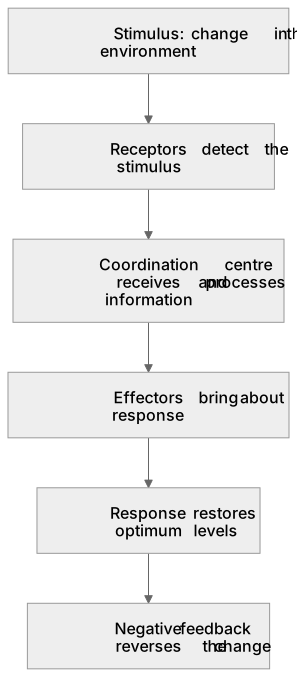
Put it in order
Put these steps in the order they happen.
- 1. Coordination centre receives and processes information
- 2. Receptors detect the stimulus
- 3. Stimulus: change in the environment
- 4. Negative feedback reverses the change
- 5. Response restores optimum levels
- 6. Effectors bring about a response
Key words
Say what each word means before you turn the card.
Receptors
Try answering aloud or in your head before turning the card.
Coordination centres
Try answering aloud or in your head before turning the card.
Effectors
Try answering aloud or in your head before turning the card.
Negative feedback
Try answering aloud or in your head before turning the card.
See every definition
- Receptors
- Cells which detect stimuli, which are changes in the environment.
- Coordination centres
- Structures such as the brain, spinal cord and pancreas that receive and process information from receptors.
- Effectors
- Muscles or glands which bring about responses which restore optimum levels.
- Negative feedback
- A process which reverses the change, so optimum levels are restored.
Label the diagram
Some boxes have lost their names. Pick the right name for each number.
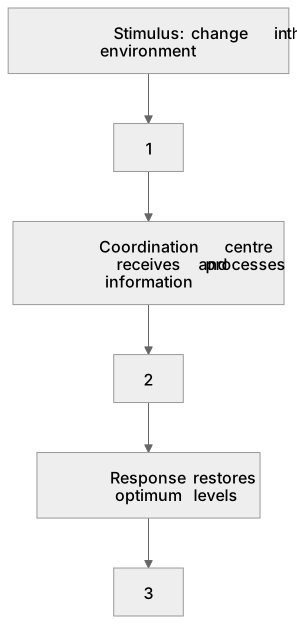
1Box 1
2Box 2
3Box 3
There is more to this lesson
The full lesson goes on to check your understanding and help you earn the marks. Create a free account to carry on, with your progress saved.
A week of Premium from your first lesson · Then the free plan continues · No card, no charge
Test your understanding of Homeostasis: All control systems include: • cells called receptors, which detect stimuli (changes in the environment) • coordination centres (such as the brain, spinal cord and pancreas) that receive and process information from receptors • effectors, muscles or glands, which bring about responses which restore optimum levels.
Active recall beats re-reading. Take an instant quiz now to test what you’ve learned and lock it into long-term memory.
A week of Premium from your first lesson · Then the free plan continues · No card, no charge