AQA · GCSE · Biology
Course version: 8461 · Version from Sept 2018
Students should be able to explain that homeostasis is the regulation of…
Full specification wording
Homeostasis: Students should be able to explain that homeostasis is the regulation of the internal conditions of a cell or organism to maintain optimum conditions for function in response to internal and external changes.
Homeostasis keeps the internal environment within narrow limits so cells work properly.
Checked against the AQA 8461 specification (opens in a new tab) on .
- Point 1 of 5
- 4 key terms
Study notes
From the checked teaching notes for this specification point.
The idea
Homeostasis keeps the internal environment within narrow limits so cells work properly. It is regulation, not a fixed state: receptors detect a change, a coordination centre processes the information, and effectors respond to restore the optimum. The change may come from inside the body, such as a rise in blood glucose after a meal, or from outside, such as cold air lowering body temperature. The response is usually a negative feedback loop: the correction cancels the original change.
For example: If body temperature falls, receptors in the skin and hypothalamus detect it, the coordination centre triggers effectors, and shivering and reduced sweating raise the temperature back towards 37 °C.
What earns the marks
- Homeostasis is the regulation of internal conditions of a cell or organism.
- The purpose is to maintain optimum conditions so that enzymes and cells can function effectively.
- Responses occur in response to both internal changes, such as blood glucose concentration, and external changes, such as temperature.
- Control involves receptors detecting a stimulus, a coordination centre processing it, and effectors producing a response.
- Negative feedback restores conditions towards the optimum by reversing the original change.
Common mistakes and how to put them right
Saying homeostasis keeps conditions constant.
Put it right by saying it keeps conditions within narrow limits around an optimum.
Omitting the receptor, coordination centre or effector when describing a response.
Put it right by naming all three in sequence.
Confusing the stimulus with the response.
Put it right by stating the change first and the corrective action second.
Exam tips
- Use the sequence stimulus, receptor, coordination centre, effector, response when explaining any homeostatic example.
- State that the response is a correction that reverses the change, which shows understanding of negative feedback.
- Give one internal and one external example to cover both parts of the statement.
Try the lesson
The start of the Homeostasis: Students should be able to explain that homeostasis is the regulation of the internal conditions of a cell or organism to maintain optimum conditions for function in response to internal and external changes. lesson, made from checked teaching notes for this specification point.
Have a go first
What name is given to the regulation of the internal conditions of the body to keep them at optimum levels?
Listen
Homeostasis keeps the internal environment within narrow limits so cells work properly. It is regulation, not a fixed state: receptors detect a change, a coordination centre processes the information, and effectors respond to restore the optimum. The change may come from inside the body, such as a rise in blood glucose after a meal, or from outside, such as cold air lowering body temperature. The response is usually a negative feedback loop: the correction cancels the original change. For example, if body temperature falls, receptors in the skin and hypothalamus detect it, the coordination centre triggers effectors, and shivering and reduced sweating raise the temperature back towards 37 °C. A strong answer earns marks for these points. Homeostasis is the regulation of internal conditions of a cell or organism. The purpose is to maintain optimum conditions so that enzymes and cells can function effectively. Responses occur in response to both internal changes, such as blood glucose concentration, and external changes, such as temperature. Control involves receptors detecting a stimulus, a coordination centre processing it, and effectors producing a response. A common slip: Saying homeostasis keeps conditions constant. Instead, saying it keeps conditions within narrow limits around an optimum. Exam tip: Use the sequence stimulus, receptor, coordination centre, effector, response when explaining any homeostatic example.
See it
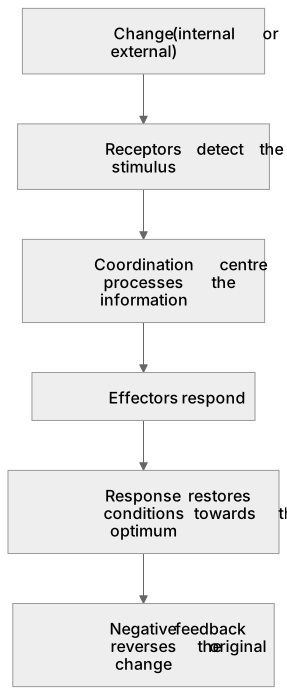
Put it in order
Put these steps in the order they happen.
- 1. Coordination centre processes the information
- 2. Receptors detect the stimulus
- 3. Change (internal or external)
- 4. Negative feedback reverses the original change
- 5. Response restores conditions towards the optimum
- 6. Effectors respond
Key words
Say what each word means before you turn the card.
Regulation of internal conditions
Try answering aloud or in your head before turning the card.
Optimum conditions for cell function
Try answering aloud or in your head before turning the card.
Internal and external stimuli
Try answering aloud or in your head before turning the card.
Negative feedback control systems
Try answering aloud or in your head before turning the card.
See every definition
- Regulation of internal conditions
- The regulation of the internal conditions of a cell or organism to maintain optimum conditions for function in response to internal and external changes.
- Optimum conditions for cell function
- The conditions that must be maintained so that enzymes and cells can function effectively.
- Internal and external stimuli
- Changes that may come from inside the body, such as a rise in blood glucose after a meal, or from outside, such as cold air lowering body temperature.
- Negative feedback control systems
- A loop in which the correction cancels the original change, restoring conditions towards the optimum by reversing the original change.
Label the diagram
Some boxes have lost their names. Pick the right name for each number.
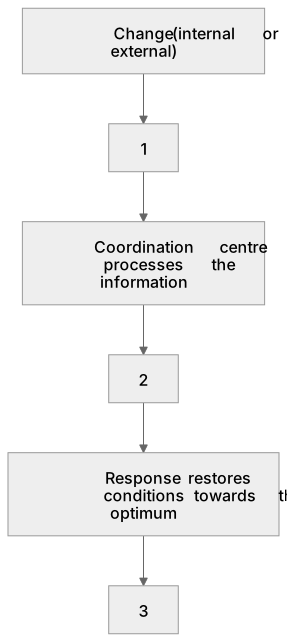
1Box 1
2Box 2
3Box 3
There is more to this lesson
The full lesson goes on to check your understanding and help you earn the marks. Create a free account to carry on, with your progress saved.
A week of Premium from your first lesson · Then the free plan continues · No card, no charge
Test your understanding of Homeostasis: Students should be able to explain that homeostasis is the regulation of the internal conditions of a cell or organism to maintain optimum conditions for function in response to internal and external changes.
Active recall beats re-reading. Take an instant quiz now to test what you’ve learned and lock it into long-term memory.
A week of Premium from your first lesson · Then the free plan continues · No card, no charge