AQA · GCSE · Biology
Course version: 8461 · Version from Sept 2018
Students should be able to describe the roles of hormones in human…
Full specification wording
Hormones in human reproduction: Students should be able to describe the roles of hormones in human reproduction, including the menstrual cycle.
Reproduction in humans is controlled by hormones.
Checked against the AQA 8461 specification (opens in a new tab) on .
- Point 1 of 10
- 4 key terms
Study notes
From the checked teaching notes for this specification point.
The idea
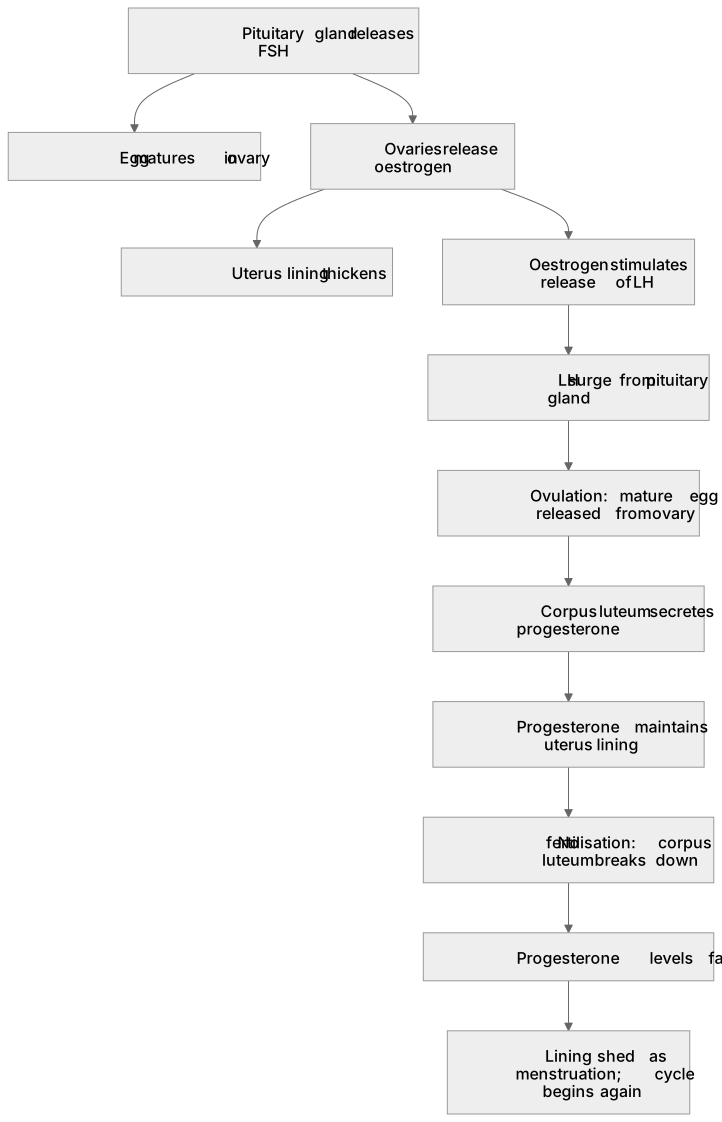
Reproduction in humans is controlled by hormones. FSH, released by the pituitary gland, causes an egg to mature in an ovary and stimulates the ovaries to release oestrogen. Oestrogen, produced by the ovaries, causes the lining of the uterus to thicken and stimulates the release of LH. A surge of LH from the pituitary gland triggers ovulation, the release of a mature egg from the ovary. After ovulation, the remains of the follicle form the corpus luteum, which secretes progesterone. Progesterone maintains the lining of the uterus, ready for a fertilised egg to implant. If fertilisation does not occur, the corpus luteum breaks down, progesterone levels fall, and the lining is shed as menstruation. The cycle then begins again.
What earns the marks
- FSH is released by the pituitary gland and causes an egg to mature in the ovary.
- Oestrogen is produced by the ovaries and causes the lining of the uterus to thicken.
- LH is released by the pituitary gland and triggers ovulation.
- Progesterone is produced by the corpus luteum and maintains the lining of the uterus.
- If fertilisation does not occur, progesterone levels fall and the lining of the uterus is shed during menstruation.
- The hormones interact through feedback, so changes in one hormone affect the release of others.
Common mistakes and how to put them right
Confusing FSH and LH.
Put it right: FSH matures the egg, while LH triggers ovulation.
Saying that oestrogen maintains the uterus lining.
Put it right: Progesterone maintains it, while oestrogen thickens it.
Thinking that progesterone is always high.
Put it right: It falls when the corpus luteum breaks down, causing menstruation.
Exam tips
- Name the gland or organ that releases each hormone when describing its role.
- Sequence the events of the menstrual cycle in order, linking each hormone to its effect.
- Use the terms ovulation, corpus luteum and menstruation accurately in written answers.
Try the lesson
The start of the Hormones in human reproduction: Students should be able to describe the roles of hormones in human reproduction, including the menstrual cycle. lesson, made from checked teaching notes for this specification point.
Have a go first
Which hormone causes the lining of the uterus to thicken during the first half of the menstrual cycle?
Listen
Reproduction in humans is controlled by hormones. FSH, released by the pituitary gland, causes an egg to mature in an ovary and stimulates the ovaries to release oestrogen. Oestrogen, produced by the ovaries, causes the lining of the uterus to thicken and stimulates the release of LH. A surge of LH from the pituitary gland triggers ovulation, the release of a mature egg from the ovary. After ovulation, the remains of the follicle form the corpus luteum, which secretes progesterone. Progesterone maintains the lining of the uterus, ready for a fertilised egg to implant. If fertilisation does not occur, the corpus luteum breaks down, progesterone levels fall, and the lining is shed as menstruation. The cycle then begins again. A strong answer earns marks for these points. FSH is released by the pituitary gland and causes an egg to mature in the ovary. Oestrogen is produced by the ovaries and causes the lining of the uterus to thicken. LH is released by the pituitary gland and triggers ovulation. Progesterone is produced by the corpus luteum and maintains the lining of the uterus. Exam tip: Name the gland or organ that releases each hormone when describing its role.
See it
Key words
Say what each word means before you turn the card.
Hormonal coordination
Try answering aloud or in your head before turning the card.
The menstrual cycle
Try answering aloud or in your head before turning the card.
Feedback control
Try answering aloud or in your head before turning the card.
Reproduction
Try answering aloud or in your head before turning the card.
See every definition
- Hormonal coordination
- In humans, the processes of reproduction are controlled by hormones, and changes in one hormone affect the release of others through feedback.
- The menstrual cycle
- A cycle in which FSH causes an egg to mature, oestrogen thickens the uterus lining, LH triggers ovulation, and progesterone maintains the lining until it is shed as menstruation.
- Feedback control
- The hormones interact through feedback, so changes in one hormone affect the release of others.
- Reproduction
- In humans, this is controlled by hormones, including FSH, oestrogen, LH and progesterone, which act in sequence during the menstrual cycle.
Label the diagram
Some boxes have lost their names. Pick the right name for each number.
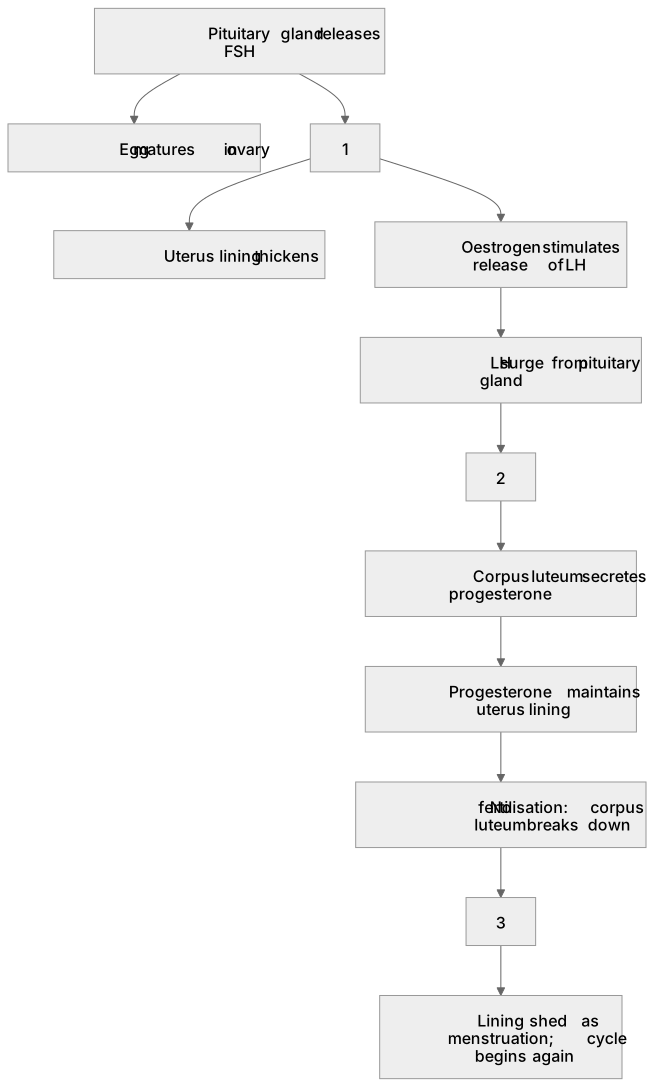
1Box 1
2Box 2
3Box 3
There is more to this lesson
The full lesson goes on to check your understanding and help you earn the marks. Create a free account to carry on, with your progress saved.
A week of Premium from your first lesson · Then the free plan continues · No card, no charge
Test your understanding of Hormones in human reproduction: Students should be able to describe the roles of hormones in human reproduction, including the menstrual cycle.
Active recall beats re-reading. Take an instant quiz now to test what you’ve learned and lock it into long-term memory.
A week of Premium from your first lesson · Then the free plan continues · No card, no charge