AQA · GCSE · Biology
Course version: 8461 · Version from Sept 2018
Hormones in human reproduction: This is called ovulation.
Ovulation is the release of a mature egg from a follicle in the ovary.
Checked against the AQA 8461 specification (opens in a new tab) on .
- Point 5 of 10
- 4 key terms
Study notes
From the checked teaching notes for this specification point.
The idea
Ovulation is the release of a mature egg from a follicle in the ovary. It is the event referred to by the previous statement about an egg being released approximately every 28 days. Ovulation occurs around the middle of the menstrual cycle and is triggered by a surge in luteinising hormone from the pituitary gland. Before ovulation, follicle stimulating hormone stimulates a follicle to mature and oestrogen rises; the oestrogen peak helps cause the luteinising hormone surge. After the follicle ruptures, the egg is swept into the oviduct, where fertilisation may occur if sperm are present. The remains of the follicle become the corpus luteum, which secretes progesterone. Ovulation is therefore a key link between hormonal control and the possibility of fertilisation.
What earns the marks
- Defines ovulation as the release of a mature egg from the ovary.
- Identifies the follicle as the structure from which the egg is released.
- States that ovulation occurs approximately midway through the menstrual cycle.
- Names luteinising hormone as the hormone that triggers ovulation.
- Describes the sequence in which follicle stimulating hormone matures the follicle and oestrogen helps trigger the luteinising hormone surge.
- Links ovulation to the formation of the corpus luteum and the later secretion of progesterone.
Common mistakes and how to put them right
Defining ovulation as fertilisation.
Put it right by stating that ovulation is the release of an egg, while fertilisation is the fusion of gametes.
Saying the egg is released from the uterus.
Put it right by naming the ovary as the release site.
Claiming ovulation is caused directly by follicle stimulating hormone alone.
Put it right by stating that a luteinising hormone surge triggers release, while follicle stimulating hormone stimulates follicle maturation.
Exam tips
- Use the exact term ovulation when asked to name the release of an egg, as this is the specification term.
- If asked to sequence events, place ovulation after follicle maturation and the oestrogen rise, and before corpus luteum formation.
- Mention luteinising hormone when explaining the trigger, because naming the hormone shows cause rather than mere description.
Try the lesson
The start of the Hormones in human reproduction: This is called ovulation. lesson, made from checked teaching notes for this specification point.
Have a go first
During the menstrual cycle, a mature egg is released from a follicle in the ovary. What is the scientific term for this process?
Listen
Ovulation is the release of a mature egg from a follicle in the ovary. It is the event referred to by the previous statement about an egg being released approximately every 28 days. Ovulation occurs around the middle of the menstrual cycle and is triggered by a surge in luteinising hormone from the pituitary gland. Before ovulation, follicle stimulating hormone stimulates a follicle to mature and oestrogen rises; the oestrogen peak helps cause the luteinising hormone surge. After the follicle ruptures, the egg is swept into the oviduct, where fertilisation may occur if sperm are present. The remains of the follicle become the corpus luteum, which secretes progesterone. Ovulation is therefore a key link between hormonal control and the possibility of fertilisation. A strong answer earns marks for these points. Defines ovulation as the release of a mature egg from the ovary. Identifies the follicle as the structure from which the egg is released. States that ovulation occurs approximately midway through the menstrual cycle. Names luteinising hormone as the hormone that triggers ovulation. A common slip: Defining ovulation as fertilisation. Instead, stating that ovulation is the release of an egg, while fertilisation is the fusion of gametes. Exam tip: Use the exact term ovulation when asked to name the release of an egg, as this is the specification term.
See it
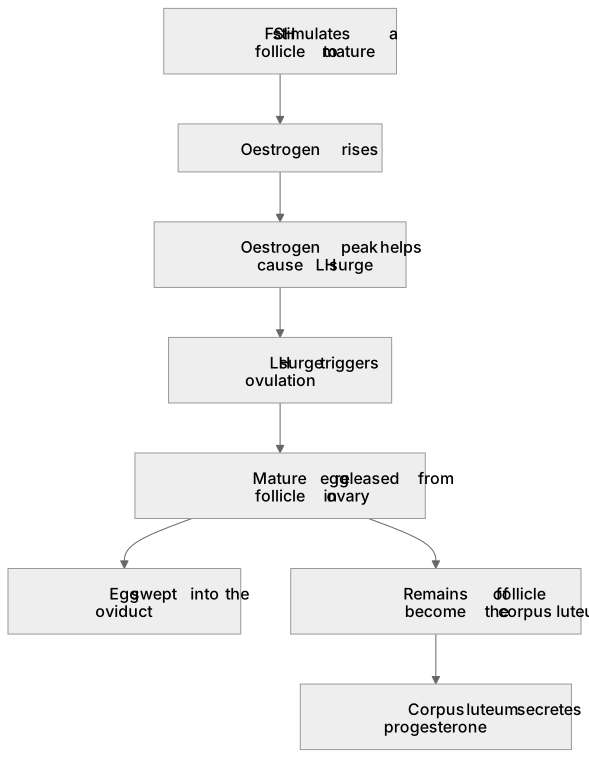
Key words
Say what each word means before you turn the card.
Ovulation
Try answering aloud or in your head before turning the card.
Luteinising hormone
Try answering aloud or in your head before turning the card.
Follicle stimulating hormone
Try answering aloud or in your head before turning the card.
Corpus luteum
Try answering aloud or in your head before turning the card.
See every definition
- Ovulation
- The release of a mature egg from a follicle in the ovary, occurring around the middle of the menstrual cycle.
- Luteinising hormone
- The hormone from the pituitary gland whose surge triggers ovulation.
- Follicle stimulating hormone
- The hormone that stimulates a follicle to mature before ovulation.
- Corpus luteum
- The remains of the follicle, which secretes progesterone.
Label the diagram
Some boxes have lost their names. Pick the right name for each number.
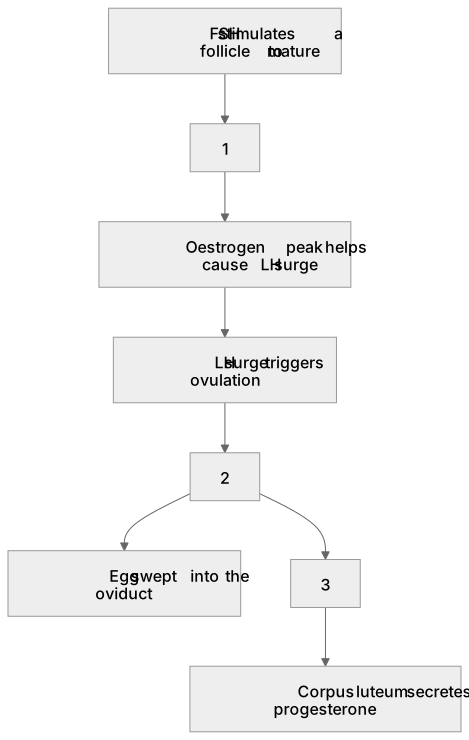
1Box 1
2Box 2
3Box 3
There is more to this lesson
The full lesson goes on to check your understanding and help you earn the marks. Create a free account to carry on, with your progress saved.
A week of Premium from your first lesson · Then the free plan continues · No card, no charge
Test your understanding of Hormones in human reproduction: This is called ovulation.
Active recall beats re-reading. Take an instant quiz now to test what you’ve learned and lock it into long-term memory.
A week of Premium from your first lesson · Then the free plan continues · No card, no charge