AQA · GCSE · Biology
Course version: 8461 · Version from Sept 2018
Students should be able to describe the function of kidneys in maintaining…
Full specification wording
Maintaining water and nitrogen balance in the body (biology only): Students should be able to describe the function of kidneys in maintaining the water balance of the body.
The kidneys maintain water balance by adjusting how much water is reabsorbed from the filtrate back into the blood, so that the volume and concentration of body fluids stay within a safe range.
Checked against the AQA 8461 specification (opens in a new tab) on .
- Point 10 of 17
- 2 key terms
Study notes
From the checked teaching notes for this specification point.
The idea
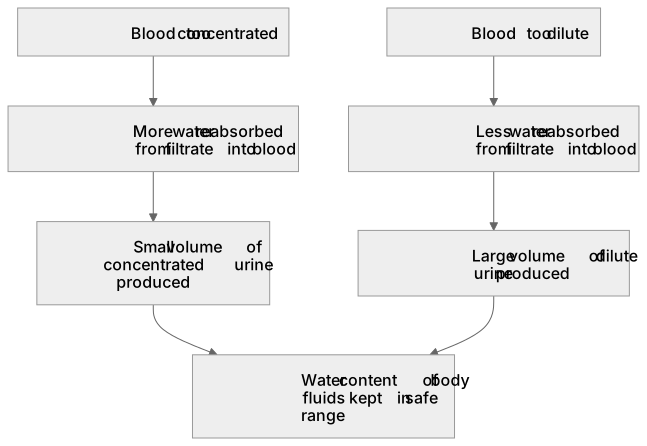
The kidneys maintain water balance by adjusting how much water is reabsorbed from the filtrate back into the blood, so that the volume and concentration of body fluids stay within a safe range. If the blood is too concentrated, more water is reabsorbed and a small volume of concentrated urine is produced. If the blood is too dilute, less water is reabsorbed and a large volume of dilute urine is produced. For example, after drinking little water on a hot day, the kidneys conserve water and urine becomes darker and more concentrated. This keeps cells at a suitable concentration so they function properly.
What earns the marks
- The kidneys regulate the water content of body fluids.
- Water is reabsorbed from the filtrate back into the blood.
- The amount of water reabsorbed determines urine concentration and volume.
- When blood is too concentrated, more water is reabsorbed and a smaller volume of concentrated urine is produced.
- When blood is too dilute, less water is reabsorbed and a larger volume of dilute urine is produced.
Common mistakes and how to put them right
Saying the kidneys make water.
Put it right by stating they reabsorb water from the filtrate.
Confusing water balance with temperature regulation.
Put it right by focusing on water content of body fluids.
Stating that urine concentration stays constant.
Put it right by linking it to water reabsorption.
Exam tips
- Use the terms reabsorption, filtrate and urine concentration.
- Give a cause-and-effect chain: blood concentration → water reabsorption → urine concentration.
- Include a specific example such as drinking little water or sweating heavily.
Try the lesson
The start of the Maintaining water and nitrogen balance in the body (biology only): Students should be able to describe the function of kidneys in maintaining the water balance of the body. lesson, made from checked teaching notes for this specification point.
Have a go first
Which statement describes the function of the kidneys in maintaining the water balance of the body?
Listen
The kidneys maintain water balance by adjusting how much water is reabsorbed from the filtrate back into the blood, so that the volume and concentration of body fluids stay within a safe range. If the blood is too concentrated, more water is reabsorbed and a small volume of concentrated urine is produced. If the blood is too dilute, less water is reabsorbed and a large volume of dilute urine is produced. For example, after drinking little water on a hot day, the kidneys conserve water and urine becomes darker and more concentrated. This keeps cells at a suitable concentration so they function properly. A strong answer earns marks for these points. The kidneys regulate the water content of body fluids. Water is reabsorbed from the filtrate back into the blood. The amount of water reabsorbed determines urine concentration and volume. When blood is too concentrated, more water is reabsorbed and a smaller volume of concentrated urine is produced. A common slip: Saying the kidneys make water. Instead, stating they reabsorb water from the filtrate. Exam tip: Use the terms reabsorption, filtrate and urine concentration.
See it
Key words
Say what each word means before you turn the card.
Kidney function
Try answering aloud or in your head before turning the card.
Reabsorption
Try answering aloud or in your head before turning the card.
See every definition
- Kidney function
- The kidneys regulate the water content of body fluids by adjusting how much water is reabsorbed from the filtrate back into the blood.
- Reabsorption
- Water is reabsorbed from the filtrate back into the blood, and the amount reabsorbed determines urine concentration and volume.
Label the diagram
Some boxes have lost their names. Pick the right name for each number.
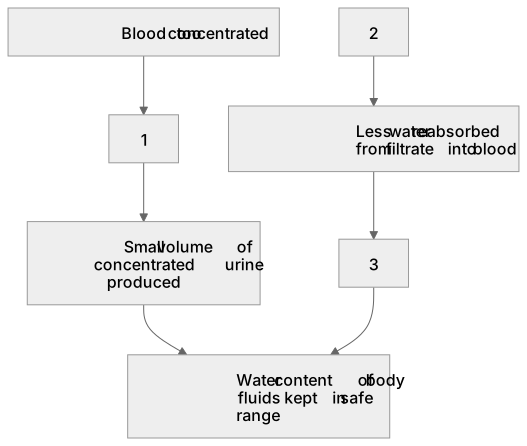
1Box 1
2Box 2
3Box 3
There is more to this lesson
The full lesson goes on to check your understanding and help you earn the marks. Create a free account to carry on, with your progress saved.
A week of Premium from your first lesson · Then the free plan continues · No card, no charge
Test your understanding of Maintaining water and nitrogen balance in the body (biology only): Students should be able to describe the function of kidneys in maintaining the water balance of the body.
Active recall beats re-reading. Take an instant quiz now to test what you’ve learned and lock it into long-term memory.
A week of Premium from your first lesson · Then the free plan continues · No card, no charge