AQA · GCSE · Biology
Course version: 8461 · Version from Sept 2018
Meiosis: As the embryo develops cells differentiate.
After fertilisation, the zygote divides by mitosis to form an embryo.
Checked against the AQA 8461 specification (opens in a new tab) on .
- Point 7 of 7
Study notes
From the checked teaching notes for this specification point.
The idea
After fertilisation, the zygote divides by mitosis to form an embryo. As the embryo develops, its cells become specialised for particular functions, a process called differentiation. Differentiation occurs because different genes are switched on or off in different cells, so each cell produces the proteins needed for its role. For example, a cell that becomes a muscle cell produces muscle proteins, while a cell that becomes a nerve cell develops the structures needed to carry electrical impulses. In animals, most differentiation happens early in development, whereas in plants many cells retain the ability to differentiate throughout life.
What earns the marks
- The embryo forms from a zygote that divides by mitosis.
- Differentiation is the process by which cells become specialised for a particular function.
- Different genes are switched on or off in different cells during differentiation.
- Specialised cells produce specific proteins and develop structures suited to their role.
- In animals, most differentiation occurs early in development, while plant cells often retain the ability to differentiate.
Common mistakes and how to put them right
Stating that differentiation changes the genes present in a cell.
Put it right: The genes stay the same but different genes are switched on or off.
Confusing differentiation with cell division.
Put it right: Division increases cell number, while differentiation makes cells specialised.
Saying that all cells in an embryo differentiate at the same time.
Put it right: Differentiation happens as the embryo develops and different cells become specialised at different stages.
Exam tips
- Define differentiation as cells becoming specialised for a particular function.
- Refer to genes being switched on or off rather than to genes being lost or changed.
- Give a named example of a specialised cell, such as a muscle cell or nerve cell, to support the explanation.
Try the lesson
The start of the Meiosis: As the embryo develops cells differentiate. lesson, made from checked teaching notes for this specification point.
Have a go first
What is the name of the process by which cells become specialised as an embryo develops?
Listen
After fertilisation, the zygote divides by mitosis to form an embryo. As the embryo develops, its cells become specialised for particular functions, a process called differentiation. Differentiation occurs because different genes are switched on or off in different cells, so each cell produces the proteins needed for its role. For example, a cell that becomes a muscle cell produces muscle proteins, while a cell that becomes a nerve cell develops the structures needed to carry electrical impulses. In animals, most differentiation happens early in development, whereas in plants many cells retain the ability to differentiate throughout life. A strong answer earns marks for these points. The embryo forms from a zygote that divides by mitosis. Differentiation is the process by which cells become specialised for a particular function. Different genes are switched on or off in different cells during differentiation. Specialised cells produce specific proteins and develop structures suited to their role. A common slip: Stating that differentiation changes the genes present in a cell. Instead, the genes stay the same but different genes are switched on or off. Exam tip: Define differentiation as cells becoming specialised for a particular function.
See it
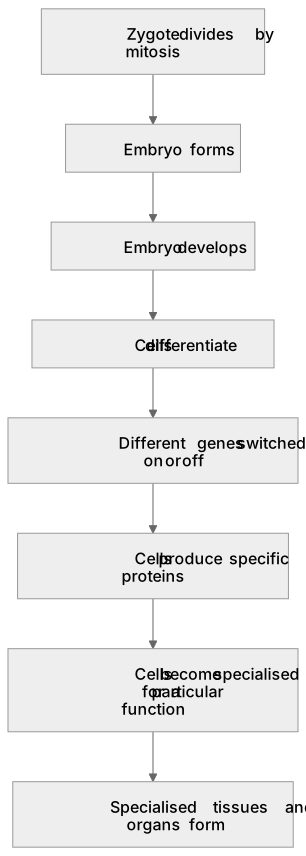
Put it in order
Put these steps in the order they happen.
- 1. Different genes switched on or off
- 2. Specialised tissues and organs form
- 3. Cells produce specific proteins
- 4. Zygote divides by mitosis
- 5. Embryo forms
- 6. Cells become specialised for a particular function
- 7. Embryo develops
- 8. Cells differentiate
Label the diagram
Some boxes have lost their names. Pick the right name for each number.
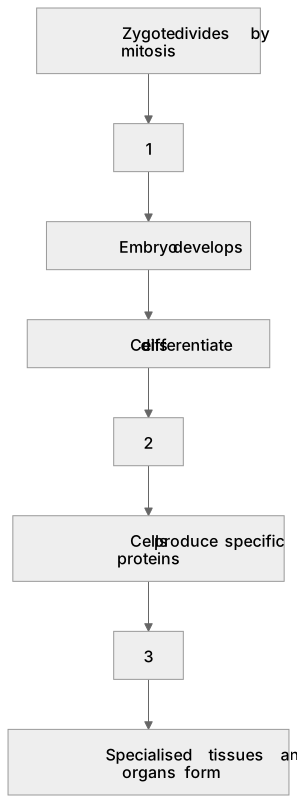
1Box 1
2Box 2
3Box 3
There is more to this lesson
The full lesson goes on to check your understanding and help you earn the marks. Create a free account to carry on, with your progress saved.
A week of Premium from your first lesson · Then the free plan continues · No card, no charge
Test your understanding of Meiosis: As the embryo develops cells differentiate.
Active recall beats re-reading. Take an instant quiz now to test what you’ve learned and lock it into long-term memory.
A week of Premium from your first lesson · Then the free plan continues · No card, no charge