AQA · GCSE · Biology
Course version: 8461 · Version from Sept 2018
Before a cell can divide it needs to grow and increase the number of…
Full specification wording
Mitosis and the cell cycle: Before a cell can divide it needs to grow and increase the number of sub-cellular structures such as ribosomes and mitochondria.
Before division, a cell must prepare by growing and making more sub-cellular structures.
Checked against the AQA 8461 specification (opens in a new tab) on .
- Point 3 of 9
- 4 key terms
Study notes
From the checked teaching notes for this specification point.
The idea
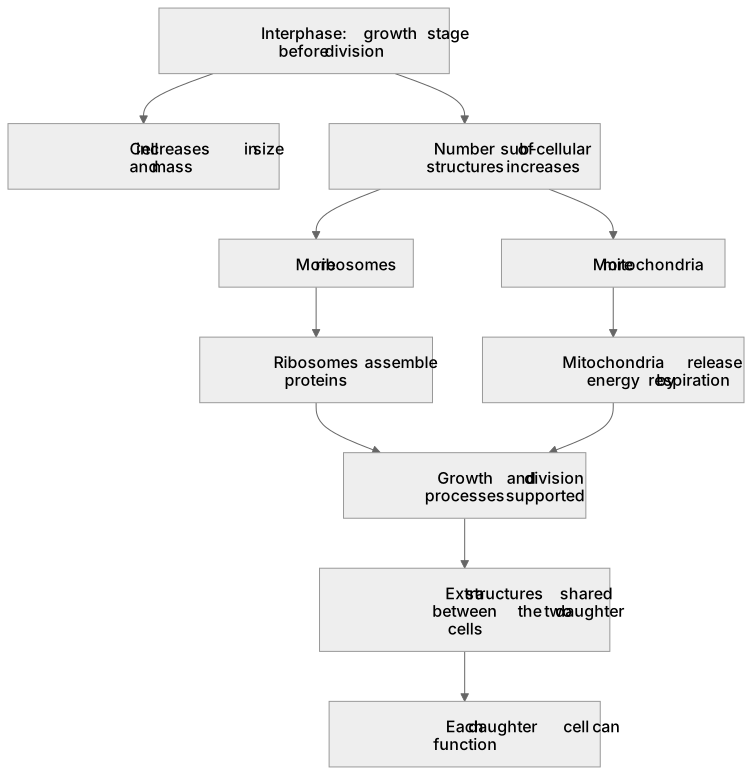
Before division, a cell must prepare by growing and making more sub-cellular structures. Interphase is the growth stage of the cell cycle. The cell increases in size, synthesises extra proteins and organelles, and replicates its DNA. Ribosomes are needed because they assemble proteins, and mitochondria are needed because they release energy by respiration for the processes of growth and division. For example, a root tip cell preparing to divide will build up its cytoplasm, ribosome number and mitochondria so that each daughter cell receives enough machinery to function. Without this preparation, division would produce cells that are too small or lack the structures needed for normal metabolism.
What earns the marks
- Identifies interphase as the growth stage before mitosis.
- States that the cell increases in size and mass before dividing.
- Names ribosomes and mitochondria as examples of sub-cellular structures that increase in number.
- Links ribosomes to protein synthesis and mitochondria to energy release by respiration.
- Explains that the extra structures are shared between the two daughter cells so each can function.
Common mistakes and how to put them right
Believing the cell divides immediately without a growth phase.
Put it right by stating that interphase must occur first.
Thinking mitochondria make energy rather than release it by respiration.
Put it right by saying respiration releases energy that the cell uses.
Assuming only the nucleus prepares for division.
Put it right by including growth of the cytoplasm and an increase in organelles such as ribosomes and mitochondria.
Exam tips
- Name specific sub-cellular structures rather than saying organelles in general.
- Link each named structure to its function to gain explanation credit.
- Use the term interphase to show you know where growth fits in the cell cycle.
Try the lesson
The start of the Mitosis and the cell cycle: Before a cell can divide it needs to grow and increase the number of sub-cellular structures such as ribosomes and mitochondria. lesson, made from checked teaching notes for this specification point.
Have a go first
Before a cell divides, what must happen to its number of sub-cellular structures such as ribosomes and mitochondria?
Listen
Before division, a cell must prepare by growing and making more sub-cellular structures. Interphase is the growth stage of the cell cycle. The cell increases in size, synthesises extra proteins and organelles, and replicates its DNA. Ribosomes are needed because they assemble proteins, and mitochondria are needed because they release energy by respiration for the processes of growth and division. For example, a root tip cell preparing to divide will build up its cytoplasm, ribosome number and mitochondria so that each daughter cell receives enough machinery to function. Without this preparation, division would produce cells that are too small or lack the structures needed for normal metabolism. A strong answer earns marks for these points. Identifies interphase as the growth stage before mitosis. States that the cell increases in size and mass before dividing. Names ribosomes and mitochondria as examples of sub-cellular structures that increase in number. Links ribosomes to protein synthesis and mitochondria to energy release by respiration. A common slip: Believing the cell divides immediately without a growth phase. Instead, stating that interphase must occur first. Exam tip: Name specific sub-cellular structures rather than saying organelles in general.
See it
Key words
Say what each word means before you turn the card.
Interphase
Try answering aloud or in your head before turning the card.
Cell growth
Try answering aloud or in your head before turning the card.
Organelle function
Try answering aloud or in your head before turning the card.
Preparation for division
Try answering aloud or in your head before turning the card.
See every definition
- Interphase
- The growth stage of the cell cycle, in which the cell increases in size, synthesises extra proteins and organelles, and replicates its DNA.
- Cell growth
- The increase in size and mass of a cell before it divides, building up its cytoplasm and sub-cellular structures.
- Organelle function
- Ribosomes assemble proteins and mitochondria release energy by respiration for the processes of growth and division.
- Preparation for division
- Growing and increasing the number of sub-cellular structures so that each daughter cell receives enough machinery to function.
Label the diagram
Some boxes have lost their names. Pick the right name for each number.
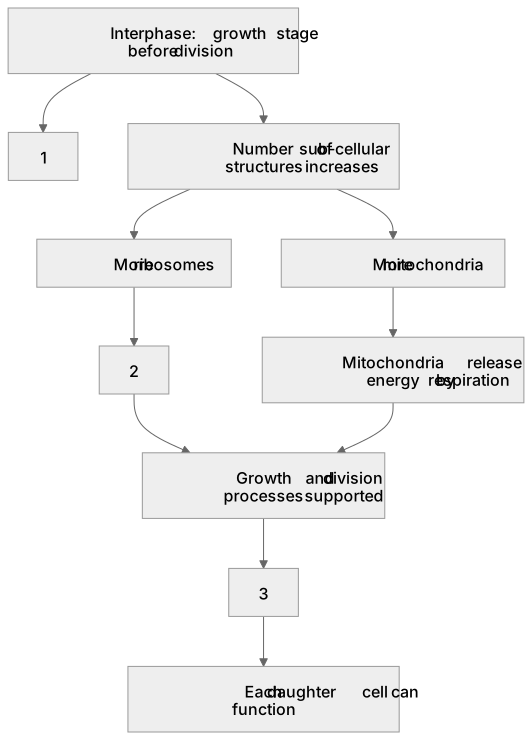
1Box 1
2Box 2
3Box 3
There is more to this lesson
The full lesson goes on to check your understanding and help you earn the marks. Create a free account to carry on, with your progress saved.
A week of Premium from your first lesson · Then the free plan continues · No card, no charge
Test your understanding of Mitosis and the cell cycle: Before a cell can divide it needs to grow and increase the number of sub-cellular structures such as ribosomes and mitochondria.
Active recall beats re-reading. Take an instant quiz now to test what you’ve learned and lock it into long-term memory.
A week of Premium from your first lesson · Then the free plan continues · No card, no charge