AQA · GCSE · Biology
Course version: 8461 · Version from Sept 2018
Cells divide in a series of stages called the cell cycle. Students should…
Full specification wording
Mitosis and the cell cycle: Cells divide in a series of stages called the cell cycle. Students should be able to describe the stages of the cell cycle, including mitosis.
The cell cycle is the sequence of events by which a cell grows, copies its genetic material and divides to form two genetically identical cells.
Checked against the AQA 8461 specification (opens in a new tab) on .
- Point 1 of 9
- 4 key terms
Study notes
From the checked teaching notes for this specification point.
The idea
The cell cycle is the sequence of events by which a cell grows, copies its genetic material and divides to form two genetically identical cells. It has three main parts: interphase, during which the cell grows, organelles increase and DNA is replicated so each chromosome becomes two identical copies; mitosis, during which the copies are separated and two nuclei form; and cytokinesis, during which the cytoplasm and membranes divide to give two separate cells. Mitosis itself is described as a series of stages in which the chromosomes line up, the copies are pulled apart and new nuclear membranes form. A useful method is to narrate the cycle as grow, copy, separate, split. This process is needed for growth, repair and asexual reproduction, and it keeps the chromosome number constant.
What earns the marks
- Names the main stages of the cell cycle: interphase, mitosis and cytokinesis.
- Describes interphase as a period of growth and DNA replication, producing two copies of each chromosome.
- Describes mitosis as the stage in which the copied chromosomes are separated and two genetically identical nuclei form.
- Describes cytokinesis as the division of the cytoplasm to produce two separate cells.
- Explains that the daughter cells are genetically identical and have the same chromosome number as the parent cell.
- Links the cell cycle to growth, repair of tissues and asexual reproduction.
Common mistakes and how to put them right
Treating mitosis as the whole cell cycle.
Put it right: Mitosis is one stage within the cycle, alongside interphase and cytokinesis.
Saying DNA replication happens during mitosis.
Put it right: DNA is replicated during interphase, before mitosis begins.
Describing the daughter cells as genetically different.
Put it right: Mitosis produces genetically identical diploid cells.
Exam tips
- Structure longer answers using the three headings interphase, mitosis and cytokinesis so every stage is covered.
- Include what happens to the DNA in each stage, because replication and separation are the key events examiners look for.
- If asked why mitosis is important, give at least two contexts such as growth and repair rather than a single example.
Try the lesson
The start of the Mitosis and the cell cycle: Cells divide in a series of stages called the cell cycle. Students should be able to describe the stages of the cell cycle, including mitosis. lesson, made from checked teaching notes for this specification point.
Have a go first
What term is used to describe the series of stages that a cell goes through as it grows and divides?
Listen
The cell cycle is the sequence of events by which a cell grows, copies its genetic material and divides to form two genetically identical cells. It has three main parts: interphase, during which the cell grows, organelles increase and DNA is replicated so each chromosome becomes two identical copies; mitosis, during which the copies are separated and two nuclei form; and cytokinesis, during which the cytoplasm and membranes divide to give two separate cells. Mitosis itself is described as a series of stages in which the chromosomes line up, the copies are pulled apart and new nuclear membranes form. A useful method is to narrate the cycle as grow, copy, separate, split. This process is needed for growth, repair and asexual reproduction, and it keeps the chromosome number constant. A strong answer earns marks for these points. Names the main stages of the cell cycle: interphase, mitosis and cytokinesis. Describes interphase as a period of growth and DNA replication, producing two copies of each chromosome. Describes mitosis as the stage in which the copied chromosomes are separated and two genetically identical nuclei form. Describes cytokinesis as the division of the cytoplasm to produce two separate cells. A common slip: Treating mitosis as the whole cell cycle. Instead, mitosis is one stage within the cycle, alongside interphase and cytokinesis. Exam tip: Structure longer answers using the three headings interphase, mitosis and cytokinesis so every stage is covered.
See it
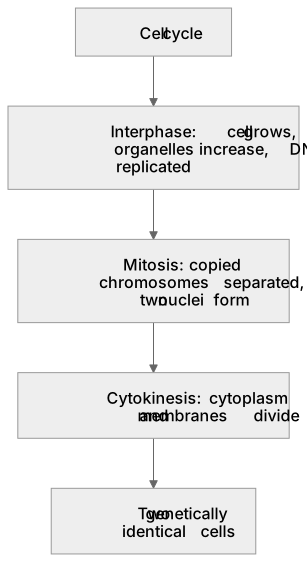
Put it in order
Put these steps in the order they happen.
- 1. Interphase: cell grows, organelles increase, DNA replicated
- 2. Mitosis: copied chromosomes separated, two nuclei form
- 3. Cell cycle
- 4. Two genetically identical cells
- 5. Cytokinesis: cytoplasm and membranes divide
Key words
Say what each word means before you turn the card.
Cell cycle
Try answering aloud or in your head before turning the card.
Interphase
Try answering aloud or in your head before turning the card.
Mitosis
Try answering aloud or in your head before turning the card.
Cytokinesis
Try answering aloud or in your head before turning the card.
See every definition
- Cell cycle
- A series of stages in which a cell grows, copies its genetic material and divides to form two genetically identical cells.
- Interphase
- The part of the cell cycle during which the cell grows, organelles increase and DNA is replicated so each chromosome becomes two identical copies.
- Mitosis
- The stage of the cell cycle in which the copied chromosomes are separated and two genetically identical nuclei form.
- Cytokinesis
- The stage of the cell cycle in which the cytoplasm and membranes divide to give two separate cells.
Label the diagram
Some boxes have lost their names. Pick the right name for each number.
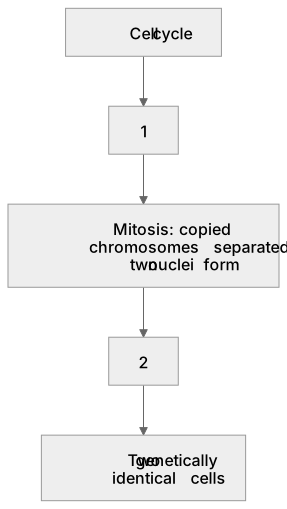
1Box 1
2Box 2
There is more to this lesson
The full lesson goes on to check your understanding and help you earn the marks. Create a free account to carry on, with your progress saved.
A week of Premium from your first lesson · Then the free plan continues · No card, no charge
Test your understanding of Mitosis and the cell cycle: Cells divide in a series of stages called the cell cycle. Students should be able to describe the stages of the cell cycle, including mitosis.
Active recall beats re-reading. Take an instant quiz now to test what you’ve learned and lock it into long-term memory.
A week of Premium from your first lesson · Then the free plan continues · No card, no charge