AQA · GCSE · Biology
Course version: 8461 · Version from Sept 2018
In mitosis one set of chromosomes is pulled to each end of the cell and…
Full specification wording
Mitosis and the cell cycle: In mitosis one set of chromosomes is pulled to each end of the cell and the nucleus divides.
Mitosis is the stage of the cell cycle in which the copied chromosomes are separated.
Checked against the AQA 8461 specification (opens in a new tab) on .
- Point 5 of 9
- 3 key terms
Study notes
From the checked teaching notes for this specification point.
The idea
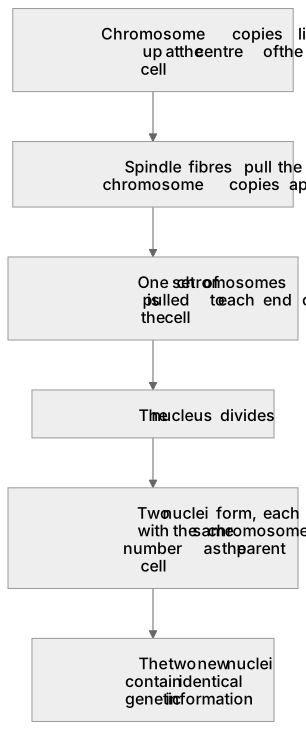
Mitosis is the stage of the cell cycle in which the copied chromosomes are separated. The chromosome copies line up at the centre of the cell and are pulled apart by spindle fibres, so that one complete set of chromosomes moves to each end of the cell. The nucleus then divides, forming two nuclei, each with the same chromosome number as the parent cell. For example, in a human body cell the 46 chromosomes are copied, then one set of 46 is pulled to each pole before the nucleus divides. This ensures the two new nuclei contain identical genetic information, ready for cytokinesis to divide the cytoplasm.
What earns the marks
- States that chromosome copies are separated during mitosis.
- Describes one set of chromosomes being pulled to each end of the cell.
- Explains that the nucleus divides to form two nuclei.
- Links the separation of chromosomes to the production of genetically identical nuclei.
- Places mitosis correctly between DNA replication and cytokinesis in the cell cycle.
Common mistakes and how to put them right
Saying the whole cell divides during mitosis.
Put it right by stating that mitosis is nuclear division and cytokinesis divides the cytoplasm.
Thinking the chromosome number is halved.
Put it right by explaining that each end receives a full set, so the number stays the same.
Describing chromosomes being pulled together rather than apart.
Put it right by saying one set moves to each end of the cell.
Exam tips
- Use the phrase one set of chromosomes to each end to match the specification.
- Distinguish clearly between mitosis and cytokinesis in your answer.
- Mention that the two nuclei formed are genetically identical to support your explanation.
Try the lesson
The start of the Mitosis and the cell cycle: In mitosis one set of chromosomes is pulled to each end of the cell and the nucleus divides. lesson, made from checked teaching notes for this specification point.
Have a go first
During mitosis, where is one set of chromosomes pulled to?
Listen
Mitosis is the stage of the cell cycle in which the copied chromosomes are separated. The chromosome copies line up at the centre of the cell and are pulled apart by spindle fibres, so that one complete set of chromosomes moves to each end of the cell. The nucleus then divides, forming two nuclei, each with the same chromosome number as the parent cell. For example, in a human body cell the 46 chromosomes are copied, then one set of 46 is pulled to each pole before the nucleus divides. This ensures the two new nuclei contain identical genetic information, ready for cytokinesis to divide the cytoplasm. A strong answer earns marks for these points. States that chromosome copies are separated during mitosis. Describes one set of chromosomes being pulled to each end of the cell. Explains that the nucleus divides to form two nuclei. Links the separation of chromosomes to the production of genetically identical nuclei. A common slip: Saying the whole cell divides during mitosis. Instead, stating that mitosis is nuclear division and cytokinesis divides the cytoplasm. Exam tip: Use the phrase one set of chromosomes to each end to match the specification.
See it
Put it in order
Put these steps in the order they happen.
- 1. One set of chromosomes is pulled to each end of the cell
- 2. Spindle fibres pull the chromosome copies apart
- 3. Chromosome copies line up at the centre of the cell
- 4. The two new nuclei contain identical genetic information
- 5. Two nuclei form, each with the same chromosome number as the parent cell
- 6. The nucleus divides
Key words
Say what each word means before you turn the card.
Mitosis
Try answering aloud or in your head before turning the card.
Chromosome separation
Try answering aloud or in your head before turning the card.
Nuclear division
Try answering aloud or in your head before turning the card.
See every definition
- Mitosis
- The stage of the cell cycle in which the copied chromosomes are separated and the nucleus divides.
- Chromosome separation
- The process in which the chromosome copies line up at the centre of the cell and are pulled apart by spindle fibres.
- Nuclear division
- The division of the nucleus to form two nuclei, each with the same chromosome number as the parent cell.
Label the diagram
Some boxes have lost their names. Pick the right name for each number.
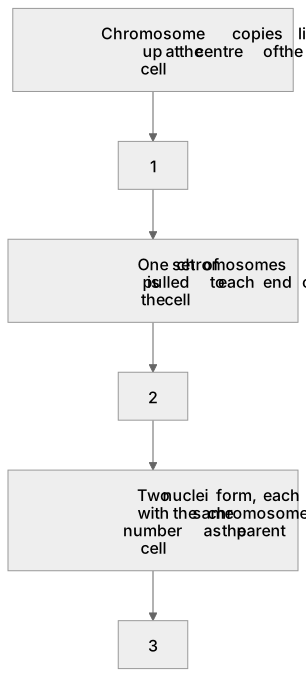
1Box 1
2Box 2
3Box 3
There is more to this lesson
The full lesson goes on to check your understanding and help you earn the marks. Create a free account to carry on, with your progress saved.
A week of Premium from your first lesson · Then the free plan continues · No card, no charge
Test your understanding of Mitosis and the cell cycle: In mitosis one set of chromosomes is pulled to each end of the cell and the nucleus divides.
Active recall beats re-reading. Take an instant quiz now to test what you’ve learned and lock it into long-term memory.
A week of Premium from your first lesson · Then the free plan continues · No card, no charge