AQA · GCSE · Biology
Course version: 8461 · Version from Sept 2018
It increases the heart rate and boosts the delivery of oxygen and glucose…
Full specification wording
Negative feedback (HT only): It increases the heart rate and boosts the delivery of oxygen and glucose to the brain and muscles, preparing the body for ‘flight or fight’.
When adrenaline is released in times of fear or stress, it increases the heart rate.
Checked against the AQA 8461 specification (opens in a new tab) on .
- Point 3 of 5
- 4 key terms
Study notes
From the checked teaching notes for this specification point.
The idea
When adrenaline is released in times of fear or stress, it increases the heart rate. A faster heartbeat circulates blood more quickly, so oxygen and glucose are delivered to the brain and muscles at a higher rate. Oxygen is needed for aerobic respiration, and glucose is the fuel respired to release energy for muscle contraction. This prepares the body for ‘flight or fight’: either running away from danger or staying to confront it.
What earns the marks
- State that adrenaline increases the heart rate.
- Explain that a faster heart rate increases blood flow to the brain and muscles.
- State that this boosts the delivery of oxygen and glucose to the brain and muscles.
- Link oxygen and glucose to aerobic respiration and energy release for muscle contraction.
- Conclude that these changes prepare the body for ‘flight or fight’.
Common mistakes and how to put them right
Saying adrenaline decreases heart rate.
Put it right by stating that it increases heart rate.
Writing that adrenaline delivers only oxygen.
Put it right by including glucose as well as oxygen.
Forgetting the target organs.
Put it right by naming the brain and muscles as the destinations for the increased oxygen and glucose.
Exam tips
- Write the sequence in order: adrenaline, increased heart rate, faster blood flow, more oxygen and glucose to brain and muscles.
- Link oxygen and glucose to respiration so the answer explains why delivery matters.
- Use the phrase ‘flight or fight’ to show the purpose of the response.
Try the lesson
The start of the Negative feedback (HT only): It increases the heart rate and boosts the delivery of oxygen and glucose to the brain and muscles, preparing the body for ‘flight or fight’. lesson, made from checked teaching notes for this specification point.
Have a go first
During a 'fight or flight' response, adrenaline is released into the blood. What is the direct effect of this hormone on the body?
Listen
When adrenaline is released in times of fear or stress, it increases the heart rate. A faster heartbeat circulates blood more quickly, so oxygen and glucose are delivered to the brain and muscles at a higher rate. Oxygen is needed for aerobic respiration, and glucose is the fuel respired to release energy for muscle contraction. This prepares the body for ‘flight or fight’: either running away from danger or staying to confront it. A strong answer earns marks for these points. State that adrenaline increases the heart rate. Explain that a faster heart rate increases blood flow to the brain and muscles. State that this boosts the delivery of oxygen and glucose to the brain and muscles. Link oxygen and glucose to aerobic respiration and energy release for muscle contraction. A common slip: Saying adrenaline decreases heart rate. Instead, stating that it increases heart rate. Exam tip: Write the sequence in order: adrenaline, increased heart rate, faster blood flow, more oxygen and glucose to brain and muscles.
See it
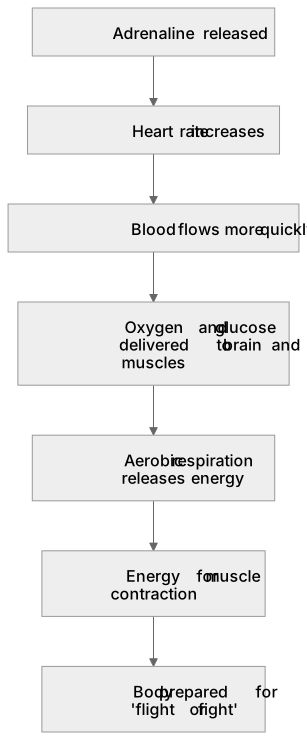
Put it in order
Put these steps in the order they happen.
- 1. Body prepared for 'flight or fight'
- 2. Energy for muscle contraction
- 3. Blood flows more quickly
- 4. Aerobic respiration releases energy
- 5. Adrenaline released
- 6. Heart rate increases
- 7. Oxygen and glucose delivered to brain and muscles
Key words
Say what each word means before you turn the card.
Response to stress
Try answering aloud or in your head before turning the card.
Transport of oxygen and glucose
Try answering aloud or in your head before turning the card.
Cellular respiration
Try answering aloud or in your head before turning the card.
Hormonal coordination
Try answering aloud or in your head before turning the card.
See every definition
- Response to stress
- Adrenaline is released in times of fear or stress and increases the heart rate.
- Transport of oxygen and glucose
- A faster heartbeat circulates blood more quickly, so oxygen and glucose are delivered to the brain and muscles at a higher rate.
- Cellular respiration
- Oxygen is needed for aerobic respiration, and glucose is the fuel respired to release energy for muscle contraction.
- Hormonal coordination
- The sequence runs from adrenaline release to increased heart rate, then to faster delivery of oxygen and glucose, and finally to more energy available in the brain and muscles.
Label the diagram
Some boxes have lost their names. Pick the right name for each number.
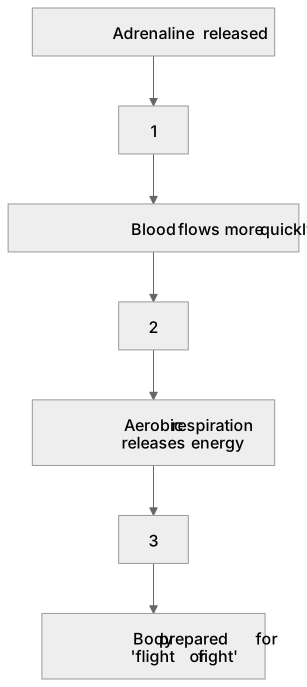
1Box 1
2Box 2
3Box 3
There is more to this lesson
The full lesson goes on to check your understanding and help you earn the marks. Create a free account to carry on, with your progress saved.
A week of Premium from your first lesson · Then the free plan continues · No card, no charge
Test your understanding of Negative feedback (HT only): It increases the heart rate and boosts the delivery of oxygen and glucose to the brain and muscles, preparing the body for ‘flight or fight’.
Active recall beats re-reading. Take an instant quiz now to test what you’ve learned and lock it into long-term memory.
A week of Premium from your first lesson · Then the free plan continues · No card, no charge