AQA · GCSE · Biology
Course version: 8461 · Version from Sept 2018
Plant defence responses: Chemical plant defence responses.
Plants cannot flee from herbivores or pathogens, so many rely on chemical defences.
Checked against the AQA 8461 specification (opens in a new tab) on .
- Point 4 of 7
- 4 key terms
Study notes
From the checked teaching notes for this specification point.
The idea
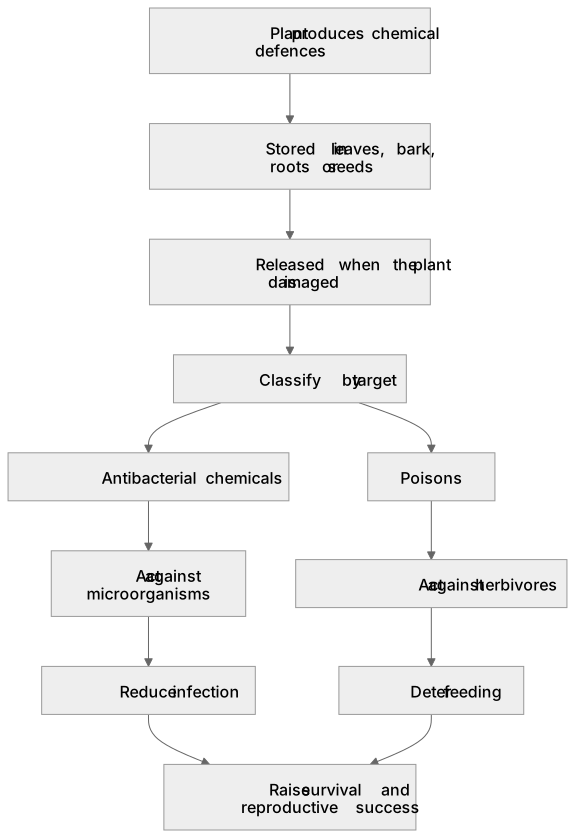
Plants cannot flee from herbivores or pathogens, so many rely on chemical defences. These are substances the plant produces and stores in tissues such as leaves, bark, roots or seeds. Some chemicals kill or inhibit bacteria and fungi, reducing infection after damage; others are toxins that make the plant unpalatable or harmful to animals that eat it. A useful method is to classify each example by its target: antibacterial chemicals act against microorganisms, while poisons act against herbivores. For instance, mint produces menthol, which deters many insects, and oak bark contains tannins that taste bitter and bind proteins, discouraging feeding. Chemical defence is therefore a heritable adaptation that raises survival and reproductive success, and it can be investigated by comparing feeding damage on treated and untreated plant material.
What earns the marks
- Chemical defences are substances produced by a plant that reduce harm from herbivores or pathogens.
- Antibacterial chemicals inhibit or kill bacteria, lowering the chance of infection entering damaged tissue.
- Poisons are toxins that deter herbivores by making plant material harmful or unpalatable.
- Chemical defences may be stored in leaves, bark, roots or seeds and released when the plant is damaged.
- Examples include tannins in oak bark and menthol in mint, each affecting particular organisms.
Common mistakes and how to put them right
Treating chemical defence as a conscious choice by the plant.
Put it right by describing it as an inherited adaptation produced automatically.
Confusing antibacterial chemicals with poisons to herbivores.
Put it right by naming the target organism for each chemical.
Assuming all plant chemicals harm humans.
Put it right by noting that many are medicines or flavourings at low doses but defensive at higher doses.
Exam tips
- Link each chemical to its target organism rather than listing substances without function.
- Use the terms antibacterial and poison precisely, and avoid the vague phrase 'chemicals kill things'.
- When explaining an advantage, connect the defence to survival and reproduction in one clear sentence.
Try the lesson
The start of the Plant defence responses: Chemical plant defence responses. lesson, made from checked teaching notes for this specification point.
Have a go first
Which of these is a chemical defence that some plants produce to stop herbivores eating them?
Listen
Plants cannot flee from herbivores or pathogens, so many rely on chemical defences. These are substances the plant produces and stores in tissues such as leaves, bark, roots or seeds. Some chemicals kill or inhibit bacteria and fungi, reducing infection after damage; others are toxins that make the plant unpalatable or harmful to animals that eat it. A useful method is to classify each example by its target: antibacterial chemicals act against microorganisms, while poisons act against herbivores. For instance, mint produces menthol, which deters many insects, and oak bark contains tannins that taste bitter and bind proteins, discouraging feeding. Chemical defence is therefore a heritable adaptation that raises survival and reproductive success, and it can be investigated by comparing feeding damage on treated and untreated plant material. A strong answer earns marks for these points. Chemical defences are substances produced by a plant that reduce harm from herbivores or pathogens. Antibacterial chemicals inhibit or kill bacteria, lowering the chance of infection entering damaged tissue. Poisons are toxins that deter herbivores by making plant material harmful or unpalatable. Chemical defences may be stored in leaves, bark, roots or seeds and released when the plant is damaged. A common slip: Treating chemical defence as a conscious choice by the plant. Instead, describing it as an inherited adaptation produced automatically. Exam tip: Link each chemical to its target organism rather than listing substances without function.
See it
Key words
Say what each word means before you turn the card.
Chemical defences
Try answering aloud or in your head before turning the card.
Antibacterial chemicals
Try answering aloud or in your head before turning the card.
Poisons
Try answering aloud or in your head before turning the card.
Adaptation and natural selection
Try answering aloud or in your head before turning the card.
See every definition
- Chemical defences
- Substances produced by a plant that reduce harm from herbivores or pathogens.
- Antibacterial chemicals
- Substances that inhibit or kill bacteria, lowering the chance of infection entering damaged tissue.
- Poisons
- Toxins that deter herbivores by making plant material harmful or unpalatable.
- Adaptation and natural selection
- Inherited features that increase survival and reproductive success, so they are subject to natural selection.
Label the diagram
Some boxes have lost their names. Pick the right name for each number.
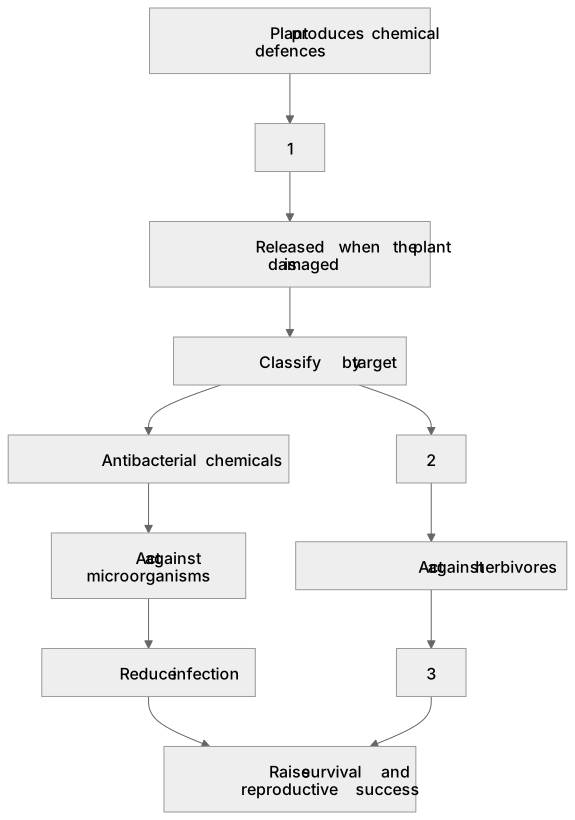
1Box 1
2Box 2
3Box 3
There is more to this lesson
The full lesson goes on to check your understanding and help you earn the marks. Create a free account to carry on, with your progress saved.
A week of Premium from your first lesson · Then the free plan continues · No card, no charge
Test your understanding of Plant defence responses: Chemical plant defence responses.
Active recall beats re-reading. Take an instant quiz now to test what you’ve learned and lock it into long-term memory.
A week of Premium from your first lesson · Then the free plan continues · No card, no charge