AQA · GCSE · Biology
Course version: 8461 · Version from Sept 2018
Students should be able to explain how the structure of root hair cells,…
Full specification wording
Plant organ system: Students should be able to explain how the structure of root hair cells, xylem and phloem are adapted to their functions.
Root hair cells, xylem and phloem each show structural adaptations that suit their transport roles.
Checked against the AQA 8461 specification (opens in a new tab) on .
- Point 1 of 13
Study notes
From the checked teaching notes for this specification point.
The idea
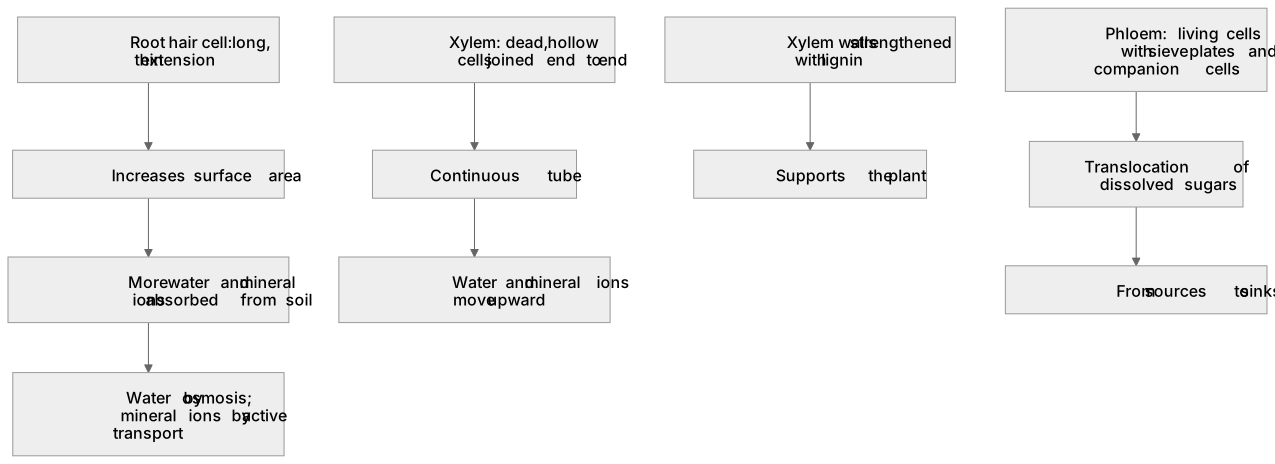
Root hair cells, xylem and phloem each show structural adaptations that suit their transport roles. A root hair cell has a long, thin extension that increases its surface area, so more water and mineral ions can be absorbed from the soil by osmosis and active transport. Xylem tissue is made of dead, hollow cells joined end to end and strengthened with lignin; this creates a continuous tube for water and mineral ions to move upward and helps support the plant. Phloem tissue contains living cells with sieve plates between them and companion cells; dissolved sugars are translocated from sources such as leaves to sinks such as roots, fruits and growing tips. Explaining adaptation means naming the feature, stating the function and linking the two.
What earns the marks
- Root hair cells have a long, thin extension that increases surface area for absorption of water and mineral ions from the soil.
- Root hair cells absorb water by osmosis and mineral ions by active transport, which requires energy from respiration.
- Xylem cells are dead and hollow and are joined end to end, forming continuous tubes that allow water and mineral ions to move upward.
- Xylem walls are strengthened with lignin, which supports the plant and helps withstand the tension of the water column.
- Phloem contains living cells with sieve plates and companion cells, enabling translocation of dissolved sugars from sources to sinks.
- The adaptations of each cell or tissue reduce resistance to flow or increase surface area, making transport more efficient.
Common mistakes and how to put them right
Saying root hair cells absorb mineral ions only by osmosis.
Put it right: Mineral ions are absorbed by active transport, while water is absorbed by osmosis.
Describing xylem as living tissue.
Put it right: Mature xylem cells are dead, leaving hollow tubes for water transport.
Stating that phloem carries water.
Put it right: Phloem translocates dissolved sugars, whereas xylem transports water and mineral ions.
Exam tips
- For each adaptation, write the feature, then its function, then how the function helps the plant, to build a complete explanation.
- Use precise transport terms such as osmosis, active transport and translocation rather than general words like 'moving'.
- If a question gives a diagram, refer to the visible feature, such as the hair-like extension or hollow tube, before explaining its advantage.
Try the lesson
The start of the Plant organ system: Students should be able to explain how the structure of root hair cells, xylem and phloem are adapted to their functions. lesson, made from checked teaching notes for this specification point.
Have a go first
Which feature of a root hair cell increases the surface area for absorbing water and mineral ions?
Listen
Root hair cells, xylem and phloem each show structural adaptations that suit their transport roles. A root hair cell has a long, thin extension that increases its surface area, so more water and mineral ions can be absorbed from the soil by osmosis and active transport. Xylem tissue is made of dead, hollow cells joined end to end and strengthened with lignin; this creates a continuous tube for water and mineral ions to move upward and helps support the plant. Phloem tissue contains living cells with sieve plates between them and companion cells; dissolved sugars are translocated from sources such as leaves to sinks such as roots, fruits and growing tips. Explaining adaptation means naming the feature, stating the function and linking the two. A strong answer earns marks for these points. Root hair cells have a long, thin extension that increases surface area for absorption of water and mineral ions from the soil. Root hair cells absorb water by osmosis and mineral ions by active transport, which requires energy from respiration. Xylem cells are dead and hollow and are joined end to end, forming continuous tubes that allow water and mineral ions to move upward. Xylem walls are strengthened with lignin, which supports the plant and helps withstand the tension of the water column. A common slip: Saying root hair cells absorb mineral ions only by osmosis. Instead, mineral ions are absorbed by active transport, while water is absorbed by osmosis. Exam tip: For each adaptation, write the feature, then its function, then how the function helps the plant, to build a complete explanation.
See it
Label the diagram
Some boxes have lost their names. Pick the right name for each number.
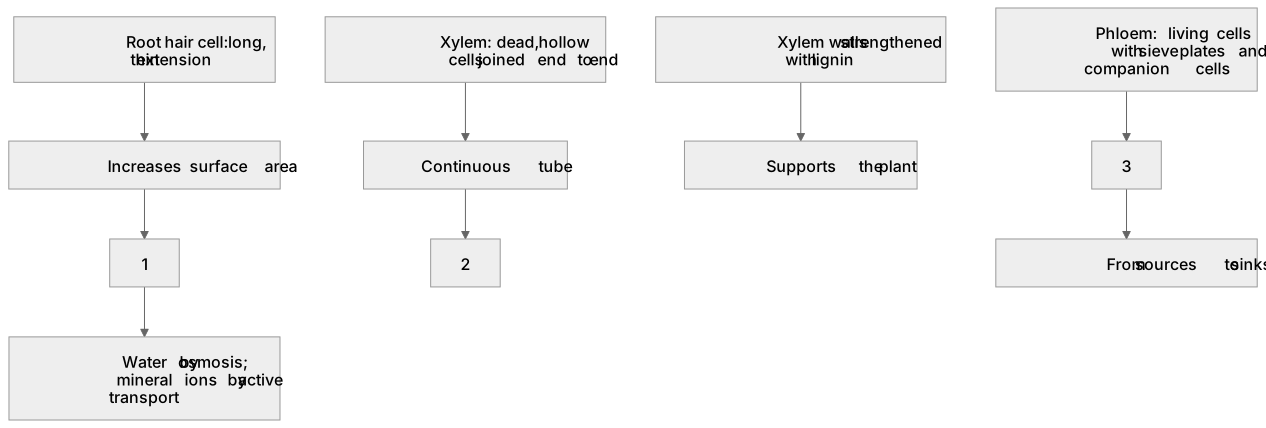
1Box 1
2Box 2
3Box 3
There is more to this lesson
The full lesson goes on to check your understanding and help you earn the marks. Create a free account to carry on, with your progress saved.
A week of Premium from your first lesson · Then the free plan continues · No card, no charge
Test your understanding of Plant organ system: Students should be able to explain how the structure of root hair cells, xylem and phloem are adapted to their functions.
Active recall beats re-reading. Take an instant quiz now to test what you’ve learned and lock it into long-term memory.
A week of Premium from your first lesson · Then the free plan continues · No card, no charge