AQA · GCSE · Biology
Course version: 8461 · Version from Sept 2018
The role of stomata and guard cells are to control gas exchange and water…
Full specification wording
Plant organ system: The role of stomata and guard cells are to control gas exchange and water loss.
Stomata are microscopic pores found mainly in the lower epidermis of leaves.
Checked against the AQA 8461 specification (opens in a new tab) on .
- Point 10 of 13
- 4 key terms
Study notes
From the checked teaching notes for this specification point.
The idea
Stomata are microscopic pores found mainly in the lower epidermis of leaves. Each pore is bordered by two guard cells. When guard cells take in water by osmosis they become turgid and curved, opening the pore; when they lose water they become flaccid and the pore closes. Open stomata allow carbon dioxide to diffuse in for photosynthesis and oxygen to diffuse out as a by-product. At the same time, water vapour diffuses out, contributing to transpiration and water loss. Guard cells therefore balance the need for gas exchange against the risk of dehydration. Environmental factors such as light, temperature, humidity and water availability influence stomatal opening. A practical method is using a potometer to estimate water uptake, or observing stomata under a microscope after peeling the lower epidermis.
What earns the marks
- Stomata are pores, mainly in the lower leaf epidermis, through which gases diffuse.
- Carbon dioxide diffuses into the leaf through open stomata for photosynthesis.
- Oxygen produced by photosynthesis diffuses out through open stomata.
- Water vapour diffuses out through stomata, and this loss is transpiration.
- Guard cells open and close the stomatal pore by changing shape as they gain or lose water.
- Turgid guard cells open the pore, while flaccid guard cells close it, helping to limit water loss.
Common mistakes and how to put them right
Saying stomata are cells.
Put it right by describing stomata as pores and guard cells as the cells that surround them.
Claiming guard cells only control gas exchange.
Put it right by stating that they also regulate water loss by transpiration.
Stating that stomata actively pump gases.
Put it right by explaining that gases move by diffusion down concentration gradients.
Exam tips
- Use the terms turgid and flaccid when explaining how guard cells open and close the pore.
- Separate the two roles clearly: gas exchange for photosynthesis and control of water loss by transpiration.
- When describing an investigation, state the variable measured, such as bubble movement in a potometer or stomatal counts under a microscope.
- Link stomatal closure to survival, for example reducing water loss in dry conditions.
Try the lesson
The start of the Plant organ system: The role of stomata and guard cells are to control gas exchange and water loss. lesson, made from checked teaching notes for this specification point.
Have a go first
Guard cells can change shape to open and close the stomata on a leaf. Why is this action important for the plant?
Listen
Stomata are microscopic pores found mainly in the lower epidermis of leaves. Each pore is bordered by two guard cells. When guard cells take in water by osmosis they become turgid and curved, opening the pore; when they lose water they become flaccid and the pore closes. Open stomata allow carbon dioxide to diffuse in for photosynthesis and oxygen to diffuse out as a by-product. At the same time, water vapour diffuses out, contributing to transpiration and water loss. Guard cells therefore balance the need for gas exchange against the risk of dehydration. Environmental factors such as light, temperature, humidity and water availability influence stomatal opening. A practical method is using a potometer to estimate water uptake, or observing stomata under a microscope after peeling the lower epidermis. A strong answer earns marks for these points. Stomata are pores, mainly in the lower leaf epidermis, through which gases diffuse. Carbon dioxide diffuses into the leaf through open stomata for photosynthesis. Oxygen produced by photosynthesis diffuses out through open stomata. Water vapour diffuses out through stomata, and this loss is transpiration. A common slip: Saying stomata are cells. Instead, describing stomata as pores and guard cells as the cells that surround them. Exam tip: Use the terms turgid and flaccid when explaining how guard cells open and close the pore.
See it
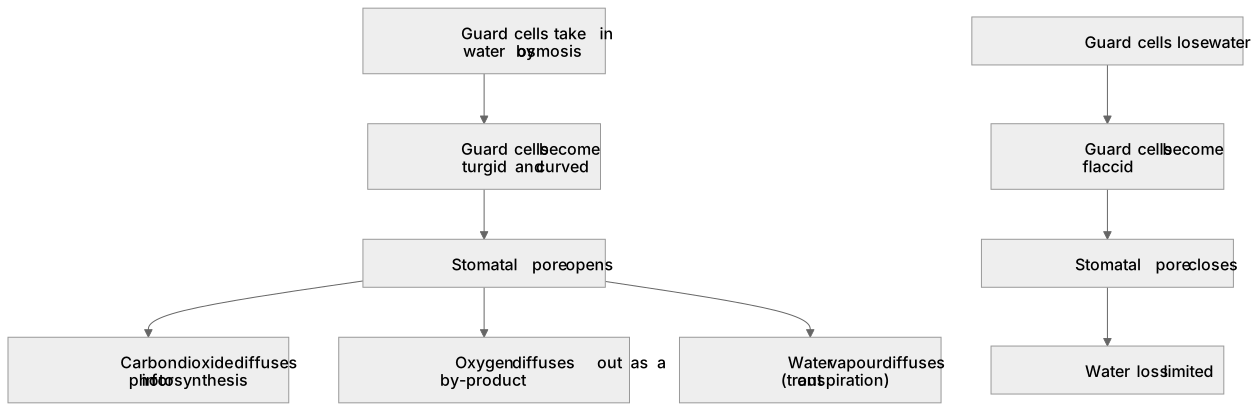
Key words
Say what each word means before you turn the card.
Stomata
Try answering aloud or in your head before turning the card.
Guard cells
Try answering aloud or in your head before turning the card.
Turgid
Try answering aloud or in your head before turning the card.
Transpiration
Try answering aloud or in your head before turning the card.
See every definition
- Stomata
- Microscopic pores found mainly in the lower epidermis of leaves, through which gases diffuse.
- Guard cells
- Two cells bordering each stomatal pore, which open and close the pore by changing shape as they gain or lose water.
- Turgid
- The state of guard cells when they take in water by osmosis, becoming curved and opening the pore.
- Transpiration
- The loss of water vapour diffusing out through stomata.
Label the diagram
Some boxes have lost their names. Pick the right name for each number.
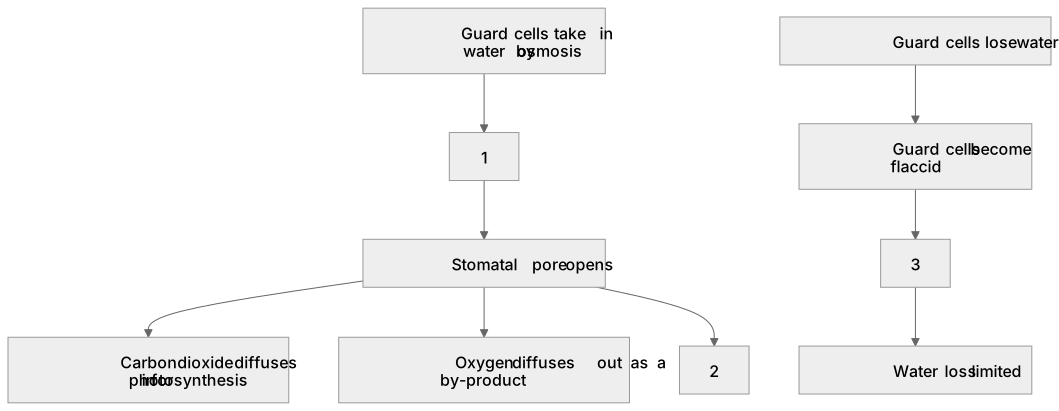
1Box 1
2Box 2
3Box 3
There is more to this lesson
The full lesson goes on to check your understanding and help you earn the marks. Create a free account to carry on, with your progress saved.
A week of Premium from your first lesson · Then the free plan continues · No card, no charge
Test your understanding of Plant organ system: The role of stomata and guard cells are to control gas exchange and water loss.
Active recall beats re-reading. Take an instant quiz now to test what you’ve learned and lock it into long-term memory.
A week of Premium from your first lesson · Then the free plan continues · No card, no charge