AQA · GCSE · Biology
Course version: 8461 · Version from Sept 2018
Xylem tissue transports water and mineral ions from the roots to the stems…
Full specification wording
Plant organ system: Xylem tissue transports water and mineral ions from the roots to the stems and leaves.
Xylem is a transport tissue forming a continuous pipeline from root tips through stems to leaves.
Checked against the AQA 8461 specification (opens in a new tab) on .
- Point 8 of 13
- 4 key terms
Study notes
From the checked teaching notes for this specification point.
The idea
Xylem is a transport tissue forming a continuous pipeline from root tips through stems to leaves. Root hair cells absorb water by osmosis and mineral ions by active transport, so the sap entering xylem is a dilute solution of ions such as nitrate, phosphate, magnesium and potassium. Once inside, water and dissolved ions move upwards as a column through hollow dead cells. This flow supplies photosynthesis in leaves with water and supplies growing regions with ions for making proteins, chlorophyll and other molecules. A useful method is tracing a labelled pathway: soil → root hair cell → root cortex → xylem → stem → leaf. Transpiration pull, driven by evaporation from leaves, draws the column upwards, while root pressure also contributes. Understanding this pathway explains why wilting, mineral deficiency and ringing experiments affect shoots.
What earns the marks
- Xylem is a plant transport tissue that carries water and dissolved mineral ions in one direction, from roots towards stems and leaves.
- Water enters root hair cells by osmosis because the soil solution is more dilute than the cell contents.
- Mineral ions such as nitrate, magnesium and phosphate are absorbed by active transport, requiring energy from respiration.
- Xylem forms a continuous pathway linking root, stem and leaf so that water and ions reach photosynthesising and growing cells.
- The upward movement occurs in the transpiration stream, driven largely by evaporation of water from leaf surfaces.
- Mineral ions are used in the plant, for example nitrate for amino acids and proteins, and magnesium for chlorophyll.
Common mistakes and how to put them right
Saying xylem transports food or sugars.
Put it right by stating that dissolved sugars are carried in phloem, while xylem carries water and mineral ions.
Claiming mineral ions enter by osmosis.
Put it right by explaining that ions are absorbed by active transport against a concentration gradient.
Describing transport as two-way.
Put it right by stating that xylem flow is essentially one-way, from roots to stems and leaves.
Exam tips
- Name the tissue, the substances carried and the direction of travel in one precise sentence to secure the transport point.
- Link each substance to its plant use, such as nitrate for proteins or magnesium for chlorophyll, to show understanding rather than recall alone.
- Use a labelled arrow diagram from root hair cell to leaf when a question asks you to trace a pathway.
- Distinguish absorption at the root from transport in the xylem, because marks are often awarded separately for each process.
Try the lesson
The start of the Plant organ system: Xylem tissue transports water and mineral ions from the roots to the stems and leaves. lesson, made from checked teaching notes for this specification point.
Have a go first
Which tissue carries water and mineral ions from a plant's roots up to its stems and leaves?
Listen
Xylem is a transport tissue forming a continuous pipeline from root tips through stems to leaves. Root hair cells absorb water by osmosis and mineral ions by active transport, so the sap entering xylem is a dilute solution of ions such as nitrate, phosphate, magnesium and potassium. Once inside, water and dissolved ions move upwards as a column through hollow dead cells. This flow supplies photosynthesis in leaves with water and supplies growing regions with ions for making proteins, chlorophyll and other molecules. A useful method is tracing a labelled pathway: soil → root hair cell → root cortex → xylem → stem → leaf. Transpiration pull, driven by evaporation from leaves, draws the column upwards, while root pressure also contributes. Understanding this pathway explains why wilting, mineral deficiency and ringing experiments affect shoots. A strong answer earns marks for these points. Xylem is a plant transport tissue that carries water and dissolved mineral ions in one direction, from roots towards stems and leaves. Water enters root hair cells by osmosis because the soil solution is more dilute than the cell contents. Mineral ions such as nitrate, magnesium and phosphate are absorbed by active transport, requiring energy from respiration. Xylem forms a continuous pathway linking root, stem and leaf so that water and ions reach photosynthesising and growing cells. A common slip: Saying xylem transports food or sugars. Instead, stating that dissolved sugars are carried in phloem, while xylem carries water and mineral ions. Exam tip: Name the tissue, the substances carried and the direction of travel in one precise sentence to secure the transport point.
See it
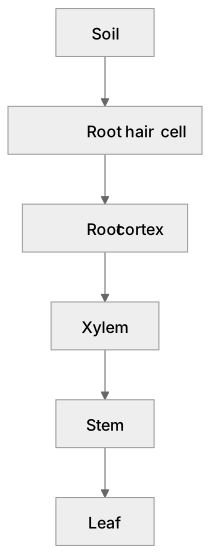
Put it in order
Put these steps in the order they happen.
- 1. Root cortex
- 2. Root hair cell
- 3. Soil
- 4. Leaf
- 5. Stem
- 6. Xylem
Key words
Say what each word means before you turn the card.
Xylem
Try answering aloud or in your head before turning the card.
Active transport
Try answering aloud or in your head before turning the card.
Transpiration stream
Try answering aloud or in your head before turning the card.
Osmosis
Try answering aloud or in your head before turning the card.
See every definition
- Xylem
- A plant transport tissue that carries water and dissolved mineral ions in one direction, from roots towards stems and leaves.
- Active transport
- The process by which mineral ions are absorbed, requiring energy from respiration.
- Transpiration stream
- The upward movement of water and ions, driven largely by evaporation of water from leaf surfaces.
- Osmosis
- The process by which water enters root hair cells because the soil solution is more dilute than the cell contents.
Label the diagram
Some boxes have lost their names. Pick the right name for each number.
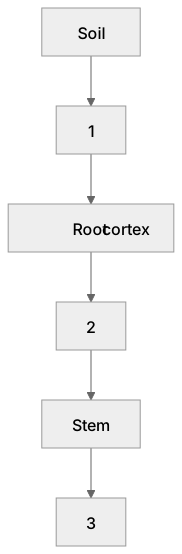
1Box 1
2Box 2
3Box 3
There is more to this lesson
The full lesson goes on to check your understanding and help you earn the marks. Create a free account to carry on, with your progress saved.
A week of Premium from your first lesson · Then the free plan continues · No card, no charge
Test your understanding of Plant organ system: Xylem tissue transports water and mineral ions from the roots to the stems and leaves.
Active recall beats re-reading. Take an instant quiz now to test what you’ve learned and lock it into long-term memory.
A week of Premium from your first lesson · Then the free plan continues · No card, no charge