AQA · GCSE · Biology
Course version: 8461 · Version from Sept 2018
Organs are organised into organ systems, which work together to form…
Full specification wording
Principles of organisation: Organs are organised into organ systems, which work together to form organisms.
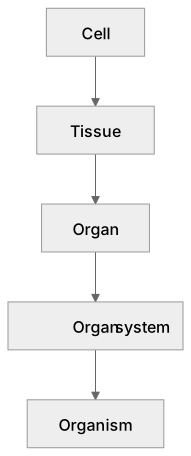
This statement describes the final levels of the organisational hierarchy that runs from cells through tissues and organs to whole organisms.
Checked against the AQA 8461 specification (opens in a new tab) on .
- Point 4 of 4
- 4 key terms
Study notes
From the checked teaching notes for this specification point.
The idea
This statement describes the final levels of the organisational hierarchy that runs from cells through tissues and organs to whole organisms. A tissue is a group of similar cells carrying out a shared function, such as muscular tissue. Several tissues combine into an organ, for example the stomach, which contains muscular tissue, glandular tissue and epithelial tissue. Organs then cooperate as an organ system: the stomach, small intestine, large intestine, liver and pancreas form the digestive system. Each system carries out a major life process, and the systems interact so that the organism functions as a coordinated whole. For instance, the digestive system supplies glucose that the circulatory system transports and that muscles use in respiration. Understanding this hierarchy lets you explain how damage at one level, such as faulty insulin-producing cells, affects the whole organism.
What earns the marks
- Cells are the basic building blocks of living organisms and become specialised for particular functions.
- A tissue is a group of similar cells that work together to carry out a shared function.
- An organ is a structure made of several different tissues working together, such as the stomach or heart.
- An organ system is a group of organs that cooperate to carry out a major function, such as digestion or gas exchange.
- Organ systems interact so that the organism can carry out all the processes needed for life.
- Examples should be used to show the sequence: cell, tissue, organ, organ system, organism.
Common mistakes and how to put them right
Treating an organ as a single tissue.
Put it right by stating that an organ contains several tissues, for example the stomach has muscular and glandular tissue.
Confusing an organ with an organ system.
Put it right by noting that an organ system is a group of organs, such as the digestive system, not one structure.
Describing the hierarchy in the wrong order.
Put it right by rehearsing the sequence cell, tissue, organ, organ system, organism.
Exam tips
- Use named examples at each level, such as muscle cell, muscular tissue, stomach, digestive system, human.
- When asked to explain, link each level to the function it performs rather than only listing the levels.
- Check that any example you give genuinely belongs to the level named in the question.
Try the lesson
The start of the Principles of organisation: Organs are organised into organ systems, which work together to form organisms. lesson, made from checked teaching notes for this specification point.
Have a go first
Which level of organisation is made up of several organs working together?
Listen
This statement describes the final levels of the organisational hierarchy that runs from cells through tissues and organs to whole organisms. A tissue is a group of similar cells carrying out a shared function, such as muscular tissue. Several tissues combine into an organ, for example the stomach, which contains muscular tissue, glandular tissue and epithelial tissue. Organs then cooperate as an organ system: the stomach, small intestine, large intestine, liver and pancreas form the digestive system. Each system carries out a major life process, and the systems interact so that the organism functions as a coordinated whole. For instance, the digestive system supplies glucose that the circulatory system transports and that muscles use in respiration. Understanding this hierarchy lets you explain how damage at one level, such as faulty insulin-producing cells, affects the whole organism. A strong answer earns marks for these points. Cells are the basic building blocks of living organisms and become specialised for particular functions. A tissue is a group of similar cells that work together to carry out a shared function. An organ is a structure made of several different tissues working together, such as the stomach or heart. An organ system is a group of organs that cooperate to carry out a major function, such as digestion or gas exchange. A common slip: Treating an organ as a single tissue. Instead, stating that an organ contains several tissues, for example the stomach has muscular and glandular tissue. Exam tip: Use named examples at each level, such as muscle cell, muscular tissue, stomach, digestive system, human.
See it
Put it in order
Put these steps in the order they happen.
- 1. Tissue
- 2. Organ
- 3. Cell
- 4. Organism
- 5. Organ system
Key words
Say what each word means before you turn the card.
Tissue
Try answering aloud or in your head before turning the card.
Organ
Try answering aloud or in your head before turning the card.
Organ system
Try answering aloud or in your head before turning the card.
Organism
Try answering aloud or in your head before turning the card.
See every definition
- Tissue
- A group of similar cells that work together to carry out a shared function, such as muscular tissue.
- Organ
- A structure made of several different tissues working together, such as the stomach or heart.
- Organ system
- A group of organs that cooperate to carry out a major function, such as digestion or gas exchange.
- Organism
- The coordinated whole formed by organ systems interacting so that all the processes needed for life can be carried out.
Label the diagram
Some boxes have lost their names. Pick the right name for each number.
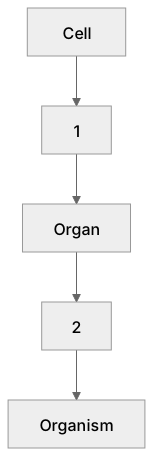
1Box 1
2Box 2
There is more to this lesson
The full lesson goes on to check your understanding and help you earn the marks. Create a free account to carry on, with your progress saved.
A week of Premium from your first lesson · Then the free plan continues · No card, no charge
Test your understanding of Principles of organisation: Organs are organised into organ systems, which work together to form organisms.
Active recall beats re-reading. Take an instant quiz now to test what you’ve learned and lock it into long-term memory.
A week of Premium from your first lesson · Then the free plan continues · No card, no charge