AQA · GCSE · Biology
Course version: 8461 · Version from Sept 2018
A large amount of the antibody can be collected and purified.
Full specification wording
Producing monoclonal antibodies: A large amount of the antibody can be collected and purified.
Once a hybridoma clone is growing well, the cells release antibody into the surrounding liquid.
Checked against the AQA 8461 specification (opens in a new tab) on .
- Point 8 of 8
- 3 key terms
Study notes
From the checked teaching notes for this specification point.
The idea
Once a hybridoma clone is growing well, the cells release antibody into the surrounding liquid. Because the clone can be grown on a large scale, the volume of antibody produced is much greater than could be obtained from lymphocytes alone. The antibody-containing liquid is then processed to separate the antibody from cells, nutrients and other substances, giving a purified product. For example, cells may be removed by filtration or centrifugation, and the antibody concentrated and cleaned so that it can be used in tests or treatments. Purity matters because contaminants could affect results or cause unwanted effects in patients. This entire process is a Higher Tier only topic.
What earns the marks
- The hybridoma clone is grown on a large scale so that antibody accumulates in the culture medium.
- The liquid containing the antibody is separated from the cells, for example by filtration or centrifugation.
- The antibody is purified to remove other substances so that only the required antibody remains.
- A large amount can be collected because the clone divides repeatedly and each cell secretes antibody.
- The purified antibody can then be used safely in medical diagnosis, research or treatment.
Common mistakes and how to put them right
Thinking the antibody is collected from inside the cells.
Put it right: It is secreted into the surrounding liquid.
Assuming collection alone gives a pure product.
Put it right: Purification steps are needed to remove cells and other substances.
Believing only a small amount is produced.
Put it right: Large-scale cloning allows large amounts to be collected.
Exam tips
- State where the antibody is found before describing how it is collected.
- Mention at least one separation method, such as filtration or centrifugation, when describing purification.
- As a Higher Tier only topic, be prepared to link purification to the safety and efficacy of medical treatments.
Try the lesson
The start of the Producing monoclonal antibodies: A large amount of the antibody can be collected and purified. lesson, made from checked teaching notes for this specification point.
Have a go first
After a clone of hybridoma cells has been grown in a laboratory culture, what is the final step in producing monoclonal antibodies for medical use?
Listen
Once a hybridoma clone is growing well, the cells release antibody into the surrounding liquid. Because the clone can be grown on a large scale, the volume of antibody produced is much greater than could be obtained from lymphocytes alone. The antibody-containing liquid is then processed to separate the antibody from cells, nutrients and other substances, giving a purified product. For example, cells may be removed by filtration or centrifugation, and the antibody concentrated and cleaned so that it can be used in tests or treatments. Purity matters because contaminants could affect results or cause unwanted effects in patients. This entire process is a Higher Tier only topic. A strong answer earns marks for these points. The hybridoma clone is grown on a large scale so that antibody accumulates in the culture medium. The liquid containing the antibody is separated from the cells, for example by filtration or centrifugation. The antibody is purified to remove other substances so that only the required antibody remains. A large amount can be collected because the clone divides repeatedly and each cell secretes antibody. A common slip: Thinking the antibody is collected from inside the cells. Instead, it is secreted into the surrounding liquid. Exam tip: State where the antibody is found before describing how it is collected.
See it
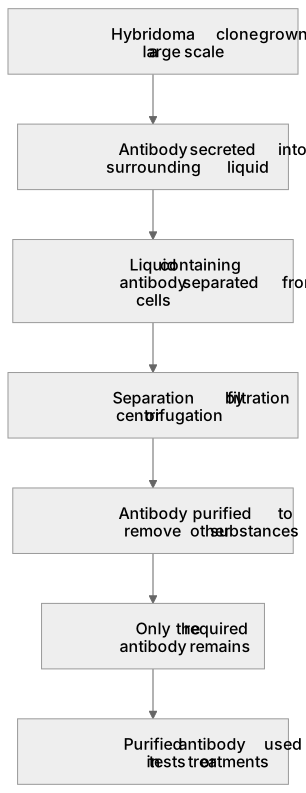
Put it in order
Put these steps in the order they happen.
- 1. Purified antibody used in tests or treatments
- 2. Only the required antibody remains
- 3. Liquid containing antibody separated from cells
- 4. Antibody purified to remove other substances
- 5. Hybridoma clone grown on a large scale
- 6. Antibody secreted into surrounding liquid
- 7. Separation by filtration or centrifugation
Key words
Say what each word means before you turn the card.
Large-scale production
Try answering aloud or in your head before turning the card.
Purification
Try answering aloud or in your head before turning the card.
Medical applications
Try answering aloud or in your head before turning the card.
See every definition
- Large-scale production
- The hybridoma clone is grown on a large scale so that antibody accumulates in the culture medium, giving a much greater volume than could be obtained from lymphocytes alone.
- Purification
- The antibody-containing liquid is processed to separate the antibody from cells, nutrients and other substances so that only the required antibody remains.
- Medical applications
- The purified antibody can then be used safely in medical diagnosis, research or treatment, because contaminants could affect results or cause unwanted effects in patients.
Label the diagram
Some boxes have lost their names. Pick the right name for each number.
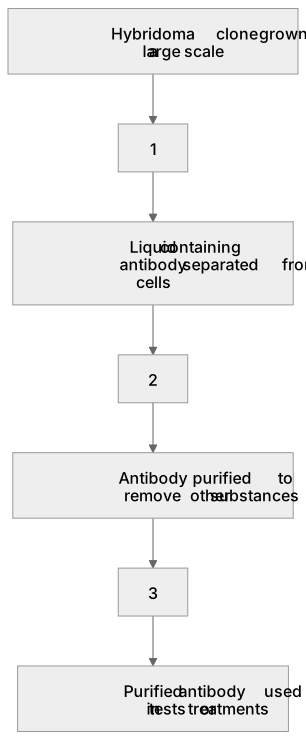
1Box 1
2Box 2
3Box 3
There is more to this lesson
The full lesson goes on to check your understanding and help you earn the marks. Create a free account to carry on, with your progress saved.
A week of Premium from your first lesson · Then the free plan continues · No card, no charge
Test your understanding of Producing monoclonal antibodies: A large amount of the antibody can be collected and purified.
Active recall beats re-reading. Take an instant quiz now to test what you’ve learned and lock it into long-term memory.
A week of Premium from your first lesson · Then the free plan continues · No card, no charge