AQA · GCSE · Biology
Course version: 8461 · Version from Sept 2018
The lymphocytes are combined with a particular kind of tumour cell to make…
Full specification wording
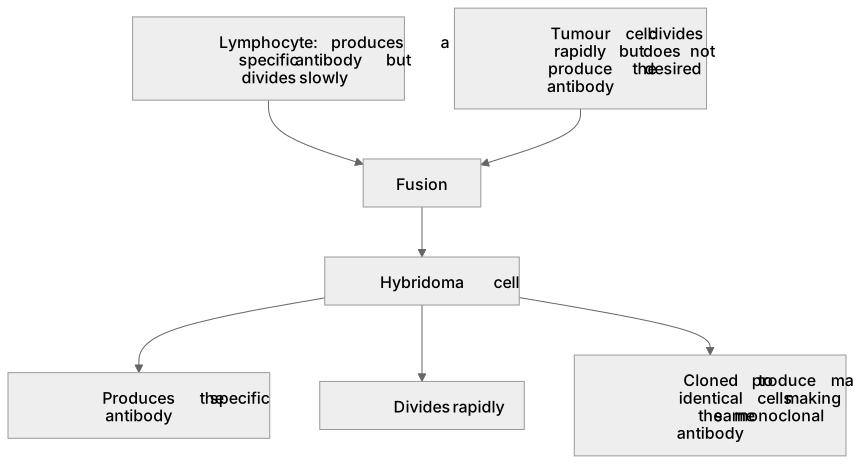
Producing monoclonal antibodies: The lymphocytes are combined with a particular kind of tumour cell to make a cell called a hybridoma cell.
Once specific lymphocytes are isolated, they must be cultured to produce large quantities of antibodies.
Checked against the AQA 8461 specification (opens in a new tab) on .
- Point 5 of 8
- 2 key terms
Study notes
From the checked teaching notes for this specification point.
The idea
Once specific lymphocytes are isolated, they must be cultured to produce large quantities of antibodies. However, lymphocytes cannot divide rapidly in laboratory conditions. To overcome this, a specific lymphocyte is fused with a tumour cell (myeloma), which divides rapidly and indefinitely but does not produce the desired antibody. This fusion creates a hybridoma cell. The hybridoma inherits both crucial properties: it manufactures the specific antibody and divides rapidly to form a clone. For example, fusing a lymphocyte making anti-viral antibodies with a myeloma cell yields a hybridoma clone producing large amounts of monoclonal antibody. Note that this entire process is assessed exclusively at Higher Tier.
What earns the marks
- A lymphocyte produces a specific antibody but has a limited ability to divide in laboratory culture.
- A tumour cell can divide rapidly and continuously but does not produce the desired specific antibody.
- The specific lymphocyte and a tumour cell are fused together to produce a single hybridoma cell.
- A hybridoma cell possesses both properties: it produces the specific antibody and divides rapidly.
- Hybridoma cells are cloned to produce many identical cells, all manufacturing the same monoclonal antibody.
Common mistakes and how to put them right
Stating that the tumour cell makes the antibody.
Put it right: The lymphocyte provides antibody production, while the tumour cell provides rapid division.
Describing the cells as merely being mixed together.
Put it right: A hybridoma is formed by the physical fusion of a lymphocyte and a tumour cell.
Believing any lymphocyte can be used.
Put it right: The lymphocyte must be one that already makes the particular antibody required for the specific antigen.
Exam tips
- Clearly state the two distinct properties contributed by each parent cell type before naming the resulting hybridoma cell.
- Use the specific term 'fusion' rather than 'mixed' when describing how the hybridoma cell is created, and remember this is a Higher Tier only topic.
Try the lesson
The start of the Producing monoclonal antibodies: The lymphocytes are combined with a particular kind of tumour cell to make a cell called a hybridoma cell. lesson, made from checked teaching notes for this specification point.
Have a go first
What is the name of the cell formed when lymphocytes are combined with a particular kind of tumour cell?
Listen
Once specific lymphocytes are isolated, they must be cultured to produce large quantities of antibodies. However, lymphocytes cannot divide rapidly in laboratory conditions. To overcome this, a specific lymphocyte is fused with a tumour cell (myeloma), which divides rapidly and indefinitely but does not produce the desired antibody. This fusion creates a hybridoma cell. The hybridoma inherits both crucial properties: it manufactures the specific antibody and divides rapidly to form a clone. For example, fusing a lymphocyte making anti-viral antibodies with a myeloma cell yields a hybridoma clone producing large amounts of monoclonal antibody. Note that this entire process is assessed exclusively at Higher Tier. A strong answer earns marks for these points. A lymphocyte produces a specific antibody but has a limited ability to divide in laboratory culture. A tumour cell can divide rapidly and continuously but does not produce the desired specific antibody. The specific lymphocyte and a tumour cell are fused together to produce a single hybridoma cell. A hybridoma cell possesses both properties: it produces the specific antibody and divides rapidly. A common slip: Stating that the tumour cell makes the antibody. Instead, the lymphocyte provides antibody production, while the tumour cell provides rapid division. Exam tip: Clearly state the two distinct properties contributed by each parent cell type before naming the resulting hybridoma cell.
See it
Key words
Say what each word means before you turn the card.
Cell fusion and hybridomas
Try answering aloud or in your head before turning the card.
Cell division and cloning
Try answering aloud or in your head before turning the card.
See every definition
- Cell fusion and hybridomas
- A specific lymphocyte and a tumour cell are fused together to produce a single hybridoma cell.
- Cell division and cloning
- Hybridoma cells are cloned to produce many identical cells, all manufacturing the same monoclonal antibody.
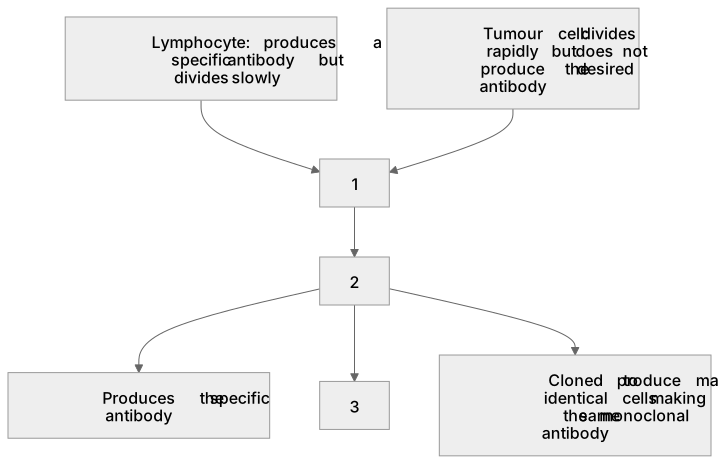
Label the diagram
Some boxes have lost their names. Pick the right name for each number.
1Box 1
2Box 2
3Box 3
There is more to this lesson
The full lesson goes on to check your understanding and help you earn the marks. Create a free account to carry on, with your progress saved.
A week of Premium from your first lesson · Then the free plan continues · No card, no charge
Test your understanding of Producing monoclonal antibodies: The lymphocytes are combined with a particular kind of tumour cell to make a cell called a hybridoma cell.
Active recall beats re-reading. Take an instant quiz now to test what you’ve learned and lock it into long-term memory.
A week of Premium from your first lesson · Then the free plan continues · No card, no charge