AQA · GCSE · Biology
Course version: 8461 · Version from Sept 2018
The spread of malaria is controlled by preventing the vectors, mosquitos,…
Full specification wording
Protist diseases: The spread of malaria is controlled by preventing the vectors, mosquitos, from breeding and by using mosquito nets to avoid being bitten.
Malaria spreads when a female mosquito bites an infected person, picks up the Plasmodium protist, and later bites someone else.
Checked against the AQA 8461 specification (opens in a new tab) on .
- Point 4 of 4
- 3 key terms
Study notes
From the checked teaching notes for this specification point.
The idea
Malaria spreads when a female mosquito bites an infected person, picks up the Plasmodium protist, and later bites someone else. To reduce transmission, people target the vector rather than the pathogen directly. Preventing mosquitoes from breeding means removing or treating standing water where they lay eggs, for example draining ponds, covering water containers and clearing blocked drains. Using mosquito nets, especially nets treated with insecticide, creates a physical barrier that stops mosquitoes biting people while they sleep. Other measures include insect repellents, window screens and spraying insecticides. These methods work best together because they reduce both the number of mosquitoes and the chance of being bitten, lowering the spread of malaria in a community.
What earns the marks
- Mosquitoes are the vectors that transmit the malaria protist between humans.
- Preventing breeding involves removing or treating standing water where mosquitoes lay eggs.
- Mosquito nets act as a physical barrier that reduces the chance of being bitten.
- Insecticide-treated nets can also kill or repel mosquitoes, giving extra protection.
- Combining methods such as draining water, nets and repellents reduces malaria transmission more effectively than one method alone.
- Control measures aim to break the transmission cycle between mosquito and human.
Common mistakes and how to put them right
Saying that mosquito nets kill the malaria pathogen.
Put it right: Nets prevent bites by blocking mosquitoes.
Confusing prevention of breeding with killing adult mosquitoes.
Put it right: Removing standing water stops eggs and larvae developing.
Thinking one control method is enough.
Put it right: Combining methods is more effective at reducing spread.
Exam tips
- Always link each control method to how it breaks the transmission cycle.
- Use the term vector correctly when referring to mosquitoes.
- Give specific examples of standing water, such as water butts, drains or discarded containers.
Try the lesson
The start of the Protist diseases: The spread of malaria is controlled by preventing the vectors, mosquitos, from breeding and by using mosquito nets to avoid being bitten. lesson, made from checked teaching notes for this specification point.
Have a go first
Which animal is the vector that spreads malaria?
Listen
Malaria spreads when a female mosquito bites an infected person, picks up the Plasmodium protist, and later bites someone else. To reduce transmission, people target the vector rather than the pathogen directly. Preventing mosquitoes from breeding means removing or treating standing water where they lay eggs, for example draining ponds, covering water containers and clearing blocked drains. Using mosquito nets, especially nets treated with insecticide, creates a physical barrier that stops mosquitoes biting people while they sleep. Other measures include insect repellents, window screens and spraying insecticides. These methods work best together because they reduce both the number of mosquitoes and the chance of being bitten, lowering the spread of malaria in a community. A strong answer earns marks for these points. Mosquitoes are the vectors that transmit the malaria protist between humans. Preventing breeding involves removing or treating standing water where mosquitoes lay eggs. Mosquito nets act as a physical barrier that reduces the chance of being bitten. Insecticide-treated nets can also kill or repel mosquitoes, giving extra protection. A common slip: Saying that mosquito nets kill the malaria pathogen. Instead, nets prevent bites by blocking mosquitoes. Exam tip: Always link each control method to how it breaks the transmission cycle.
See it
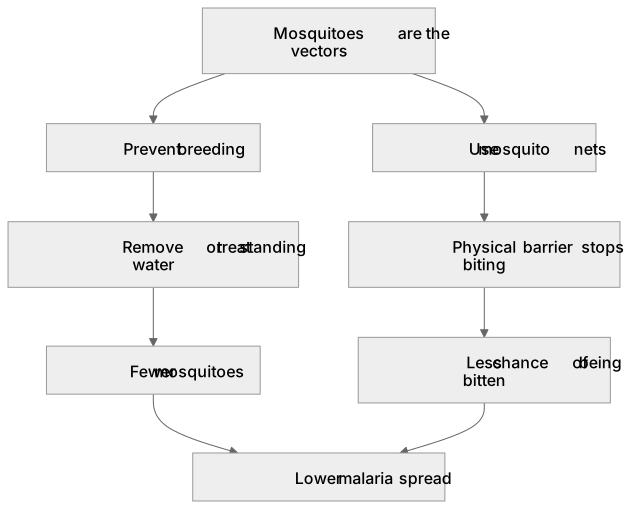
Key words
Say what each word means before you turn the card.
Vectors and transmission
Try answering aloud or in your head before turning the card.
Prevention strategies
Try answering aloud or in your head before turning the card.
Community health
Try answering aloud or in your head before turning the card.
See every definition
- Vectors and transmission
- Mosquitoes are the vectors that transmit the malaria protist between humans, and control measures aim to break this transmission cycle.
- Prevention strategies
- Preventing mosquitoes from breeding means removing or treating standing water where they lay eggs, and mosquito nets act as a physical barrier that reduces the chance of being bitten.
- Community health
- Combining methods such as draining water, nets and repellents reduces malaria transmission in a community more effectively than one method alone.
Label the diagram
Some boxes have lost their names. Pick the right name for each number.
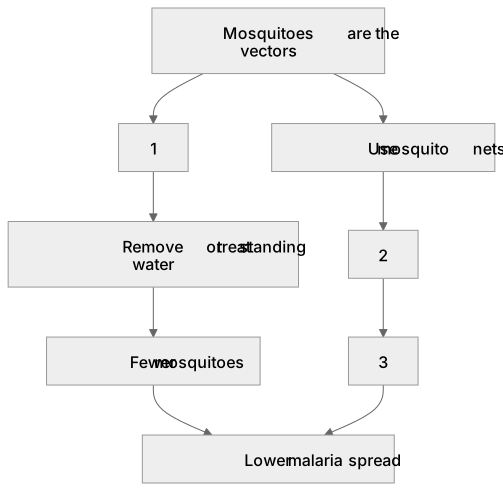
1Box 1
2Box 2
3Box 3
There is more to this lesson
The full lesson goes on to check your understanding and help you earn the marks. Create a free account to carry on, with your progress saved.
A week of Premium from your first lesson · Then the free plan continues · No card, no charge
Test your understanding of Protist diseases: The spread of malaria is controlled by preventing the vectors, mosquitos, from breeding and by using mosquito nets to avoid being bitten.
Active recall beats re-reading. Take an instant quiz now to test what you’ve learned and lock it into long-term memory.
A week of Premium from your first lesson · Then the free plan continues · No card, no charge