AQA · GCSE · Biology
Course version: 8461 · Version from Sept 2018
Pyramids of biomass can be constructed to represent the relative amount of…
Full specification wording
Pyramids of biomass: Pyramids of biomass can be constructed to represent the relative amount of biomass in each level of a food chain.
A pyramid of biomass is a diagram that shows the relative mass of living material at each trophic level of a food chain.
Checked against the AQA 8461 specification (opens in a new tab) on .
- Point 1 of 3
- 3 key terms
Study notes
From the checked teaching notes for this specification point.
The idea
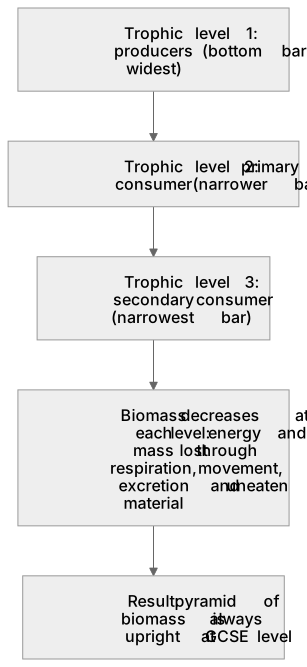
A pyramid of biomass is a diagram that shows the relative mass of living material at each trophic level of a food chain. Each level is drawn as a horizontal bar whose width is proportional to the biomass present, and the bars are stacked with trophic level 1 (producers) at the bottom. Biomass is the mass of living material, often measured as dry mass per unit area, for example in grams per square metre (g/m²). Because energy is lost between trophic levels through respiration, movement, excretion and uneaten material, the biomass always decreases at each successive level. Consequently, at GCSE level, a pyramid of biomass is always a true pyramid shape and is never inverted, unlike pyramids of numbers which can take irregular shapes.
What earns the marks
- A pyramid of biomass represents the relative mass of living material at each trophic level.
- The width of each horizontal bar is strictly proportional to the biomass at that level.
- Bars are stacked symmetrically with trophic level 1 (producers) at the bottom and higher levels above.
- Biomass is often measured as dry mass per unit area, for example g/m².
- Biomass always decreases at higher trophic levels because energy and mass are lost between levels (e.g., through faeces, urea, and respiration).
- Pyramids of biomass are always upright (pyramid-shaped) at GCSE level, reflecting this continuous loss of biomass.
Common mistakes and how to put them right
Confusing a pyramid of biomass with a pyramid of numbers.
Put it right: Biomass uses mass of living material, not a count of organisms, so it is always pyramid-shaped.
Drawing bars with widths that are not proportional to the biomass values.
Put it right: Each bar width must represent the actual biomass using a consistent scale.
Believing a pyramid of biomass can be inverted.
Put it right by remembering that at GCSE, biomass pyramids are always upright due to biomass loss at each stage.
Exam tips
- Label each trophic level clearly, for example producer, primary consumer and secondary consumer, and ensure level 1 is at the base.
- Use a ruler and a consistent scale when drawing bars so the widths are proportional to the data provided.
- Include units such as g/m² or kg/m² when stating biomass values.
Try the lesson
The start of the Pyramids of biomass: Pyramids of biomass can be constructed to represent the relative amount of biomass in each level of a food chain. lesson, made from checked teaching notes for this specification point.
Have a go first
A pyramid of biomass is drawn for a food chain. What does the width of each bar in the pyramid represent?
Listen
A pyramid of biomass is a diagram that shows the relative mass of living material at each trophic level of a food chain. Each level is drawn as a horizontal bar whose width is proportional to the biomass present, and the bars are stacked with trophic level 1 (producers) at the bottom. Biomass is the mass of living material, often measured as dry mass per unit area, for example in grams per square metre (g/m²). Because energy is lost between trophic levels through respiration, movement, excretion and uneaten material, the biomass always decreases at each successive level. Consequently, at GCSE level, a pyramid of biomass is always a true pyramid shape and is never inverted, unlike pyramids of numbers which can take irregular shapes. A strong answer earns marks for these points. A pyramid of biomass represents the relative mass of living material at each trophic level. The width of each horizontal bar is strictly proportional to the biomass at that level. Bars are stacked symmetrically with trophic level 1 (producers) at the bottom and higher levels above. Biomass is often measured as dry mass per unit area, for example g/m². A common slip: Believing a pyramid of biomass can be inverted. Instead, remembering that at GCSE, biomass pyramids are always upright due to biomass loss at each stage. Exam tip: Label each trophic level clearly, for example producer, primary consumer and secondary consumer, and ensure level 1 is at the base.
See it
Put it in order
Put these steps in the order they happen.
- 1. Trophic level 2: primary consumer (narrower bar)
- 2. Trophic level 3: secondary consumer (narrowest bar)
- 3. Trophic level 1: producers (bottom bar, widest)
- 4. Result: pyramid of biomass is always upright at GCSE level
- 5. Biomass decreases at each level: energy and mass lost through respiration, movement, excretion and uneaten material
Key words
Say what each word means before you turn the card.
Biomass as living material
Try answering aloud or in your head before turning the card.
Proportional representation
Try answering aloud or in your head before turning the card.
Energy and biomass loss in food chains
Try answering aloud or in your head before turning the card.
See every definition
- Biomass as living material
- The mass of living material, often measured as dry mass per unit area, for example in grams per square metre (g/m²).
- Proportional representation
- Each level is drawn as a horizontal bar whose width is proportional to the biomass present, using a consistent scale.
- Energy and biomass loss in food chains
- Energy is lost between trophic levels through respiration, movement, excretion and uneaten material, so biomass always decreases at each successive level.
Label the diagram
Some boxes have lost their names. Pick the right name for each number.
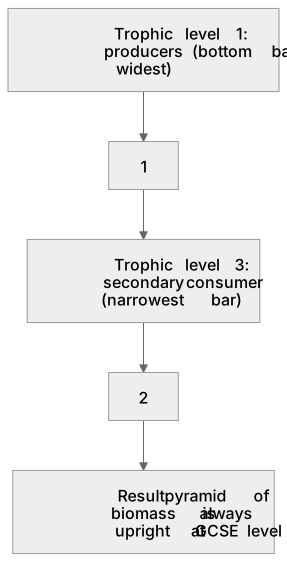
1Box 1
2Box 2
There is more to this lesson
The full lesson goes on to check your understanding and help you earn the marks. Create a free account to carry on, with your progress saved.
A week of Premium from your first lesson · Then the free plan continues · No card, no charge
Test your understanding of Pyramids of biomass: Pyramids of biomass can be constructed to represent the relative amount of biomass in each level of a food chain.
Active recall beats re-reading. Take an instant quiz now to test what you’ve learned and lock it into long-term memory.
A week of Premium from your first lesson · Then the free plan continues · No card, no charge