AQA · GCSE · Biology
Course version: 8461 · Version from Sept 2018
This practical activity also provides opportunities to develop WS and MS.…
Full specification wording
Rate of photosynthesis: This practical activity also provides opportunities to develop WS and MS. Details of all skills are given in Key opportunities for skills development.
This statement explains that the photosynthesis practical develops working scientifically (WS) and mathematical skills (MS), which are listed in the Key opportunities for skills development.
Checked against the AQA 8461 specification (opens in a new tab) on .
- Point 9 of 9
- 2 key terms
Study notes
From the checked teaching notes for this specification point.
The idea
This statement explains that the photosynthesis practical develops working scientifically (WS) and mathematical skills (MS), which are listed in the Key opportunities for skills development. WS includes planning investigations, using apparatus, recording data and evaluating methods. MS includes calculating means, rates and percentages, and interpreting graphs. For example, a student might calculate the mean number of oxygen bubbles per minute at each light intensity and plot a line graph. They might also use the inverse square relationship to predict how light intensity affects the rate.
What earns the marks
- WS: plan an investigation into light intensity and photosynthesis, identifying variables and a control.
- WS: record observations accurately in a table with correct headings and units.
- MS: calculate a mean rate from repeat measurements, for example total bubbles divided by total time.
- MS: plot and interpret a graph of rate against light intensity, describing the pattern.
- MS: use the inverse square law to explain why rate decreases as distance from the lamp increases.
Common mistakes and how to put them right
Confusing WS and MS skills.
Put it right: WS covers investigation design and evaluation, while MS covers calculations and graph work.
Forgetting units when calculating rates.
Put it right: Include units such as bubbles per minute or cm³ per minute.
Drawing a bar chart for continuous data.
Put it right: Use a line graph when both variables are continuous.
Exam tips
- When asked about skills, link your answer to the specific photosynthesis practical rather than giving a general answer.
- For calculations, write the equation, substitute values and give the answer with units.
- When interpreting a graph, quote data points to support your description of the trend.
Try the lesson
The start of the Rate of photosynthesis: This practical activity also provides opportunities to develop WS and MS. Details of all skills are given in Key opportunities for skills development. lesson, made from checked teaching notes for this specification point.
Have a go first
A student investigates the effect of carbon dioxide concentration on the rate of photosynthesis. They record the number of bubbles produced in one minute. Their results for 0.2% carbon dioxide are 14, 15, 29 and 13 bubbles. How should the student process this data to find the most accurate mean?
Listen
This statement explains that the photosynthesis practical develops working scientifically (WS) and mathematical skills (MS), which are listed in the Key opportunities for skills development. WS includes planning investigations, using apparatus, recording data and evaluating methods. MS includes calculating means, rates and percentages, and interpreting graphs. For example, a student might calculate the mean number of oxygen bubbles per minute at each light intensity and plot a line graph. They might also use the inverse square relationship to predict how light intensity affects the rate. A strong answer earns marks for these points. WS: plan an investigation into light intensity and photosynthesis, identifying variables and a control. WS: record observations accurately in a table with correct headings and units. MS: calculate a mean rate from repeat measurements, for example total bubbles divided by total time. MS: plot and interpret a graph of rate against light intensity, describing the pattern. A common slip: Confusing WS and MS skills. Instead, WS covers investigation design and evaluation, while MS covers calculations and graph work. Exam tip: When asked about skills, link your answer to the specific photosynthesis practical rather than giving a general answer.
See it
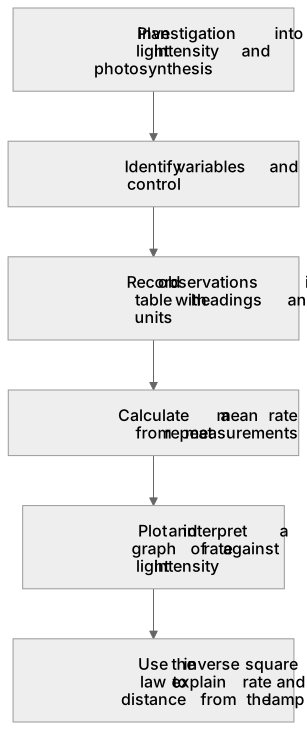
Put it in order
Put these steps in the order they happen.
- 1. Record observations in a table with headings and units
- 2. Identify variables and a control
- 3. Plan investigation into light intensity and photosynthesis
- 4. Use the inverse square law to explain rate and distance from the lamp
- 5. Plot and interpret a graph of rate against light intensity
- 6. Calculate a mean rate from repeat measurements
Key words
Say what each word means before you turn the card.
Working scientifically
Try answering aloud or in your head before turning the card.
Mathematical skills in biology
Try answering aloud or in your head before turning the card.
See every definition
- Working scientifically
- Covers investigation design and evaluation, including planning investigations, using apparatus, recording data and evaluating methods.
- Mathematical skills in biology
- Covers calculations and graph work, including calculating means, rates and percentages, and interpreting graphs.
Label the diagram
Some boxes have lost their names. Pick the right name for each number.
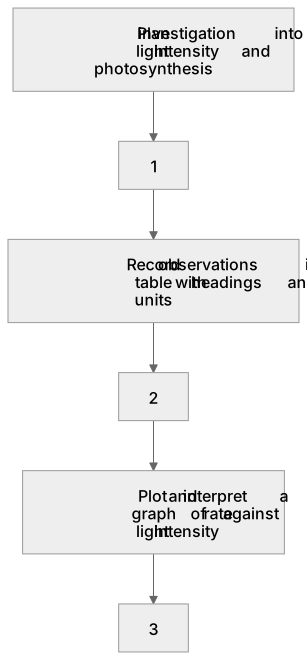
1Box 1
2Box 2
3Box 3
There is more to this lesson
The full lesson goes on to check your understanding and help you earn the marks. Create a free account to carry on, with your progress saved.
A week of Premium from your first lesson · Then the free plan continues · No card, no charge
Test your understanding of Rate of photosynthesis: This practical activity also provides opportunities to develop WS and MS. Details of all skills are given in Key opportunities for skills development.
Active recall beats re-reading. Take an instant quiz now to test what you’ve learned and lock it into long-term memory.
A week of Premium from your first lesson · Then the free plan continues · No card, no charge