AQA · GCSE · Biology
Course version: 8461 · Version from Sept 2018
The resistant strain will then spread because people are not immune to it…
Full specification wording
Resistant bacteria: The resistant strain will then spread because people are not immune to it and there is no effective treatment.
This statement explains why a resistant bacterial strain can spread through a population.
Checked against the AQA 8461 specification (opens in a new tab) on .
- Point 5 of 10
Study notes
From the checked teaching notes for this specification point.
The idea
This statement explains why a resistant bacterial strain can spread through a population. Humans do not have natural immunity to the resistant strain, so more people can become infected. Because the strain is resistant to antibiotics, there may be no effective treatment to stop the infection or reduce transmission. The bacteria can spread from person to person through contact, droplets, contaminated surfaces or medical equipment. In healthcare settings, this is a serious problem because vulnerable patients may be infected. For example, MRSA can spread in hospitals where patients are already ill. The combination of no immunity and no effective treatment allows the resistant strain to increase in the population.
What earns the marks
- People are not immune to the resistant bacterial strain, so they can be infected.
- There is no effective antibiotic treatment for the resistant strain.
- Without effective treatment, the infection is harder to control and can spread more easily.
- Spread can occur through contact, droplets, contaminated surfaces or medical equipment.
Common mistakes and how to put them right
Confusing bacterial resistance with human immunity.
Put it right: People are not immune to the bacterium, and the bacterium is resistant to antibiotics.
Assuming that a resistant strain is always more infectious.
Put it right: Resistance to antibiotics does not automatically mean it spreads faster, but lack of treatment allows it to persist and spread.
Forgetting that spread requires a route of transmission, such as contact or droplets.
Exam tips
- Separate the two reasons clearly: no human immunity and no effective treatment.
- Use a named example such as MRSA to support your answer.
- Mention a transmission route to show how the strain spreads.
Try the lesson
The start of the Resistant bacteria: The resistant strain will then spread because people are not immune to it and there is no effective treatment. lesson, made from checked teaching notes for this specification point.
Have a go first
A resistant strain of bacteria has developed in a hospital. Why is this resistant strain likely to spread between people?
Listen
This statement explains why a resistant bacterial strain can spread through a population. Humans do not have natural immunity to the resistant strain, so more people can become infected. Because the strain is resistant to antibiotics, there may be no effective treatment to stop the infection or reduce transmission. The bacteria can spread from person to person through contact, droplets, contaminated surfaces or medical equipment. In healthcare settings, this is a serious problem because vulnerable patients may be infected. For example, MRSA can spread in hospitals where patients are already ill. The combination of no immunity and no effective treatment allows the resistant strain to increase in the population. A strong answer earns marks for these points. People are not immune to the resistant bacterial strain, so they can be infected. There is no effective antibiotic treatment for the resistant strain. Without effective treatment, the infection is harder to control and can spread more easily. Spread can occur through contact, droplets, contaminated surfaces or medical equipment. Exam tip: Separate the two reasons clearly: no human immunity and no effective treatment.
See it
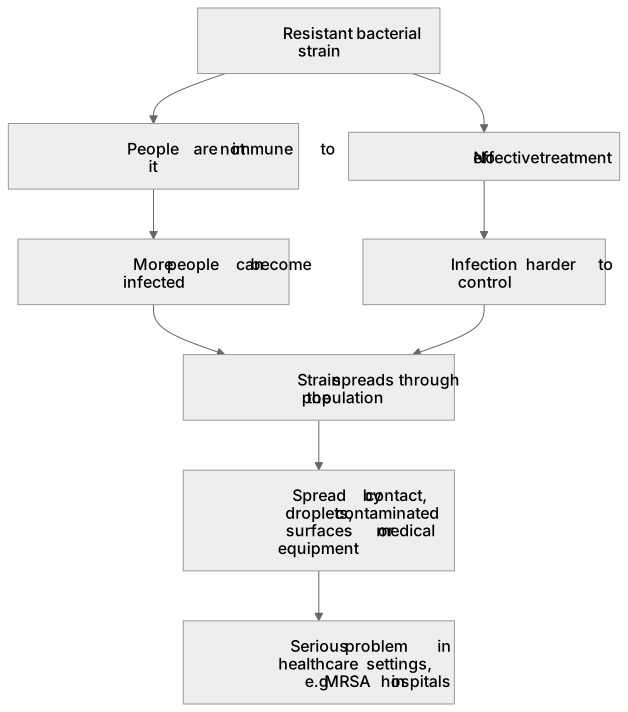
Label the diagram
Some boxes have lost their names. Pick the right name for each number.

1Box 1
2Box 2
3Box 3
There is more to this lesson
The full lesson goes on to check your understanding and help you earn the marks. Create a free account to carry on, with your progress saved.
A week of Premium from your first lesson · Then the free plan continues · No card, no charge
Test your understanding of Resistant bacteria: The resistant strain will then spread because people are not immune to it and there is no effective treatment.
Active recall beats re-reading. Take an instant quiz now to test what you’ve learned and lock it into long-term memory.
A week of Premium from your first lesson · Then the free plan continues · No card, no charge