AQA · GCSE · Biology
Course version: 8461 · Version from Sept 2018
Selective breeding (artificial selection) is the process by which humans…
Full specification wording
Selective breeding: Selective breeding (artificial selection) is the process by which humans breed plants and animals for particular genetic characteristics.
Selective breeding, also called artificial selection, is a human-directed process that changes the inherited characteristics of a population over generations.
Checked against the AQA 8461 specification (opens in a new tab) on .
- Point 2 of 9
- 3 key terms
Study notes
From the checked teaching notes for this specification point.
The idea
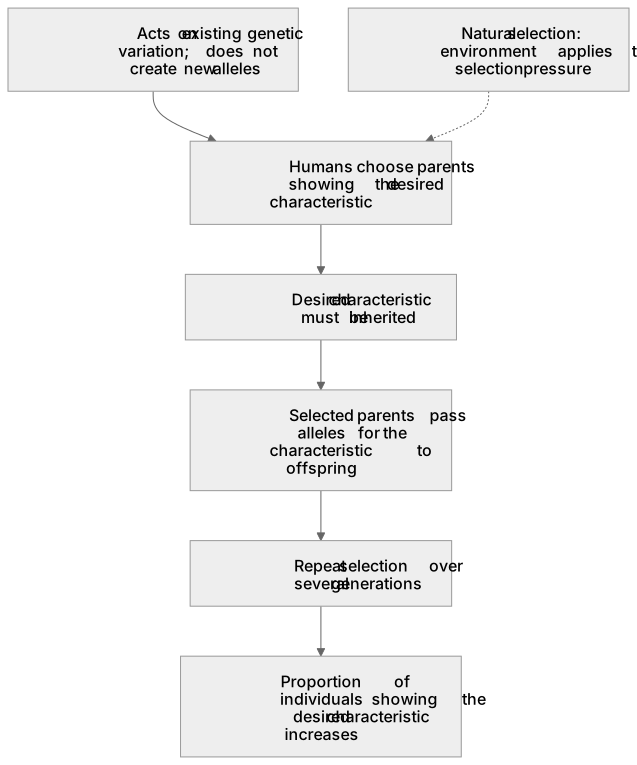
Selective breeding, also called artificial selection, is a human-directed process that changes the inherited characteristics of a population over generations. Humans decide which individuals become parents, so alleles for chosen traits become more common while unwanted alleles become rarer. For example, a farmer wanting higher milk yield measures yield in a herd, breeds the highest-yielding cows with a high-yielding bull, then repeats the selection with the best offspring. The process relies on natural genetic variation and inheritance; it does not create new alleles. It differs from natural selection because humans, not environmental pressures, determine which individuals reproduce. The chosen characteristic must be heritable, and selection usually continues over many generations before a clear population-level change appears.
What earns the marks
- Selective breeding is also known as artificial selection because humans choose which organisms reproduce.
- Humans select parents that already show the desired genetic characteristic, such as high milk yield or large fruit size.
- The desired characteristic must be inherited, so selected parents pass alleles for it to their offspring.
- Repeating selection over several generations increases the proportion of individuals showing the desired characteristic.
- Selective breeding acts on existing genetic variation and does not create new alleles.
Common mistakes and how to put them right
Thinking selective breeding creates new alleles.
Put it right by stating that it selects from existing variation, and new alleles arise only by mutation.
Confusing selective breeding with genetic engineering.
Put it right by noting that selective breeding involves breeding existing organisms, whereas genetic engineering transfers genes directly.
Assuming one round of breeding is enough.
Put it right by explaining that repeated selection over many generations is usually needed for a clear change.
Exam tips
- Define selective breeding in one sentence, then give a named example such as dairy cattle or wheat to show understanding.
- Use the phrase 'desired characteristic' and link it to inheritance, for example by stating that parents pass alleles for the characteristic to offspring.
- When comparing with natural selection, state clearly who or what does the selecting: humans in selective breeding, the environment in natural selection.
Try the lesson
The start of the Selective breeding: Selective breeding (artificial selection) is the process by which humans breed plants and animals for particular genetic characteristics. lesson, made from checked teaching notes for this specification point.
Have a go first
Which statement best describes the process of selective breeding?
Listen
Selective breeding, also called artificial selection, is a human-directed process that changes the inherited characteristics of a population over generations. Humans decide which individuals become parents, so alleles for chosen traits become more common while unwanted alleles become rarer. For example, a farmer wanting higher milk yield measures yield in a herd, breeds the highest-yielding cows with a high-yielding bull, then repeats the selection with the best offspring. The process relies on natural genetic variation and inheritance; it does not create new alleles. It differs from natural selection because humans, not environmental pressures, determine which individuals reproduce. The chosen characteristic must be heritable, and selection usually continues over many generations before a clear population-level change appears. A strong answer earns marks for these points. Selective breeding is also known as artificial selection because humans choose which organisms reproduce. Humans select parents that already show the desired genetic characteristic, such as high milk yield or large fruit size. The desired characteristic must be inherited, so selected parents pass alleles for it to their offspring. Repeating selection over several generations increases the proportion of individuals showing the desired characteristic. A common slip: Thinking selective breeding creates new alleles. Instead, stating that it selects from existing variation, and new alleles arise only by mutation. Exam tip: Define selective breeding in one sentence, then give a named example such as dairy cattle or wheat to show understanding.
See it
Key words
Say what each word means before you turn the card.
Selective breeding
Try answering aloud or in your head before turning the card.
Artificial selection
Try answering aloud or in your head before turning the card.
Natural selection
Try answering aloud or in your head before turning the card.
See every definition
- Selective breeding
- The process by which humans breed plants and animals for particular genetic characteristics, also known as artificial selection.
- Artificial selection
- Another name for selective breeding, because humans choose which organisms reproduce.
- Natural selection
- A process that differs from selective breeding because the selection pressure is applied by the environment rather than by humans.
Label the diagram
Some boxes have lost their names. Pick the right name for each number.
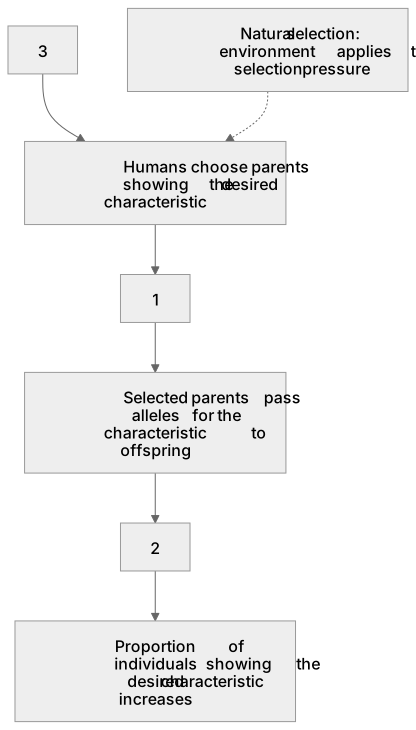
1Box 1
2Box 2
3Box 3
There is more to this lesson
The full lesson goes on to check your understanding and help you earn the marks. Create a free account to carry on, with your progress saved.
A week of Premium from your first lesson · Then the free plan continues · No card, no charge
Test your understanding of Selective breeding: Selective breeding (artificial selection) is the process by which humans breed plants and animals for particular genetic characteristics.
Active recall beats re-reading. Take an instant quiz now to test what you’ve learned and lock it into long-term memory.
A week of Premium from your first lesson · Then the free plan continues · No card, no charge