AQA · GCSE · Biology
Course version: 8461 · Version from Sept 2018
Alfred Russel Wallace independently proposed the theory of evolution by…
Full specification wording
Speciation (biology only): Alfred Russel Wallace independently proposed the theory of evolution by natural selection.
Wallace reached the same conclusion as Darwin without seeing Darwin's unpublished work.
Checked against the AQA 8461 specification (opens in a new tab) on .
- Point 2 of 7
- 3 key terms
Study notes
From the checked teaching notes for this specification point.
The idea
Wallace reached the same conclusion as Darwin without seeing Darwin's unpublished work. While collecting specimens in the Malay Archipelago, he noticed that closely related species often lived in nearby but separate areas, and that each area had species suited to local conditions. He sent Darwin an essay in 1858 outlining natural selection. This showed that the mechanism was not a one-off insight but could be worked out from evidence. Wallace's fieldwork also contributed to ideas about geographical distribution and warning colouration. His independence strengthened the theory because two naturalists using different evidence reached the same explanation.
What earns the marks
- State that Wallace developed the idea of natural selection independently of Darwin.
- Describe Wallace's fieldwork in South America and South-East Asia as a source of evidence.
- Explain that Wallace observed variation and adaptation in species living in different regions.
- Explain that his essay sent to Darwin in 1858 described the same mechanism.
- Recognise that independent discovery strengthened confidence in the theory.
Common mistakes and how to put them right
Claiming Wallace copied Darwin's idea.
Put it right by stating he worked independently and sent his essay to Darwin.
Confusing Wallace with Lamarck.
Put it right by noting Wallace proposed natural selection, not inheritance of acquired characteristics.
Saying Wallace only studied birds.
Put it right by referring more broadly to his work on variation, adaptation and geographical distribution.
Exam tips
- Use the word 'independently' to show you know Wallace was not working from Darwin's notes.
- Give one concrete detail of Wallace's fieldwork, such as his travels in the Malay Archipelago.
- Link his proposal to the same mechanism as Darwin: inherited variation, survival and reproduction.
Try the lesson
The start of the Speciation (biology only): Alfred Russel Wallace independently proposed the theory of evolution by natural selection. lesson, made from checked teaching notes for this specification point.
Have a go first
Which scientist independently proposed the theory of evolution by natural selection at the same time as Charles Darwin?
Listen
Wallace reached the same conclusion as Darwin without seeing Darwin's unpublished work. While collecting specimens in the Malay Archipelago, he noticed that closely related species often lived in nearby but separate areas, and that each area had species suited to local conditions. He sent Darwin an essay in 1858 outlining natural selection. This showed that the mechanism was not a one-off insight but could be worked out from evidence. Wallace's fieldwork also contributed to ideas about geographical distribution and warning colouration. His independence strengthened the theory because two naturalists using different evidence reached the same explanation. A strong answer earns marks for these points. State that Wallace developed the idea of natural selection independently of Darwin. Describe Wallace's fieldwork in South America and South-East Asia as a source of evidence. Explain that Wallace observed variation and adaptation in species living in different regions. Explain that his essay sent to Darwin in 1858 described the same mechanism. A common slip: Claiming Wallace copied Darwin's idea. Instead, stating he worked independently and sent his essay to Darwin. Exam tip: Use the word 'independently' to show you know Wallace was not working from Darwin's notes.
See it
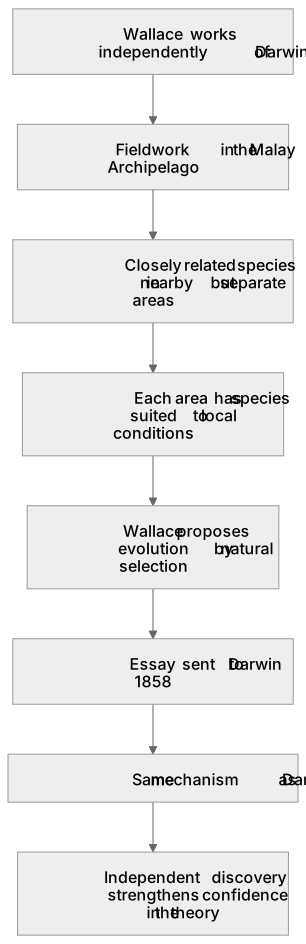
Put it in order
Put these steps in the order they happen.
- 1. Wallace proposes evolution by natural selection
- 2. Independent discovery strengthens confidence in the theory
- 3. Essay sent to Darwin in 1858
- 4. Wallace works independently of Darwin
- 5. Fieldwork in the Malay Archipelago
- 6. Same mechanism as Darwin
- 7. Closely related species in nearby but separate areas
- 8. Each area has species suited to local conditions
Key words
Say what each word means before you turn the card.
Independent discovery
Try answering aloud or in your head before turning the card.
Natural selection
Try answering aloud or in your head before turning the card.
Field evidence and biogeography
Try answering aloud or in your head before turning the card.
See every definition
- Independent discovery
- Reaching the same conclusion as another person without seeing their unpublished work, as when Wallace reached the same conclusion as Darwin.
- Natural selection
- The theory of evolution that Wallace independently proposed and that he outlined in an essay sent to Darwin in 1858.
- Field evidence and biogeography
- Observations from fieldwork, such as closely related species living in nearby but separate areas and species suited to local conditions, which contributed to ideas about geographical distribution.
Label the diagram
Some boxes have lost their names. Pick the right name for each number.
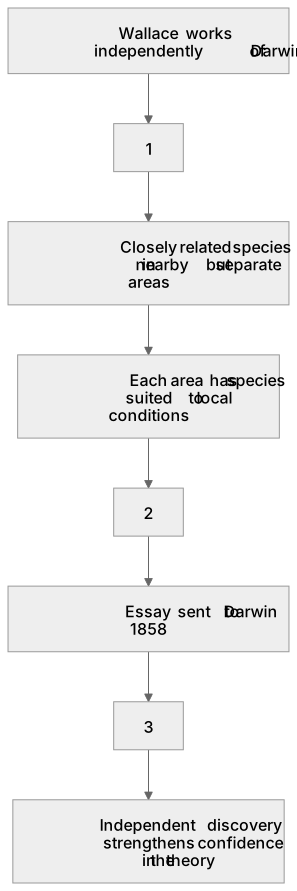
1Box 1
2Box 2
3Box 3
There is more to this lesson
The full lesson goes on to check your understanding and help you earn the marks. Create a free account to carry on, with your progress saved.
A week of Premium from your first lesson · Then the free plan continues · No card, no charge
Test your understanding of Speciation (biology only): Alfred Russel Wallace independently proposed the theory of evolution by natural selection.
Active recall beats re-reading. Take an instant quiz now to test what you’ve learned and lock it into long-term memory.
A week of Premium from your first lesson · Then the free plan continues · No card, no charge