AQA · GCSE · Biology
Course version: 8461 · Version from Sept 2018
Students should be able to explain how the various structures in a reflex…
Full specification wording
Structure and function: Students should be able to explain how the various structures in a reflex arc – including the sensory neurone, synapse, relay neurone and motor neurone – relate to their function.
A reflex arc is the fixed pathway taken by a nerve impulse during a rapid, automatic response that does not involve conscious thought.
Checked against the AQA 8461 specification (opens in a new tab) on .
- Point 7 of 13
- 4 key terms
Study notes
From the checked teaching notes for this specification point.
The idea
A reflex arc is the fixed pathway taken by a nerve impulse during a rapid, automatic response that does not involve conscious thought. A receptor detects a stimulus and generates an electrical impulse in a sensory neurone, which carries it towards the central nervous system. At a synapse, the impulse causes release of a neurotransmitter that diffuses across the tiny gap and stimulates the next neurone, so the signal passes to a relay neurone inside the spinal cord or brain. The relay neurone links sensory and motor pathways, allowing the impulse to be processed and directed. A motor neurone then carries the impulse to an effector, such as a muscle or gland, which produces the response. Each structure's shape and position suit its role: long fibres conduct quickly, and the synapse ensures one-way transmission.
What earns the marks
- A receptor detects a stimulus and initiates an electrical impulse in a sensory neurone.
- The sensory neurone carries the impulse from the receptor towards the central nervous system.
- At a synapse, a neurotransmitter is released, diffuses across the gap and stimulates the next neurone, allowing the impulse to continue.
- A relay neurone in the central nervous system connects the sensory neurone to the motor neurone, coordinating the pathway.
- The motor neurone carries the impulse away from the central nervous system to an effector.
- An effector, such as a muscle or gland, responds by contracting or secreting, producing the reflex action.
- The arrangement of neurones and synapses makes the pathway rapid and automatic, protecting the body from harm.
Common mistakes and how to put them right
Thinking the impulse travels across a synapse as an electrical signal.
Put it right: A chemical neurotransmitter diffuses across the gap and triggers a new electrical impulse.
Believing the relay neurone is found in the effector.
Put it right: Relay neurones are located in the central nervous system, linking sensory and motor neurones.
Stating that a motor neurone carries impulses towards the central nervous system.
Put it right: Motor neurones carry impulses away from the central nervous system to effectors.
Exam tips
- Name each neurone in the correct sequence and state the direction of impulse travel, using the terms receptor, coordinator and effector.
- When describing a synapse, include the words neurotransmitter, diffusion and stimulation of the next neurone rather than saying the impulse simply jumps the gap.
- Link each structure to its function in the same sentence, for example the long fibre of a sensory neurone carries impulses rapidly to the central nervous system.
Try the lesson
The start of the Structure and function: Students should be able to explain how the various structures in a reflex arc – including the sensory neurone, synapse, relay neurone and motor neurone – relate to their function. lesson, made from checked teaching notes for this specification point.
Have a go first
In a reflex arc, which structure carries the electrical impulse from the receptor to the central nervous system?
Listen
A reflex arc is the fixed pathway taken by a nerve impulse during a rapid, automatic response that does not involve conscious thought. A receptor detects a stimulus and generates an electrical impulse in a sensory neurone, which carries it towards the central nervous system. At a synapse, the impulse causes release of a neurotransmitter that diffuses across the tiny gap and stimulates the next neurone, so the signal passes to a relay neurone inside the spinal cord or brain. The relay neurone links sensory and motor pathways, allowing the impulse to be processed and directed. A motor neurone then carries the impulse to an effector, such as a muscle or gland, which produces the response. Each structure's shape and position suit its role: long fibres conduct quickly, and the synapse ensures one-way transmission. A strong answer earns marks for these points. A receptor detects a stimulus and initiates an electrical impulse in a sensory neurone. The sensory neurone carries the impulse from the receptor towards the central nervous system. At a synapse, a neurotransmitter is released, diffuses across the gap and stimulates the next neurone, allowing the impulse to continue. A relay neurone in the central nervous system connects the sensory neurone to the motor neurone, coordinating the pathway. A common slip: Thinking the impulse travels across a synapse as an electrical signal. Instead, a chemical neurotransmitter diffuses across the gap and triggers a new electrical impulse. Exam tip: Name each neurone in the correct sequence and state the direction of impulse travel, using the terms receptor, coordinator and effector.
See it
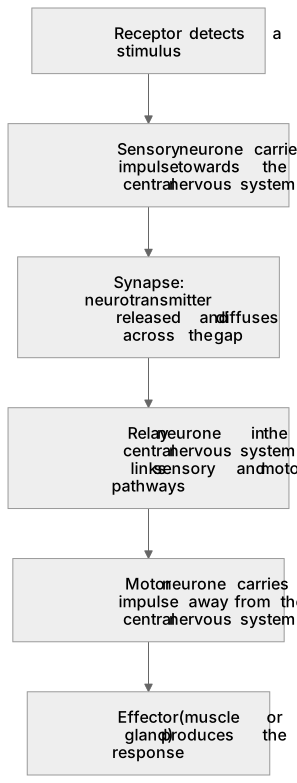
Put it in order
Put these steps in the order they happen.
- 1. Synapse: neurotransmitter released and diffuses across the gap
- 2. Sensory neurone carries impulse towards the central nervous system
- 3. Receptor detects a stimulus
- 4. Effector (muscle or gland) produces the response
- 5. Motor neurone carries impulse away from the central nervous system
- 6. Relay neurone in the central nervous system links sensory and motor pathways
Key words
Say what each word means before you turn the card.
Reflex arc
Try answering aloud or in your head before turning the card.
Synapse
Try answering aloud or in your head before turning the card.
Relay neurone
Try answering aloud or in your head before turning the card.
Effector
Try answering aloud or in your head before turning the card.
See every definition
- Reflex arc
- The fixed pathway taken by a nerve impulse during a rapid, automatic response that does not involve conscious thought.
- Synapse
- The tiny gap at which a neurotransmitter is released, diffuses across and stimulates the next neurone, ensuring one-way transmission.
- Relay neurone
- A neurone inside the spinal cord or brain that links sensory and motor pathways, allowing the impulse to be processed and directed.
- Effector
- A muscle or gland that responds by contracting or secreting, producing the reflex action.
Label the diagram
Some boxes have lost their names. Pick the right name for each number.
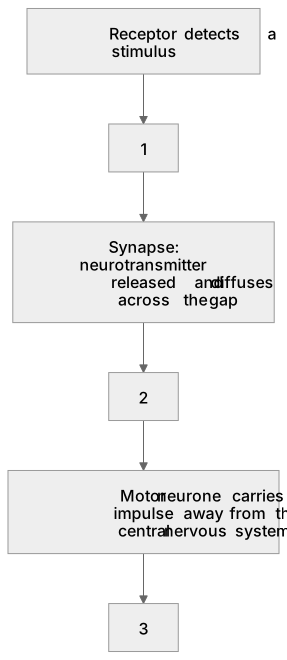
1Box 1
2Box 2
3Box 3
There is more to this lesson
The full lesson goes on to check your understanding and help you earn the marks. Create a free account to carry on, with your progress saved.
A week of Premium from your first lesson · Then the free plan continues · No card, no charge
Test your understanding of Structure and function: Students should be able to explain how the various structures in a reflex arc – including the sensory neurone, synapse, relay neurone and motor neurone – relate to their function.
Active recall beats re-reading. Take an instant quiz now to test what you’ve learned and lock it into long-term memory.
A week of Premium from your first lesson · Then the free plan continues · No card, no charge