AQA · GCSE · Biology
Course version: 8461 · Version from Sept 2018
The nervous system enables humans to react to their surroundings and to…
Full specification wording
Structure and function: The nervous system enables humans to react to their surroundings and to coordinate their behaviour.
The nervous system allows humans to detect changes in their surroundings and produce appropriate responses.
Checked against the AQA 8461 specification (opens in a new tab) on .
- Point 2 of 13
- 4 key terms
Study notes
From the checked teaching notes for this specification point.
The idea
The nervous system allows humans to detect changes in their surroundings and produce appropriate responses. Receptors detect stimuli such as light, sound, touch, temperature and chemicals. Electrical impulses travel along sensory neurones to the central nervous system, which processes the information and coordinates a response. Motor neurones then carry impulses to effectors, which are muscles or glands. Muscles contract to produce movement, while glands secrete chemicals such as hormones. This coordination allows rapid reactions, including reflexes such as withdrawing a hand from a hot object, and more complex behaviours such as catching a ball. The nervous system therefore links detection of a stimulus to a coordinated response, helping the body respond to its environment and maintain control.
What earns the marks
- Receptors detect stimuli in the surroundings.
- Sensory neurones carry impulses to the CNS.
- The CNS coordinates the response by processing information.
- Motor neurones carry impulses to effectors.
- Effectors are muscles, which contract, or glands, which secrete chemicals.
- Reflex actions are rapid, automatic responses that protect the body.
Common mistakes and how to put them right
Saying the brain directly detects stimuli.
Put it right: Receptors detect stimuli and send impulses to the CNS.
Thinking effectors are only muscles.
Put it right: Glands are also effectors and respond by secreting chemicals.
Confusing a reflex with a voluntary action.
Put it right: Reflexes are rapid and automatic, while voluntary actions involve conscious decision-making.
Exam tips
- Use the stimulus–receptor–coordinator–effector–response sequence in your answers.
- Give a named example, such as withdrawing a hand from a hot object, to show coordination.
- State clearly that the CNS coordinates the response rather than simply passing it on.
Try the lesson
The start of the Structure and function: The nervous system enables humans to react to their surroundings and to coordinate their behaviour. lesson, made from checked teaching notes for this specification point.
Have a go first
Which part of the human nervous system is responsible for coordinating the response to a stimulus?
Listen
The nervous system allows humans to detect changes in their surroundings and produce appropriate responses. Receptors detect stimuli such as light, sound, touch, temperature and chemicals. Electrical impulses travel along sensory neurones to the central nervous system, which processes the information and coordinates a response. Motor neurones then carry impulses to effectors, which are muscles or glands. Muscles contract to produce movement, while glands secrete chemicals such as hormones. This coordination allows rapid reactions, including reflexes such as withdrawing a hand from a hot object, and more complex behaviours such as catching a ball. The nervous system therefore links detection of a stimulus to a coordinated response, helping the body respond to its environment and maintain control. A strong answer earns marks for these points. Receptors detect stimuli in the surroundings. Sensory neurones carry impulses to the CNS. The CNS coordinates the response by processing information. Motor neurones carry impulses to effectors. A common slip: Saying the brain directly detects stimuli. Instead, receptors detect stimuli and send impulses to the CNS. Exam tip: Use the stimulus–receptor–coordinator–effector–response sequence in your answers.
See it
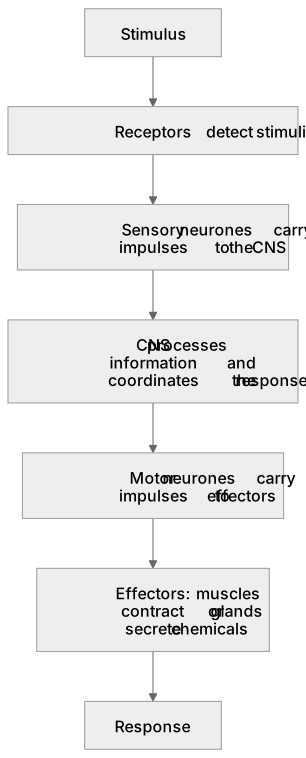
Put it in order
Put these steps in the order they happen.
- 1. Response
- 2. Effectors: muscles contract or glands secrete chemicals
- 3. Sensory neurones carry impulses to the CNS
- 4. Motor neurones carry impulses to effectors
- 5. Stimulus
- 6. Receptors detect stimuli
- 7. CNS processes information and coordinates the response
Key words
Say what each word means before you turn the card.
Stimulus and response
Try answering aloud or in your head before turning the card.
Coordination
Try answering aloud or in your head before turning the card.
Reflex action
Try answering aloud or in your head before turning the card.
Effectors and response
Try answering aloud or in your head before turning the card.
See every definition
- Stimulus and response
- Receptors detect stimuli in the surroundings, and the nervous system links this detection to a coordinated response.
- Coordination
- The central nervous system processes information and coordinates the response, allowing rapid reactions and more complex behaviours.
- Reflex action
- Rapid, automatic responses that protect the body, such as withdrawing a hand from a hot object.
- Effectors and response
- Muscles, which contract, or glands, which secrete chemicals, respond to impulses carried by motor neurones.
Label the diagram
Some boxes have lost their names. Pick the right name for each number.
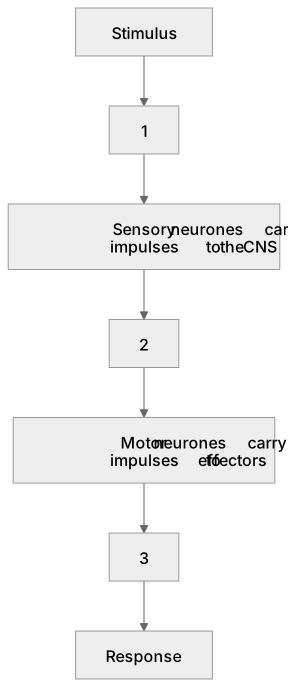
1Box 1
2Box 2
3Box 3
There is more to this lesson
The full lesson goes on to check your understanding and help you earn the marks. Create a free account to carry on, with your progress saved.
A week of Premium from your first lesson · Then the free plan continues · No card, no charge
Test your understanding of Structure and function: The nervous system enables humans to react to their surroundings and to coordinate their behaviour.
Active recall beats re-reading. Take an instant quiz now to test what you’ve learned and lock it into long-term memory.
A week of Premium from your first lesson · Then the free plan continues · No card, no charge