AQA · GCSE · Biology
Course version: 8461 · Version from Sept 2018
Control of net size and the introduction of fishing quotas play important…
Full specification wording
Sustainable fisheries: Control of net size and the introduction of fishing quotas play important roles in conservation of fish stocks at a sustainable level.
Two main methods help conserve fish stocks.
Checked against the AQA 8461 specification (opens in a new tab) on .
- Point 3 of 3
- 4 key terms
Study notes
From the checked teaching notes for this specification point.
The idea
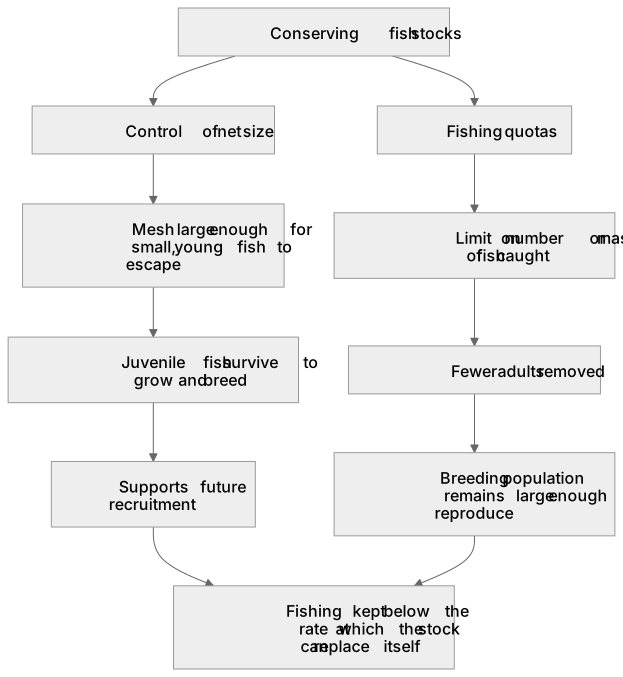
Two main methods help conserve fish stocks. First, controlling net size means using nets with a mesh large enough to let young, small fish escape while retaining larger adult fish. This allows juveniles to grow and breed before they are caught, supporting future recruitment. Second, fishing quotas set a limit on the number or mass of fish that can be caught from a particular stock in a given period. Quotas prevent too many adults being removed, so the breeding population remains large enough to reproduce. Together, these measures aim to keep the rate of fishing below the rate at which the stock can replace itself.
For example: A quota might limit a fleet to a set tonnage of cod per year, while a larger mesh size reduces the catch of undersized cod.
What earns the marks
- State that controlling net size means using a mesh that allows small, young fish to escape.
- Explain that larger mesh sizes let juvenile fish survive to grow and breed, supporting future stocks.
- Describe fishing quotas as limits on the number or mass of fish that can be caught.
- Explain that quotas reduce the removal of adult fish so the breeding population remains sustainable.
- Recognise that both methods aim to keep fishing at a level the stock can replace.
Common mistakes and how to put them right
Thinking that smaller mesh nets are better for conservation.
Put it right: Smaller mesh catches more young fish and harms future stocks.
Confusing quotas with total bans.
Put it right: A quota allows a limited catch, whereas a ban prohibits fishing entirely.
Assuming net size alone is enough.
Put it right: Quotas and net size work together to protect breeding adults and juveniles.
Exam tips
- Name both methods and explain the effect of each on the fish population.
- Use the terms ‘juvenile fish’ and ‘breeding adults’ to show which part of the population each method protects.
- Link each method to the idea of keeping fishing below the rate of reproduction.
Try the lesson
The start of the Sustainable fisheries: Control of net size and the introduction of fishing quotas play important roles in conservation of fish stocks at a sustainable level. lesson, made from checked teaching notes for this specification point.
Have a go first
Which action helps to conserve fish stocks at a sustainable level by limiting the number of fish that can be caught?
Listen
Two main methods help conserve fish stocks. First, controlling net size means using nets with a mesh large enough to let young, small fish escape while retaining larger adult fish. This allows juveniles to grow and breed before they are caught, supporting future recruitment. Second, fishing quotas set a limit on the number or mass of fish that can be caught from a particular stock in a given period. Quotas prevent too many adults being removed, so the breeding population remains large enough to reproduce. Together, these measures aim to keep the rate of fishing below the rate at which the stock can replace itself. For example, a quota might limit a fleet to a set tonnage of cod per year, while a larger mesh size reduces the catch of undersized cod. A strong answer earns marks for these points. State that controlling net size means using a mesh that allows small, young fish to escape. Explain that larger mesh sizes let juvenile fish survive to grow and breed, supporting future stocks. Describe fishing quotas as limits on the number or mass of fish that can be caught. Explain that quotas reduce the removal of adult fish so the breeding population remains sustainable. Exam tip: Name both methods and explain the effect of each on the fish population.
See it
Key words
Say what each word means before you turn the card.
Sustainable fisheries
Try answering aloud or in your head before turning the card.
Conservation methods
Try answering aloud or in your head before turning the card.
Net size
Try answering aloud or in your head before turning the card.
Fishing quotas
Try answering aloud or in your head before turning the card.
See every definition
- Sustainable fisheries
- Fishing kept at a level the stock can replace, so fish stocks are conserved at a sustainable level.
- Conservation methods
- Controlling net size and introducing fishing quotas, which together aim to keep the rate of fishing below the rate at which the stock can replace itself.
- Net size
- Using a mesh large enough to let young, small fish escape while retaining larger adult fish, so juveniles can grow and breed before they are caught.
- Fishing quotas
- A limit on the number or mass of fish that can be caught from a particular stock in a given period, so the breeding population remains large enough to reproduce.
Label the diagram
Some boxes have lost their names. Pick the right name for each number.
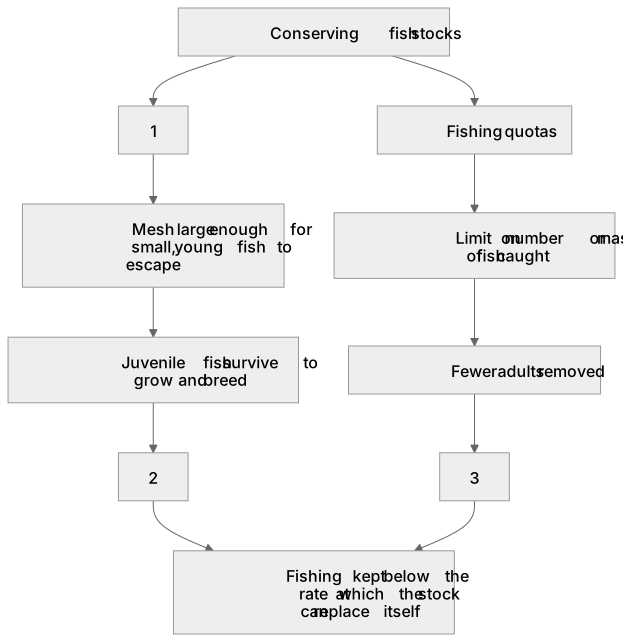
1Box 1
2Box 2
3Box 3
There is more to this lesson
The full lesson goes on to check your understanding and help you earn the marks. Create a free account to carry on, with your progress saved.
A week of Premium from your first lesson · Then the free plan continues · No card, no charge
Test your understanding of Sustainable fisheries: Control of net size and the introduction of fishing quotas play important roles in conservation of fish stocks at a sustainable level.
Active recall beats re-reading. Take an instant quiz now to test what you’ve learned and lock it into long-term memory.
A week of Premium from your first lesson · Then the free plan continues · No card, no charge