AQA · GCSE · Biology
Course version: 8461 · Version from Sept 2018
Students should be able to: • discuss the human and financial cost of…
Full specification wording
The effect of lifestyle on some non-communicable diseases: Students should be able to: • discuss the human and financial cost of these non-communicable diseases to an individual, a local community, a nation or globally • explain the effect of lifestyle factors including diet, alcohol and smoking on the incidence of non-communicable diseases at local, national and global levels.
Non-communicable diseases cannot be passed from person to person.
Checked against the AQA 8461 specification (opens in a new tab) on .
- Point 1 of 9
- 4 key terms
Study notes
From the checked teaching notes for this specification point.
The idea
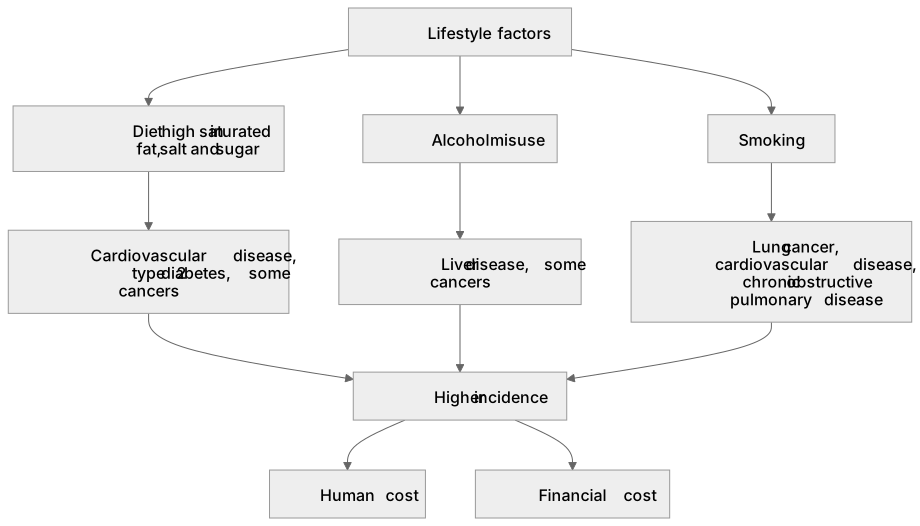
Non-communicable diseases cannot be passed from person to person. Their human cost includes pain, disability, reduced quality of life, premature death and emotional strain on families and carers. Their financial cost includes treatment, lost income, care costs and reduced productivity. Lifestyle factors affect incidence, which means the number of new cases in a population over a period. A diet high in saturated fat, salt and sugar raises the risk of cardiovascular disease, type 2 diabetes and some cancers. Alcohol misuse raises the risk of liver disease and some cancers. Smoking raises the risk of lung cancer, cardiovascular disease and chronic obstructive pulmonary disease. These effects can be analysed at individual, local, national and global levels.
What earns the marks
- Non-communicable diseases are not infectious and cannot be transmitted between people.
- Human costs include pain, disability, reduced quality of life, premature death and emotional effects on families and carers.
- Financial costs include treatment, care, lost income and reduced productivity for individuals, communities, nations and globally.
- A diet high in saturated fat, salt and sugar increases the risk of cardiovascular disease, type 2 diabetes and some cancers.
- Alcohol misuse increases the risk of liver disease and some cancers; smoking increases the risk of lung cancer, cardiovascular disease and chronic obstructive pulmonary disease.
- Incidence means the number of new cases in a population over a period, and lifestyle factors can change incidence at local, national and global levels.
Common mistakes and how to put them right
Confusing incidence with prevalence.
Put it right by defining incidence as new cases over a period and prevalence as all existing cases at a point in time.
Claiming that a lifestyle factor guarantees disease.
Put it right by saying it increases the risk or is associated with a higher incidence.
Describing non-communicable diseases as infectious.
Put it right by stating that they are not passed from person to person.
Exam tips
- Structure extended answers by scale: individual, local community, nation and global, using a named disease example for each lifestyle factor.
- Use data or graphs if provided to compare incidence between populations or over time, and quote figures accurately.
- Distinguish human costs from financial costs clearly, and avoid repeating the same point in both categories.
Try the lesson
The start of the The effect of lifestyle on some non-communicable diseases: Students should be able to: • discuss the human and financial cost of these non-communicable diseases to an individual, a local community, a nation or globally • explain the effect of lifestyle factors including diet, alcohol and smoking on the incidence of non-communicable diseases at local, national and global levels. lesson, made from checked teaching notes for this specification point.
Have a go first
Which of the following is a lifestyle factor that can affect the incidence of non-communicable diseases?
Listen
Non-communicable diseases cannot be passed from person to person. Their human cost includes pain, disability, reduced quality of life, premature death and emotional strain on families and carers. Their financial cost includes treatment, lost income, care costs and reduced productivity. Lifestyle factors affect incidence, which means the number of new cases in a population over a period. A diet high in saturated fat, salt and sugar raises the risk of cardiovascular disease, type 2 diabetes and some cancers. Alcohol misuse raises the risk of liver disease and some cancers. Smoking raises the risk of lung cancer, cardiovascular disease and chronic obstructive pulmonary disease. These effects can be analysed at individual, local, national and global levels. A strong answer earns marks for these points. Non-communicable diseases are not infectious and cannot be transmitted between people. Human costs include pain, disability, reduced quality of life, premature death and emotional effects on families and carers. Financial costs include treatment, care, lost income and reduced productivity for individuals, communities, nations and globally. A diet high in saturated fat, salt and sugar increases the risk of cardiovascular disease, type 2 diabetes and some cancers. A common slip: Confusing incidence with prevalence. Instead, defining incidence as new cases over a period and prevalence as all existing cases at a point in time. Exam tip: Structure extended answers by scale: individual, local community, nation and global, using a named disease example for each lifestyle factor.
See it
Key words
Say what each word means before you turn the card.
Non-communicable disease burden
Try answering aloud or in your head before turning the card.
Human versus financial cost
Try answering aloud or in your head before turning the card.
Lifestyle risk factors
Try answering aloud or in your head before turning the card.
Incidence at different scales
Try answering aloud or in your head before turning the card.
See every definition
- Non-communicable disease burden
- Non-communicable diseases cannot be passed from person to person, and their burden includes human costs such as pain, disability, reduced quality of life, premature death and emotional strain on families and carers.
- Human versus financial cost
- Human costs include pain, disability, reduced quality of life, premature death and emotional strain on families and carers, while financial costs include treatment, lost income, care costs and reduced productivity.
- Lifestyle risk factors
- Diet, alcohol and smoking affect the incidence of non-communicable diseases, with a diet high in saturated fat, salt and sugar, alcohol misuse and smoking each raising the risk of named diseases.
- Incidence at different scales
- Incidence means the number of new cases in a population over a period, and lifestyle factors can change incidence at local, national and global levels.
Label the diagram
Some boxes have lost their names. Pick the right name for each number.
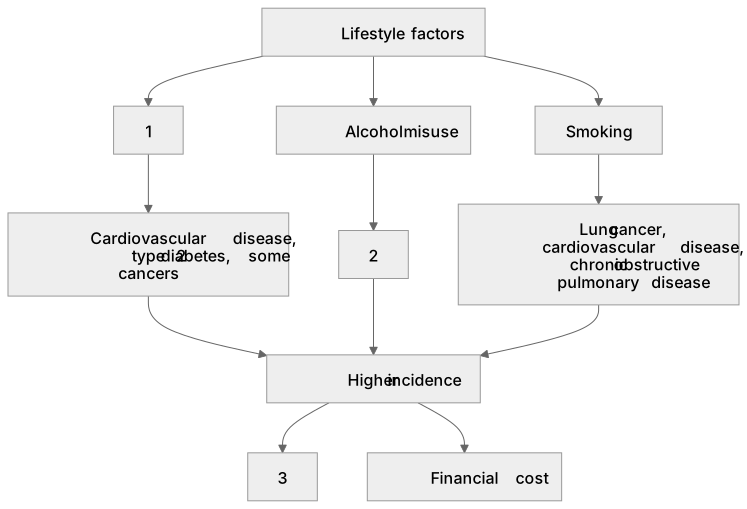
1Box 1
2Box 2
3Box 3
There is more to this lesson
The full lesson goes on to check your understanding and help you earn the marks. Create a free account to carry on, with your progress saved.
A week of Premium from your first lesson · Then the free plan continues · No card, no charge
Test your understanding of The effect of lifestyle on some non-communicable diseases: Students should be able to: • discuss the human and financial cost of these non-communicable diseases to an individual, a local community, a nation or globally • explain the effect of lifestyle factors including diet, alcohol and smoking on the incidence of non-communicable diseases at local, national and global levels.
Active recall beats re-reading. Take an instant quiz now to test what you’ve learned and lock it into long-term memory.
A week of Premium from your first lesson · Then the free plan continues · No card, no charge