AQA · GCSE · Biology
Course version: 8461 · Version from Sept 2018
Students should be able to relate the structures of the eye to their…
Full specification wording
The eye (biology only): Students should be able to relate the structures of the eye to their functions. This includes: • accommodation to focus on near or distant objects • adaptation to dim light.
The eye has structures whose shapes and positions suit their functions.
Checked against the AQA 8461 specification (opens in a new tab) on .
- Point 1 of 10
- 2 key terms
Study notes
From the checked teaching notes for this specification point.
The idea
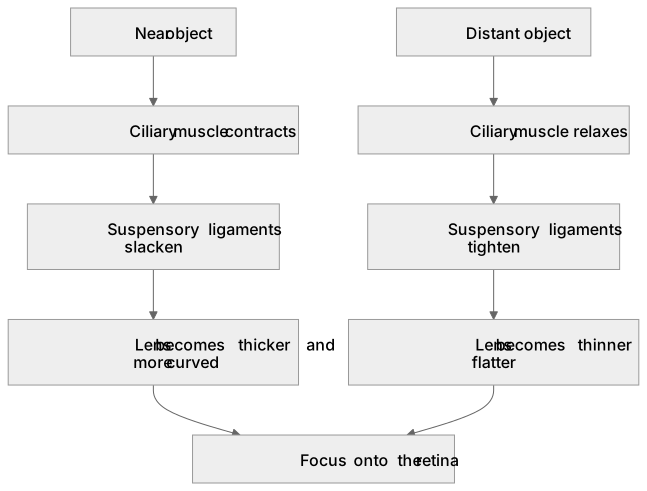
The eye has structures whose shapes and positions suit their functions. The cornea refracts light into the eye, the iris controls pupil diameter, and the lens fine-tunes focus onto the retina, where receptors detect light. Accommodation is the lens changing shape to focus near or distant objects. To focus a near object, the ciliary muscle contracts, suspensory ligaments slacken, and the lens becomes thicker and more curved. To focus a distant object, the ciliary muscle relaxes, ligaments tighten, and the lens becomes thinner and flatter. Adaptation to dim light occurs in the iris: the radial muscles contract and circular muscles relax, widening the pupil so more light enters the retina.
What earns the marks
- The cornea refracts light and the lens fine-tunes focus onto the retina.
- Accommodation is the lens changing shape to focus on near or distant objects.
- For a near object, ciliary muscle contracts, suspensory ligaments slacken, and the lens becomes thicker and more curved.
- For a distant object, ciliary muscle relaxes, suspensory ligaments tighten, and the lens becomes thinner and flatter.
- In dim light, radial muscles in the iris contract and circular muscles relax, widening the pupil.
- In bright light, circular muscles contract and radial muscles relax, narrowing the pupil to protect the retina.
Common mistakes and how to put them right
Saying the lens becomes thicker for distant objects.
Put it right: The lens becomes thinner and flatter for distant objects and thicker and more curved for near objects.
Confusing the roles of ciliary muscle and suspensory ligaments.
Put it right: Ciliary muscle contraction slackens the ligaments, allowing the lens to become thicker.
Thinking the pupil widens because the lens changes.
Put it right: Pupil diameter is controlled by the iris muscles, not the lens.
Exam tips
- Use the sequence ciliary muscle, suspensory ligaments, lens shape when explaining accommodation.
- State the direction of change clearly: near objects need a thicker lens, distant objects need a thinner lens.
- For adaptation to dim light, name both muscle groups and their actions in the iris.
Try the lesson
The start of the The eye (biology only): Students should be able to relate the structures of the eye to their functions. This includes: • accommodation to focus on near or distant objects • adaptation to dim light. lesson, made from checked teaching notes for this specification point.
Have a go first
Which part of the eye changes shape to focus light onto the retina when looking at a near object?
Listen
The eye has structures whose shapes and positions suit their functions. The cornea refracts light into the eye, the iris controls pupil diameter, and the lens fine-tunes focus onto the retina, where receptors detect light. Accommodation is the lens changing shape to focus near or distant objects. To focus a near object, the ciliary muscle contracts, suspensory ligaments slacken, and the lens becomes thicker and more curved. To focus a distant object, the ciliary muscle relaxes, ligaments tighten, and the lens becomes thinner and flatter. Adaptation to dim light occurs in the iris: the radial muscles contract and circular muscles relax, widening the pupil so more light enters the retina. A strong answer earns marks for these points. The cornea refracts light and the lens fine-tunes focus onto the retina. Accommodation is the lens changing shape to focus on near or distant objects. For a near object, ciliary muscle contracts, suspensory ligaments slacken, and the lens becomes thicker and more curved. For a distant object, ciliary muscle relaxes, suspensory ligaments tighten, and the lens becomes thinner and flatter. A common slip: Saying the lens becomes thicker for distant objects. Instead, the lens becomes thinner and flatter for distant objects and thicker and more curved for near objects. Exam tip: Use the sequence ciliary muscle, suspensory ligaments, lens shape when explaining accommodation.
See it
Key words
Say what each word means before you turn the card.
Accommodation
Try answering aloud or in your head before turning the card.
Iris
Try answering aloud or in your head before turning the card.
See every definition
- Accommodation
- The lens changing shape to focus on near or distant objects.
- Iris
- Controls pupil diameter, and in dim light its radial muscles contract and circular muscles relax, widening the pupil.
Label the diagram
Some boxes have lost their names. Pick the right name for each number.
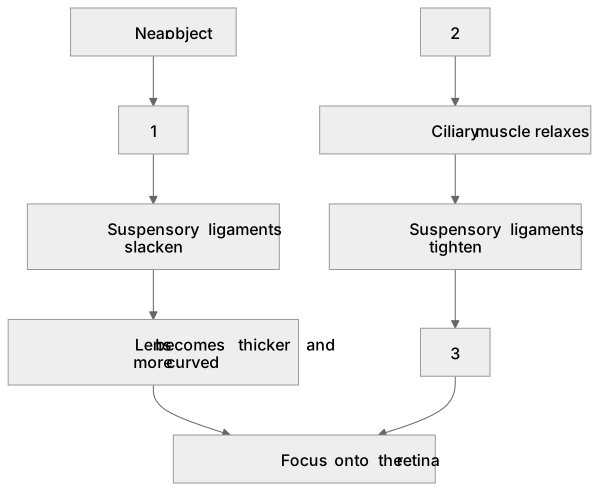
1Box 1
2Box 2
3Box 3
There is more to this lesson
The full lesson goes on to check your understanding and help you earn the marks. Create a free account to carry on, with your progress saved.
A week of Premium from your first lesson · Then the free plan continues · No card, no charge
Test your understanding of The eye (biology only): Students should be able to relate the structures of the eye to their functions. This includes: • accommodation to focus on near or distant objects • adaptation to dim light.
Active recall beats re-reading. Take an instant quiz now to test what you’ve learned and lock it into long-term memory.
A week of Premium from your first lesson · Then the free plan continues · No card, no charge