AQA · GCSE · Biology
Course version: 8461 · Version from Sept 2018
Iodine reagent is to be used to test for starch every 30 seconds.
Full specification wording
The human digestive system: Iodine reagent is to be used to test for starch every 30 seconds.
This required practical investigates how starch is broken down by amylase.
Checked against the AQA 8461 specification (opens in a new tab) on .
- Point 23 of 25
- 4 key terms
Study notes
From the checked teaching notes for this specification point.
The idea
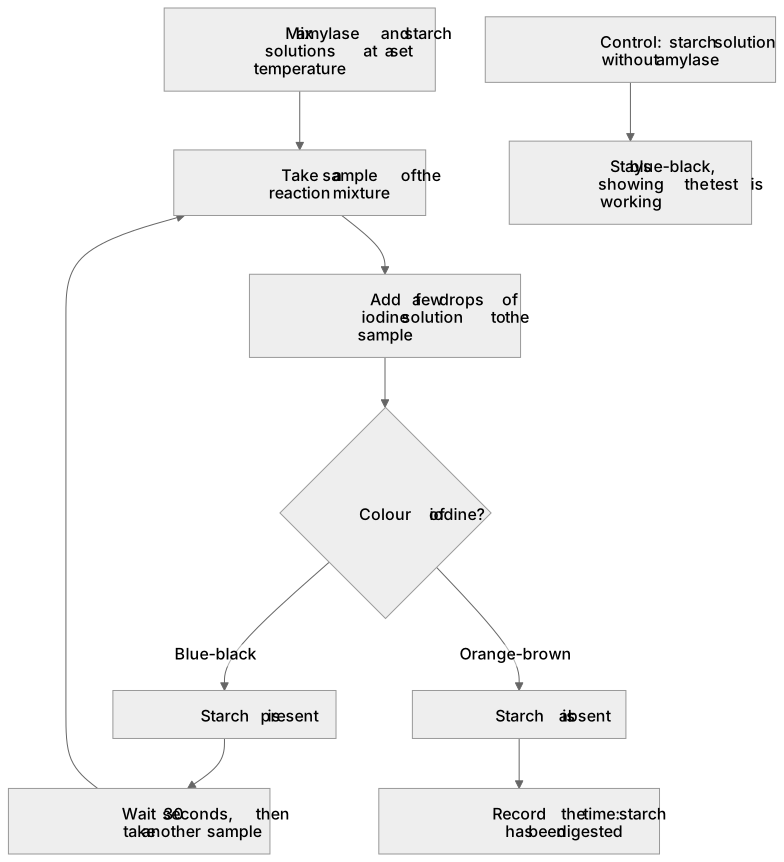
This required practical investigates how starch is broken down by amylase. Iodine solution is the reagent that tests for starch: a few drops added to a sample turn the solution blue-black if starch is present, and remain orange-brown if starch is absent. Samples of the reaction mixture are taken at 30-second intervals and tested with iodine so that the time taken for starch to disappear can be followed. Testing every 30 seconds gives a series of timed observations rather than a single end point. A control sample of starch solution alone should stay blue-black, showing the test is working. The time when iodine no longer turns blue-black indicates that starch has been digested.
What earns the marks
- Iodine solution is identified as the reagent used to test for starch, turning blue-black when starch is present.
- The colour change is described accurately: blue-black with starch and orange-brown without starch.
- Samples are taken from the reaction mixture at regular 30-second intervals and tested separately with iodine.
- The time at which iodine stops turning blue-black is recorded as the time taken for starch to be digested.
- A control is included, such as testing starch solution without amylase, to show that the blue-black colour is caused by starch.
- A suitable method is described, for example mixing amylase and starch solutions at a set temperature and testing samples every 30 seconds.
Common mistakes and how to put them right
Using Benedict's solution to test for starch.
Put it right: Iodine solution tests for starch, while Benedict's solution tests for reducing sugars.
Adding iodine to the whole reaction mixture instead of testing separate samples.
Put it right: Iodine is added to small samples removed at each 30-second interval.
Recording only the final colour rather than the time of each colour change.
Put it right: Record the result at every 30-second interval so the time starch disappears can be identified.
Exam tips
- State the colour change precisely as blue-black for a positive starch test and orange-brown for a negative result.
- Explain why samples are tested every 30 seconds: it allows the time taken for starch to be broken down to be measured.
- Describe a control that shows the result is due to starch, such as testing starch solution without amylase.
Try the lesson
The start of the The human digestive system: Iodine reagent is to be used to test for starch every 30 seconds. lesson, made from checked teaching notes for this specification point.
Have a go first
What colour change shows that starch is present when iodine reagent is added to a food sample?
Listen
This required practical investigates how starch is broken down by amylase. Iodine solution is the reagent that tests for starch: a few drops added to a sample turn the solution blue-black if starch is present, and remain orange-brown if starch is absent. Samples of the reaction mixture are taken at 30-second intervals and tested with iodine so that the time taken for starch to disappear can be followed. Testing every 30 seconds gives a series of timed observations rather than a single end point. A control sample of starch solution alone should stay blue-black, showing the test is working. The time when iodine no longer turns blue-black indicates that starch has been digested. A strong answer earns marks for these points. Iodine solution is identified as the reagent used to test for starch, turning blue-black when starch is present. The colour change is described accurately: blue-black with starch and orange-brown without starch. Samples are taken from the reaction mixture at regular 30-second intervals and tested separately with iodine. The time at which iodine stops turning blue-black is recorded as the time taken for starch to be digested. A common slip: Using Benedict's solution to test for starch. Instead, iodine solution tests for starch, while Benedict's solution tests for reducing sugars. Exam tip: State the colour change precisely as blue-black for a positive starch test and orange-brown for a negative result.
See it
Key words
Say what each word means before you turn the card.
Iodine solution
Try answering aloud or in your head before turning the card.
Control
Try answering aloud or in your head before turning the card.
Rate of starch digestion
Try answering aloud or in your head before turning the card.
Timed observations
Try answering aloud or in your head before turning the card.
See every definition
- Iodine solution
- The reagent used to test for starch, turning blue-black when starch is present and remaining orange-brown when starch is absent.
- Control
- A sample such as starch solution without amylase, included to show that the blue-black colour is caused by starch.
- Rate of starch digestion
- Shown by the time taken for the iodine test to become negative, as samples are tested every 30 seconds.
- Timed observations
- A series of results recorded at every 30-second interval rather than a single end point, so the time starch disappears can be identified.
Label the diagram
Some boxes have lost their names. Pick the right name for each number.
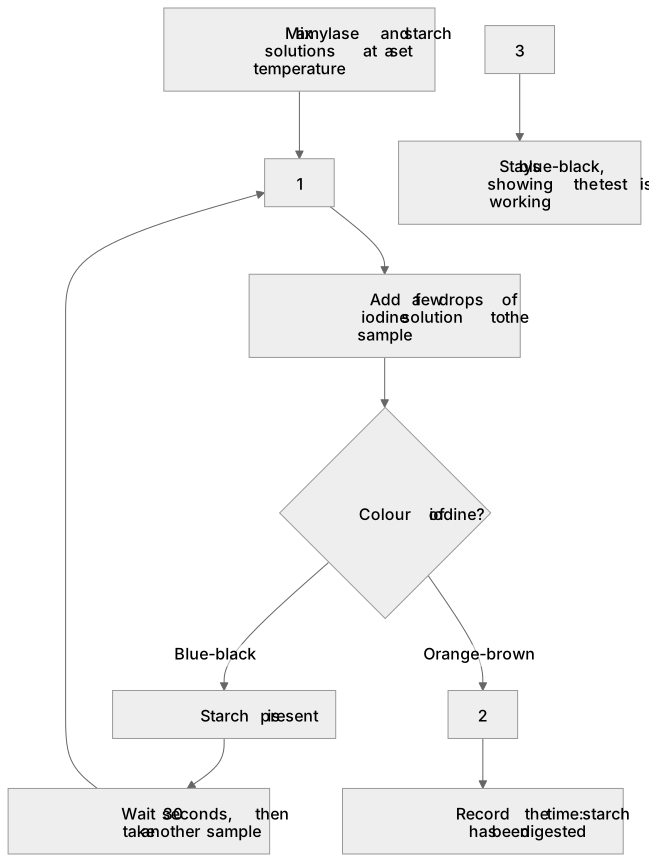
1Box 1
2Box 2
3Box 3
There is more to this lesson
The full lesson goes on to check your understanding and help you earn the marks. Create a free account to carry on, with your progress saved.
A week of Premium from your first lesson · Then the free plan continues · No card, no charge
Test your understanding of The human digestive system: Iodine reagent is to be used to test for starch every 30 seconds.
Active recall beats re-reading. Take an instant quiz now to test what you’ve learned and lock it into long-term memory.
A week of Premium from your first lesson · Then the free plan continues · No card, no charge